


LLM SEO: How It Works, Best Practices and Mistakes (2026)

Key Takeaways
- LLM SEO is the practice of making your brand and content easier for AI search systems to discover, understand, cite, and recommend.
- Traditional SEO still matters because AI systems pull from search results, websites, reviews, forums, and other indexed sources. But ranking well on Google no longer guarantees AI visibility.
- LLMs don't use one universal ranking system. ChatGPT, Gemini, Perplexity, and Claude can pull from different sources and surface the same brand in very different ways.
- Your AI visibility depends on more surfaces than your own website. Third-party articles, Reddit, YouTube, review sites, and other sources can shape what an LLM knows and says about you.
- To monitor LLM visibility, you need to track your share of voice, citation share, and prompt coverage per platform.
What Is LLM SEO?
LLM SEO is the practice of optimizing your content, brand presence, and technical setup so large language models can discover, understand, cite, and mention you when they generate answers. It covers what your site says about you, what other sites say about you, and how retrievable both are to the crawlers that feed the models.
It sits at the intersection of traditional SEO, digital PR, and content built for how language models retrieve and synthesize information. People also call it LLM optimization or LLMO (in addition to AEO and GEO).
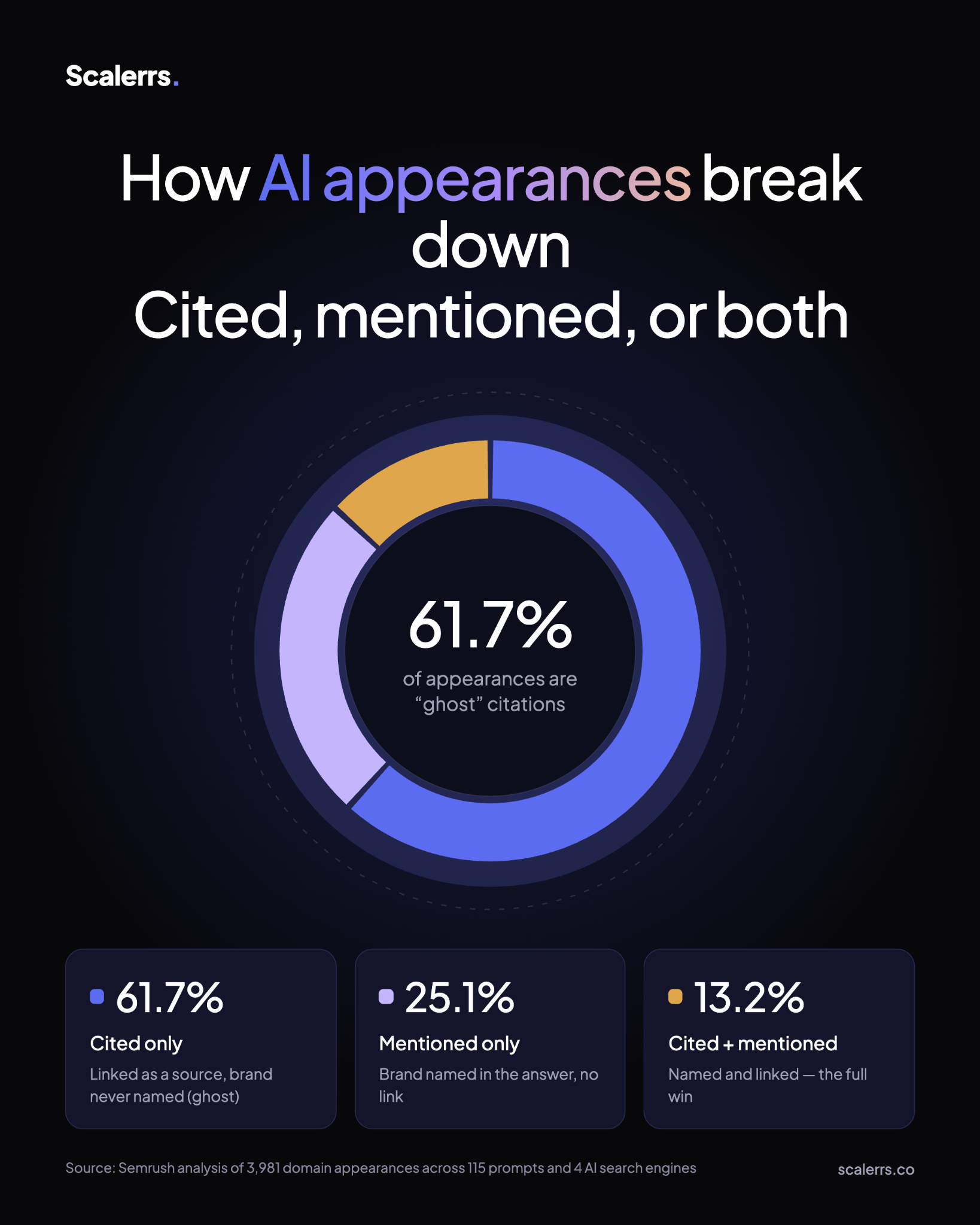
Semrush's 2026 research into "ghost citations" found that 62% of AI citations in its dataset did not result in a brand being mentioned in the answer. ChatGPT cited domains in 87% of appearances in the study, but mentioned the corresponding brands only 20.7% of the time. So if your reporting dashboard says "1,000 AI citations," that doesn't automatically mean 1,000 people saw your brand recommended. You need to track both.
How LLMs Find and Choose Content to Cite
There isn't just one LLM ranking factor you can optimize for.
AI systems use different retrieval systems, search indexes, training data, and ranking processes. The practical job for your team is to understand where each model is getting its information and why certain sources keep appearing for your buyer prompts.
There are two broad pathways in which LLMs find and choose content to cite.
Pathway #1: The Training Dataset (What the Model Already Knows About You)
Language models are pre-trained on huge slices of the public web. When your brand appears repeatedly (editorial coverage, Wikipedia, product reviews, Reddit, YouTube transcripts, podcast show notes) the model absorbs your brand as an entity. It learns your category, your competitors, and how people describe you.
You don't get to submit your company to an LLM and say, "Here is the version of our positioning we'd like you to remember." Your overall web presence matters.
If your website says you're an enterprise SaaS platform for healthcare teams, but third-party reviews describe you as a tool for small businesses, an AI system has conflicting signals to reconcile.
The more important your category becomes, the more places that description can come from.
Your product pages matter. So do comparison pages, customer stories, reviews, industry publications, Reddit discussions, YouTube transcripts, and other sources that provide context about your company.
This is also why brand positioning becomes an LLM SEO problem. The process is a "consensus" and "context" game, as this LinkedIn post describes.
🔑 The takeaway? Don't build your AI search strategy around your domain alone.
📚 Further Reading: Need help getting your AEO program up and running? Our guide to the top GEO/SEO agencies gives you some of the best in the business to choose from.
Pathway #2: The Real-Time Retrieval (What the Model Looks Up When Searching the Web)
When an AI search product has access to the live web, your chances of being surfaced depend on what its retrieval system can find and what sources it chooses to use.
This is where traditional on-page SEO fundamentals carry over. If your page is blocked from crawlers, buried behind JavaScript, poorly linked internally, or absent from the search index, an AI system may have a harder time retrieving it.
But ranking alone doesn't guarantee an AI citation.
An LLM may retrieve a page because it answers a specific question well. It may then cite another page because that source has stronger evidence, clearer wording, more relevant context, or better coverage of the question.
So, when you're trying to understand how to rank in ChatGPT, Gemini, or Claude, don't think of it like a second Google. Think of it as a retrieval-and-synthesis system. Your job is to become one of the sources it can find and trust when answering a specific buyer question.
LLM SEO vs. Traditional SEO
LLM SEO and traditional SEO share a foundation, but they optimize for different outcomes.
The overlap is still substantial, and traditional SEO isn't going away. Pages that rank higher tend to get cited higher in AI Overviews when they're included. But the citation set has broadened.
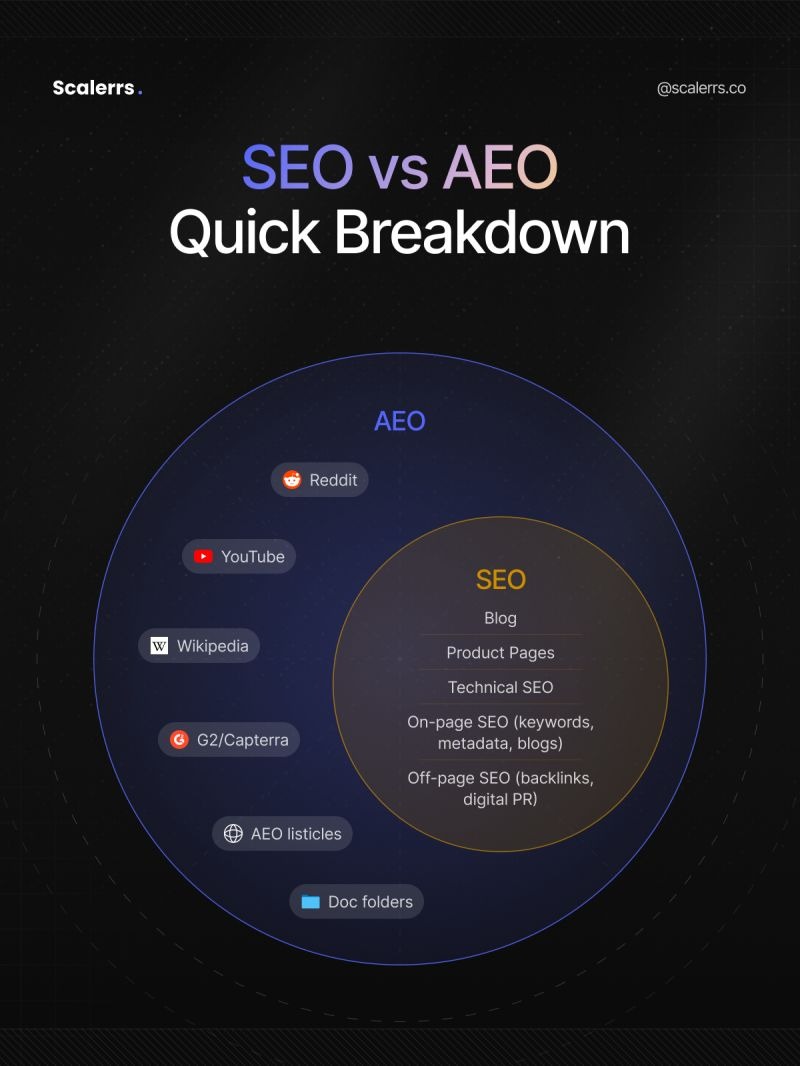
So, you need to extend your existing SEO strategy beyond the SERP, and include:
- GEO: Optimizing content and brand presence for generative AI systems
- AEO: Broader practice of earning visibility in answer engines, including AI Overviews and conversational search
At Scalerrs, we treat these as connected parts of the same organic strategy rather than isolated channels. We help SaaS brands identify what AI engines cite for their highest-intent queries, then build the content, mentions, and third-party presence needed to show up in ChatGPT, Perplexity, Gemini, Claude, and Google AI Overviews.
See how our AI search/AEO service works.
How Each LLM Platform Sources Its Answers
Every major LLM answers the same question differently because they use different search infrastructure and weight sources differently.
Here's the breakdown for the five platforms that account for nearly all B2B AI traffic.
ChatGPT
Semrush's 2026 AI Visibility Index found that ChatGPT cites an average of 15 sources per response and frequently draws from community and reference platforms such as Reddit and Wikipedia.
However, Promptwatch's August 2026 analysis found that Reddit's share of ChatGPT Search citations dropped from an average of 3.83% between July 18 and August 7 to 0.52% between August 14 and 17.
More interestingly, Promptwatch also observed ChatGPT's use of the site: search operator jump from about 0.37% of fanout queries to 16.8% on August 8.
That suggests ChatGPT was increasingly asking specific domains for information rather than relying only on broad web searches.
AI source selection can change fast. If your entire AEO strategy depends on one platform or one source type, a product change can wipe out a large part of your visibility overnight.
Gemini
According to Semrush, Gemini cites an average of three sources per response. Google says those sources can include public websites and other connected information, depending on the user's setup.
Semrush's research also found a major difference between Gemini and ChatGPT when it looked at brand mentions and citations. In its ghost-citation study, brands were mentioned in 83.7% of Gemini appearances but cited only 21.4% of the time. ChatGPT showed almost the reverse pattern: 87% citation rate versus a 20.7% mention rate.
Gemini is rewarded most by branded web mentions and anchors. So, if you only count citations, you could miss a large part of how Gemini exposes brands.
Perplexity
Perplexity is closer to a research interface than a traditional chatbot. Its answers are built around original web sources rather than aggregations, which makes source-level visibility especially important.
Ahrefs found that Perplexity had the highest overlap with Google's top 10 results among the AI assistants it studied, at 28.6%.
Perplexity is also interesting for Reddit-led visibility. Profound's analysis found that Reddit accounted for 46.7% of citations among Perplexity's 10 most-cited sources from August 2024 to June 2025.
That means your strategy should extend beyond your own pages—to review sites, industry publications, Reddit threads, and other sources that consistently appear in your prompt set.
Claude
Claude's web search feature searches multiple sources and provides citations. That makes the same principle relevant here: don't just monitor whether Claude mentions your brand. Look at which sources it uses to form the answer.
If you see the same domains repeatedly, you've found what’s shaping your category.
And that’s where LLM SEO becomes much more actionable.
📥 Free Download: For an even deeper dive into citation patterns across AI engines, download our LLM Search Study. It breaks down the retrieval patterns we track across ChatGPT, Perplexity, Gemini, and AI Overviews.
7 LLM SEO Best Practices for B2B SaaS
If you're trying to improve LLM visibility, start with the things that make your site retrievable. Then work outward.
The biggest mistake we see brands make is jumping straight to "AI content" while ignoring technical access, buyer intent, and the third-party sources AI systems already trust.
Here are the seven practices we'd prioritize:
1. Make Your Site Accessible to AI Crawlers
Make sure the pages you want cited can actually be crawled and retrieved.
Check your robots.txt today. If you're blocking GPTBot, ClaudeBot, PerplexityBot, or Google-Extended, you're invisible to LLMs.
Google says the same SEO fundamentals used for traditional Search apply to AI Overviews and AI Mode. Pages need to be crawlable, indexable, internally linked, and available as text. Google also says there is no special AI markup or schema required to appear in its AI features.
ChatGPT has a more explicit crawler requirement. OpenAI says websites should allow OAI-SearchBot if they want their content to be eligible for ChatGPT search results.
So, secure your technical SEO hygiene:
- robots.txt access
- Crawlable navigation
- Indexable pages
- Clean internal links
- Server-rendered or otherwise accessible important content
- Correct canonicals
- No accidental WAF (Web Application Firewall) or CDN (Content Delivery Network) blocks
📥 Free Download: You can use our LLM SEO Technical Guide as a ready checklist for this step.
2. Build Content for Buyer Prompts
Start with the searches your buyers make, then turn those searches into the prompts they would actually type into an AI tool.
A keyword such as "practice management software" can become: "What's the best practice management software for a multi-location clinic?"
The question contains the category, use case, buyer context, and evaluation criteria. It also gives you clues about which other sources should exist if you want to be part of the answer.
And prioritize BOFU keywords and prompts.
If the prompt is "best X for Y," "X alternatives," "X vs Y," or "best software for [specific use case]," the answer can directly influence a buying decision.
This is the approach we adopted for our client, Pabau. The team started with Pabau's highest-intent keywords, reverse-engineered the prompts buyers would use, then identified the Reddit threads, review sites, comparison pages, and other sources AI systems were pulling into those answers.
The results speak for themselves:
🔥 33% of pipeline now AI-attributed
🔥 #1 cited domain in their category
🔥 Organic traffic: 21,900 → 75,300
🔥 71% increase in traffic value
📥 Free Download: Get our SaaS Keyword and Prompt Research Playbook to understand this process in more detail and apply it to your brand.
3. Make Every Important Page Easy to Quote
Put the answer matching the search intent close to the top of the page and state it in plain language. Growth Memo analyzed 18,012 verified ChatGPT citations and found that 44.2% came from the first 30% of a page.
Use clean H2/H3 hierarchy. Then, open each section with a direct one- or two-sentence response to the heading, then add the context, examples, and nuance underneath:
- If you're explaining a category, define it clearly
- If you're comparing products, give the comparison in a table
- If you're explaining a feature, state what it does before the five-paragraph backstory
It works for readers because they can confirm they've found the answer quickly. It also gives AI systems a clear, self-contained passage to retrieve.
That's the standard we aim for when building content for both Google and AI search. At Scalerrs, our content marketing team uses the principles of technical SEO, search intent first answers, product expertise, expert interviews, and rigorous editorial workflows to create SaaS content that earns rankings, citations, and pipeline.
Explore our SaaS content creation services.
4. Get Your Brand Mentioned Across the Third-Party Sources AI Refers to
Your website is only one part of your AI search footprint.
Profound's analysis of 11.84 billion citations found that while company-owned sites make up about 57% of AI citations globally, the remaining citations come from earned media, institutions, social platforms, and other sources.
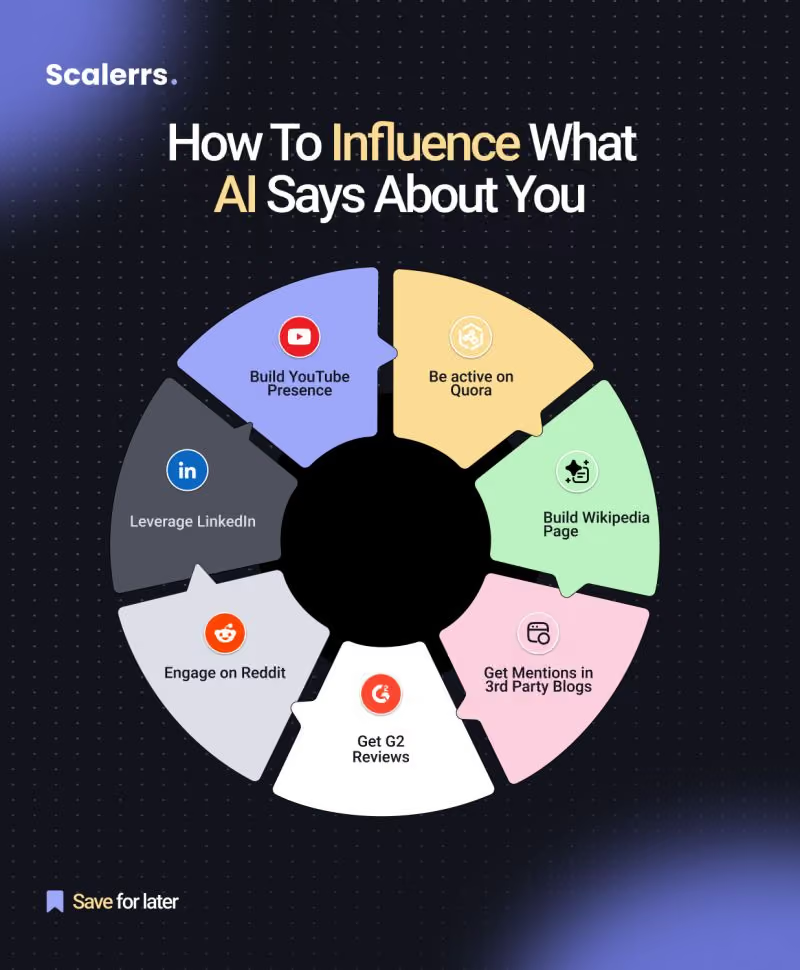
Ahrefs' 75,000-brand study on AI Overview factors also found brand mentions carry roughly three times the weight of backlinks.
For this reason, we run 3rd-party listicles and AI brand mentions as a dedicated service at Scalerrs. Getting into the "best of" pages AI models trust is one of the fastest ways to move the citation dial.
5. Use Reddit, YouTube, Reviews, and Communities for the Right Reasons
Treat third-party platforms as evidence sources, not distribution checkboxes.
On Reddit, you need to identify the conversations your buyers already care about and contribute useful information there.
Getting Reddit right is slow and community-native. It means posting from your branded handle, participating under real names with disclosure, growing your own subreddit, and pitching only when relevant. It does not mean fake accounts or upvote manipulation. That path gets you banned and your brand described negatively by the same LLMs you were trying to influence.
We run this via our Reddit marketing service.
👉🏽 Book a demo with us if you want Reddit done the white-hat, enterprise-grade way.
YouTube
In Ahrefs' 75,000-brand study, YouTube mentions, a brand appearing in video titles, transcripts, and descriptions, showed the strongest single correlation with AI visibility at 0.737.
A video titled around a real buyer question can give an AI system another source to retrieve when answering that question. It also gives buyers a visual explanation of your product and creates a transcript that can be indexed elsewhere.
Reviews
And don't ignore reviews.
A detailed customer review saying, "We use this for a 20-person sales team because..." contains far more useful context than "Great product!"
We follow this strategy for Scalerrs' own marketing, with the goal of giving AI systems clearer context about our brand.
6. Create llms.txt If It Helps Your Technical Workflow, But Don't Bet Your Strategy on It
Treat llms.txt more as an optional technical experiment and less as an AI ranking hack.
The idea behind llms.txt is simple. A website publishes a machine-readable file that points AI systems toward important content and explains how the site should be understood.
It sounds useful. But the evidence for it as a major visibility driver is weak.
So if you're deciding between:
A. Spending days building an elaborate llms.txt file
B. Fixing crawl issues, improving your product pages, publishing useful BOFU content, and earning citations from relevant third-party sources
Pick B first.
You can still test llms.txt if your technical team wants to. Just measure whether it changes anything. Don't let a speculative file become the center of your AEO strategy.
7. Keep Measuring and Updating Your AI Footprint
LLM visibility is dynamic, so your strategy needs a feedback loop.
A page that gets cited today can disappear from an answer next month. A Reddit thread can rise or fall in SERPs. A competitor can publish a better comparison page. A model update can change its source mix overnight.
We've already seen this with Reddit.
Promptwatch reported an 86% relative drop in Reddit's share of ChatGPT citations in August 2026. Other researchers also observed the change, while OpenAI said citation sources evolve as it improves search relevance.
That is exactly why you shouldn't optimize around one platform or one source type. Build a prompt set. Track it. Look for changes. Then update the underlying sources.
📥 Free Download: Want to know what it takes to get recommended by AI? Get our free GEO / LLM SEO Workshop Deck and see the exact framework we use to map buyer prompts, identify citation sources, build AI visibility, and track results across ChatGPT, Perplexity, and Google AI.
LLM Seeding and Shaping What AI Says About Your Brand
LLM seeding is the practice of deliberately placing accurate, useful information about your brand across the sources AI systems are likely to retrieve.
This is the part most LLM SEO guides miss.
Getting your brand mentioned is one job. Getting the right context attached to that mention is another.
If ChatGPT knows your company exists but describes you as an SMB tool when you're actually built for enterprise teams, visibility alone hasn't solved the problem.
To solve that, we think about LLM seeding in three steps.
Step 1: Decide the Messaging You want AI to Understand
Start with two or three specific things you want AI models to say about you. This should be dictated by your positioning and messaging strategy.
A simple way to do this? Write down the facts you want consistently associated with your brand:
- Who your product is for
- Which use cases you solve
- Which industries you serve
- Where you sit in the market
- What makes you different
- Which products you compete with
- Where you're a poor fit
Step 2: Find the Sources Where AI Gets Its Information from
Run your target prompts and map the sources behind the answers.
For each important prompt, record:
Now you know where the information gap lives. If five AI answers keep citing the same comparison article, getting your brand onto another random DR 70 website won’t help as much as being in that comparison article will.
Step 3: Place the Message into Those Sources
Build your presence where you see AI looking.
This can mean
- Traditional SEO and link building
- Pitching for inclusion in relevant third-party listicles
- Creating YouTube videos around buyer questions
- Earning detailed customer reviews
- Participating in Reddit discussions where your ICP is already asking questions.
And in some cases, it can mean improving your company's factual presence on Wikipedia or other reference sources where you meet their editorial standards.
The key is that every channel has to earn its place.
At Scalerrs, this is why our AEO work covers multiple surfaces at once: Reddit marketing, AI brand mentions in third-party listicles, YouTube SEO, SaaS link building, and Wikipedia page creation alongside traditional SEO.
Rather than trying to spam your brand everywhere, we put it where the buyer's prompts and the AI's citations tell us it needs to be.
How to Track LLM Visibility
Track these specific metrics to assess how LLM SEO is performing for your company:
If you don't have an AI visibility platform, start manually.
- Take 20-50 high-intent prompts
- Run them every month across your chosen LLMs
- Save the answers: Record the brands mentioned, cited sources, position in the answer, and any recommendation language
- Then compare that data with your competitors
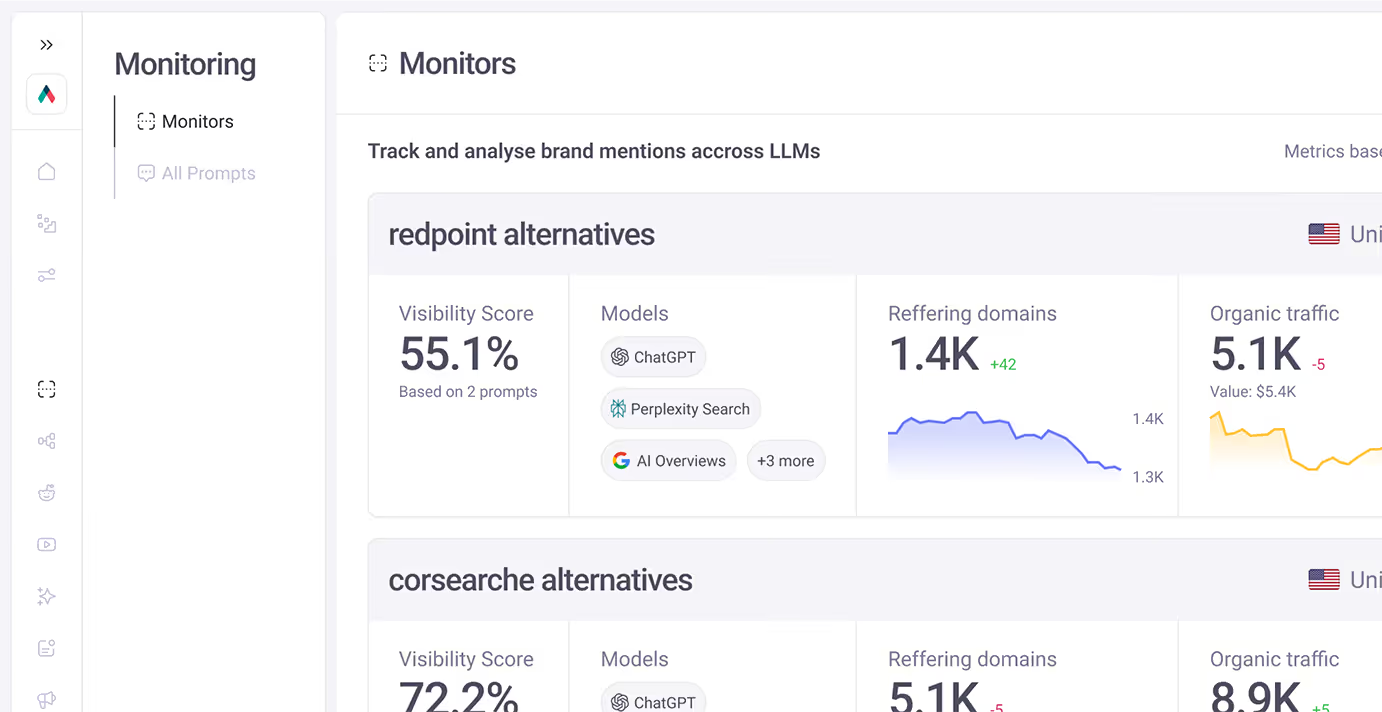
Tools such as Semrush's Prompt Tracking can automate this across ChatGPT, Google AI Mode, and Gemini and show the domains and pages being cited for tracked prompts.
📚 Further Reading: For the broader measurement layer that ties LLM visibility back to pipeline, our guide on SaaS SEO KPIs covers reporting.
LLM SEO Mistakes That Keep Brands Out of AI Answers
Mistake #1: Blocking AI Crawlers in robots.txt
The most common mistake we see is a template shipped with Disallow: / for GPTBot or ClaudeBot. Your content is invisible to the models until you remove it.
✅ The fix: Audit robots.txt today. Explicitly allow GPTBot, OAI-Searchbot, ChatGPT-User, ClaudeBot, PerplexityBot, Google-Extended, and CCBot on marketing pages.
Mistake #2: Treating LLM SEO as a Content Formatting Exercise
Adding FAQs and bolding key sentences can help readability. They won't compensate for a site nobody can retrieve or a brand that has no credible presence outside its own domain.
✅ The fix: Start with making your content retrievable, focus on boosting domain authority, and expand source coverage.
Mistake #3: Measuring Citations without Measuring Positioning
A citation can exist without your brand being mentioned. And a brand can be mentioned without being recommended. Your dashboard needs to capture both.
✅ The fix: Track what AI says, not just where it links to.
Mistake #4: Skipping the Off-Site Work Entirely
Most SaaS teams spend the majority of their SEO budget on their own site and skip the platforms AI models actually pull from. 94% of AI citations come from non-paid, non-brand-owned sources.
✅ The fix: Rebalance your efforts. A multi-surface program covering Google SEO, AEO, Reddit, YouTube, Wikipedia, and third-party listicles outperforms a single-channel strategy every time.
📥 Free Download: Grab our AEO Checklist for B2B SaaS for the full audit we run on new engagements.
FAQs
1. Is LLM SEO the same as GEO or AEO?
Yes, mostly. LLM SEO, LLMO, GEO, and AEO all describe overlapping work: getting your brand cited inside AI-generated answers. Different practitioners prefer different labels. The underlying practice is the same.
2. How do I rank in ChatGPT?
No classical ranking. Getting cited in ChatGPT requires training-corpus presence (Wikipedia, editorial mentions, Reddit, YouTube transcripts) plus retrievable, structured content on your site. LinkedIn also correlates strongly with ChatGPT citations for B2B queries.
3. Is llms.txt required for LLM SEO?
No. Google says llms.txt and other special AI files are not required for inclusion in AI Overviews or AI Mode. Treat it as an optional experiment rather than a core ranking tactic.
Get Your SaaS Brand Into LLM Answers with Scalerrs
LLM SEO isn't a repackaging of the old SEO playbook. It's a broader system spanning your site, your brand mentions across the web, and the specific sources each engine trusts.
If you're a B2B SaaS company that needs to show up in ChatGPT, Perplexity, Gemini, Claude, and Google's AI surfaces alongside traditional organic, Scalerrs is built for that specifically. Every engagement combines traditional SEO, AEO, Reddit, YouTube, Wikipedia, and third-party listicles into one program tied to pipeline.
That's how we helped Qrvey reach #3 in AI brand visibility with ~2,836 LLM mentions, and doubled AI-attributed inbound for AutoRFP.
Want to see where your brand shows up across LLMs today? Book a demo. We'll walk through your AI visibility and the biggest-impact moves to change it.
Book a Discovery Call
Turn Organic Search Into Your #1 SaaS Acquisition Channel.

Let us scale your SEO channel for you.
reviewed onClutch
4.9 rating






Get Free Resources In Your Inbox
Get all of our FUTURE playbooks such as Figma files, checklists and SOPs directly into your inbox.

.avif)