


SaaS Content Writing: 6 Steps to More Signups (2026)

Key Takeaways
- SaaS content writing is the practice of creating content for B2B software companies that moves buyers toward a trial, demo, or paid signup across long, multi-stakeholder sales cycles.
- The five mistakes that most often make SaaS content fail are writing for keywords instead of the buyer’s actual question, using generalist writers, skipping the AEO layer, padding the top of the funnel, and leaving published content to go stale.
- The 6-step process to write SaaS content that converts is buyer and problem research, commercial-intent topic selection, a strategic brief, product-depth writing, on-page AEO structuring, and pipeline-relevant CTAs with a scheduled refresh cadence.
- The SaaS content formats that consistently drive signups are comparison and alternatives pages, use-case pages, product-led how-to guides, customer stories, and original data reports.
- Getting cited by AI search requires both an on-page layer (question-led headings, extractable answers, schema, cited data) and an off-page layer (third-party listicles, consistent product descriptions, and owned-community activity).
- Scalerrs works exclusively with mid-market and enterprise B2B SaaS companies to help them own their category across SEO, Reddit, third-party listicles, and AI search. Every account is staffed with a dedicated pod of senior SEO strategists, SaaS-specialist writers, and an AEO lead.
What Is SaaS Content Writing?
SaaS content writing is the practice of creating content for B2B software companies that moves buyers toward a trial, demo, or paid signup. It sits inside the broader SaaS content marketing function, and the writing itself has to do a few things well:
- Educate buyers across sales cycles that can stretch 3-6 months
- Explain technical products in language that non-technical decision-makers can still follow
- Tie every piece back to a specific product use case, so readers can see themselves in it
In practice, this means writing for a buyer who reads deeply before ever talking to sales and needs real convincing that your product solves their exact problem. The writing has to carry genuine product knowledge, and it has to give readers a clear reason to take the next step rather than close the tab.
How SaaS Content Writing Differs From Regular Content Writing
Content writing is usually built for a short buying decision, a single reader, and a fairly light product touch.
B2B SaaS content writing, on the other hand, has to hold a reader’s attention across months of research, speak to several stakeholders inside one deal, and carry enough product depth to help someone evaluate the software.
Here’s a quick overview of where the two differ:
Why SaaS Content Writing Matters for Pipeline
For most B2B SaaS companies, content is the first and often only interaction a buyer has with the brand before they ever fill out a form. What that content says, and where it shows up, now decides whether the company makes the shortlist at all.
G2’s April 2026 Answer Economy report found that 51% of B2B software buyers now begin their research inside an AI chatbot rather than a traditional search engine, up from 29% twelve months earlier.
In the same report, 69% of buyers said they chose a different vendor than they had originally planned based on chatbot guidance. So it’s pretty evident that the shortlist is being built inside ChatGPT, Claude, and Perplexity, and your content is the raw material those tools are pulling from.
Even beyond AI chatbots, the surfaces buyers use to research software have multiplied. Google’s still in the mix, but so are Reddit threads, YouTube reviews, third-party comparison listicles, and Wikipedia pages. Content that only shows up in one of those places is content that misses most of the buying journey.
Good SaaS content writing pulls its weight across the full funnel:
- Acquisition: ranks in Google and gets cited by AI tools, so buyers find you when they’re actively researching
- Trust: builds credibility with technical readers who need to see the product working before they’ll book a call
- Nurture: gives long sales cycles the touchpoints they need, without leaning on paid retargeting
- Retention: helps existing customers get more value from the product, which pushes churn down
- AI visibility: shows up as a citation in ChatGPT, Claude, and Google AI Mode when someone describes their problem in simple language
Our work with Default at Scalerrs shows what this looks like in practice: 30% of Default’s pipeline now comes from AEO/SEO and AI search, including $300K in a single month from the channel alone. It didn’t come from more content. It came from the right kind of content, written for pipeline from the first draft.
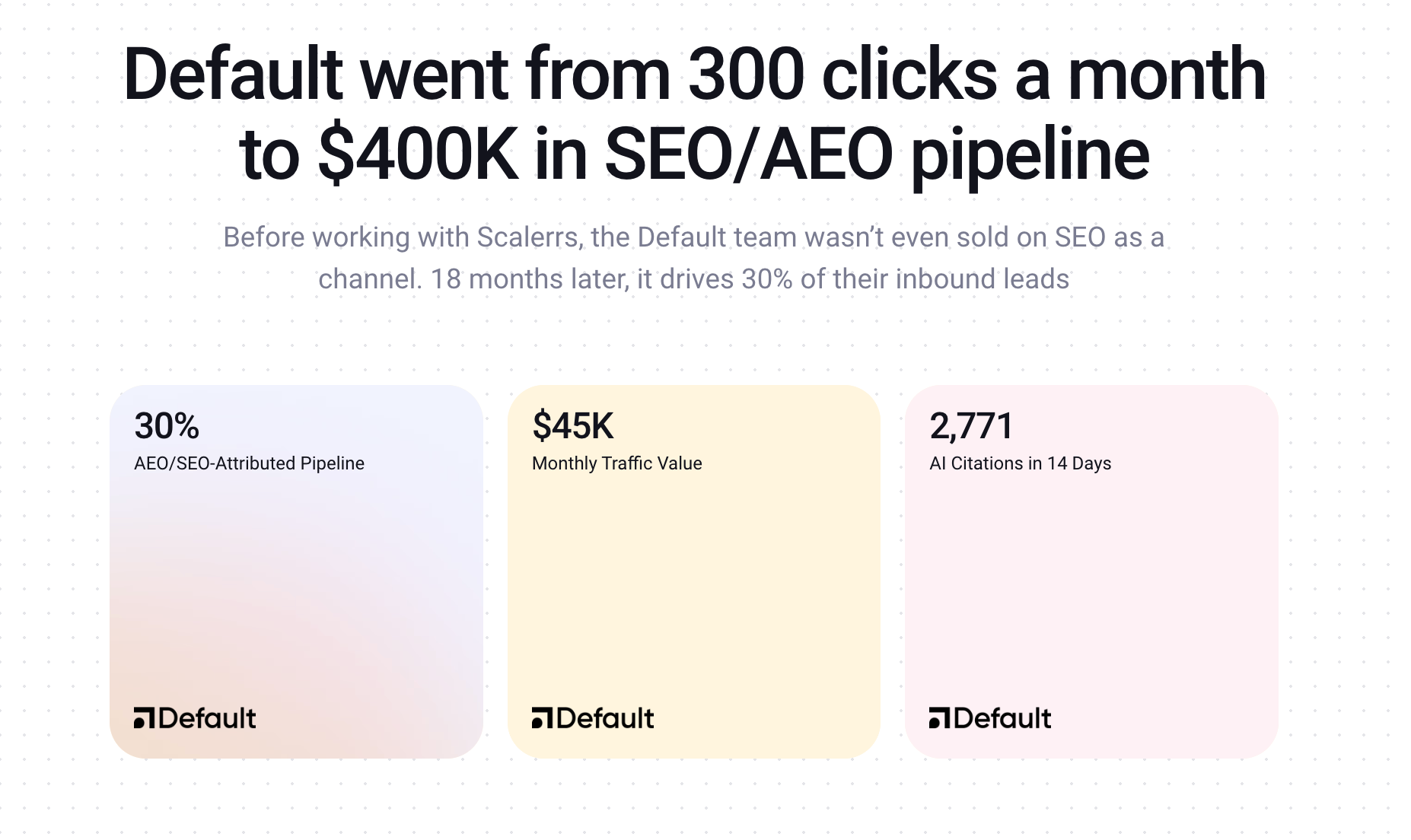
Read more about Default’s case study here.
5 Mistakes That Make SaaS Content Fail
Most SaaS content fails for a handful of predictable reasons. Here are the five we see most often when auditing SaaS content for prospective clients, and how to fix each one.
1. Writing for Keywords Instead of the Buyer’s Actual Question
A lot of SaaS content is built backward from a keyword volume report. The writer sees “project management software” has 40,000 monthly searches and writes a generic overview article, without ever asking what a real buyer typing that query wants to solve.
The fix is to work from the buyer’s problem language first. Pull from sales calls, support tickets, Reddit and G2 threads, and prompt-testing inside ChatGPT before you touch a keyword tool. The keyword becomes the wrapper, and the article becomes the answer to a question the buyer is genuinely asking.
2. Using Generalist Writers Who Can’t Carry Product Depth
Content written by writers with no SaaS background reads shallow. It stays surface-level, avoids specifics about integrations and edge cases, and doesn’t really show the product working inside a real workflow.
Buyers can spot it immediately, and so do LLMs when they weigh which sources to cite.
The fix is to hire writers who have either worked inside SaaS or written for it long enough to hold their own on a technical call. If in-house isn’t an option, work with a specialist team that has category experience already built in.
The writer needs to understand product-led growth, buying committees, and how a comparison page reads differently from a use-case page before they’re even briefed.
3. Skipping the AEO Layer Entirely
Content optimized only for Google is now half-optimized. If the piece has no extractable answer block, no schema, no clear question-and-answer structure, and no citations to authoritative data, it will rank in Google but stay invisible inside ChatGPT, Claude, and Perplexity. And, given that 51% of B2B buyers now start their research in an AI chatbot, half-optimized content leaves a significant amount of pipeline on the table.
The fix is to build for both surfaces from the first draft. That means structuring content around clear questions, answering them upfront, adding schema, and citing original data with inline source links.
Done well, this can turn a single article into two assets at once: a page that ranks in Google, and a source that AI models pull from when a buyer describes their problem in the language they speak.
4. Padding the Top of the Funnel and Ignoring Commercial-Intent Pages
Most content calendars are heavy on top-of-funnel explainers and light on the pages that actually influence a buying decision. Commercial-intent pages consistently drive higher signup rates than TOF explainers, but they get deprioritized because their search volume looks smaller.
The fix is to weight your content mix toward commercial intent early.
A single well-written comparison page will often outperform a dozen top-of-funnel blogs on signups, even if the traffic numbers look less impressive on paper. Audit your existing content and see how many pages sit at the bottom of the funnel. If the ratio is skewed toward informational content, that’s where the next quarter’s roadmap should focus.
5. Publishing Content and Leaving It to Rot
SaaS products change quickly. Features are rolled out quickly, pricing shifts overnight, integrations get added or deprecated, and competitors reposition.
Content that was accurate in Q1 can be misleading by Q3, and outdated content is one of the fastest ways to lose credibility with both buyers and AI models that check for recency signals.
The fix is a scheduled refresh cadence. A few things worth building into the workflow:
- Audit your top-performing and highest-intent pages at least twice a year
- Update product screenshots, feature names, and integration lists whenever the product changes
- Refresh stats, pricing references, and competitor mentions so nothing sits more than 12 months out of date
- Track ranking and citation performance after each refresh, so you can see which updates are moving the needle
Refreshed content compounds. Pages that stay accurate keep earning rankings, citations, and signups long after the original publish date, while stale pages bleed both.
The 6-Step Process to Write SaaS Content That Converts
Here’s the exact process our team uses when writing content for B2B SaaS clients. Each step is designed to compound, so skipping any one of them makes the next weaker.
Step 1: Start With Buyer and Problem Research
Every strong SaaS piece starts before the outline. Spend the first block of time understanding who’s reading, what they’re trying to solve, and how they describe that problem in their own words. Sources worth pulling from:
- Recorded sales and discovery calls (Gong, Fathom, Chorus, etc.)
- Recent support tickets and Intercom conversations
- Reddit, G2, Capterra, and TrustRadius threads on the topic you’re targeting
- Customer success interviews about onboarding friction and top questions in the first 30 days
- Prompt testing inside ChatGPT and Perplexity to see what follow-up questions the AI surfaces
The output of this step is a list of phrases, objections, and questions from buyers, and works as a raw material for everything downstream: topic, outline, headline, CTAs, etc. Content built without this step almost always ends up sounding generic, because the writer is guessing at what the reader cares about.
At Scalerrs, our senior SEO strategists run this discovery work at the start of every account before a single content brief goes out. The insights get captured in a shared buyer research doc that both strategists and writers pull from across the engagement.
Step 2: Choose Topics That Sit Close to a Buying Decision
Once you understand the buyer, weight your topic selection toward commercial-intent queries. These topics have smaller search volumes than top-of-funnel explainers, but they capture buyers who are already evaluating options and much closer to signing up. Categories to prioritize:
- Comparison pages (Your Product vs Competitor)
- Alternatives pages (Best Alternatives to Competitor)
- Use-case pages built around a specific job the reader is trying to do
- Category and roundup pages where your product deserves a spot on the shortlist
- Pricing guides and buyer-decision content
A simple test: for each topic on your roadmap, ask whether a reader landing on the page could plausibly book a demo in the next 48 hours. If the answer is no, the topic sits too far from the buying decision. Balance the roadmap so at least half of your published output speaks directly to prospects who are ready to shortlist a solution. Our SaaS SEO checklist walks through this prioritization in more detail if you want a reference to work from.
Step 3: Build a Strategic Brief Before the Writer Opens a Doc
The brief is where most SaaS content wins or loses. A strong brief includes:
- The target buyer and where they sit in the funnel
- The specific questions the piece needs to answer
- The angle, thesis, and unique point of view
- Competitor content to beat, with notes on what’s missing from theirs
- Internal links, product pages, and case studies to weave in
- The primary CTA the piece is accountable to
- Extractable answer blocks and schema notes for the AEO layer
At Scalerrs, every brief is built by a senior SEO strategist, like Artur Perrella Glukhovskyy, Vladi Kriulin, Stanislav Farkas, or our AEO Lead, Elena Dyulgerova, before it reaches a writer.
Our writers are SaaS specialists, including Zain Zia (ex Visme & VEED), Garima Behal (ex ClickUp), and Saffa Faisal (ex Userpilot & Databox), led by Beatrice Manuel, who understand product-led growth, buying committees, and category positioning.
The two sides work in tandem across every piece, so strategy and execution stay aligned from brief to publish. It’s why our clients rarely get first drafts that miss the point, and why we’re consistently ranked among the best SaaS content marketing agencies.
Step 4: Write With Real Product Depth and Specificity
The content pieces that convert readers into signups show the product doing real work inside a specific workflow. That means real screenshots, integration examples, edge cases, and language only someone familiar with the software could write.
If the writer can’t get inside the product themselves, arrange a walkthrough with the customer success or product team. Ask them to show you the top three use cases, the most common integrations, and where new users tend to get stuck.
The reader should finish the piece feeling like they’ve just watched a demo in slow motion.
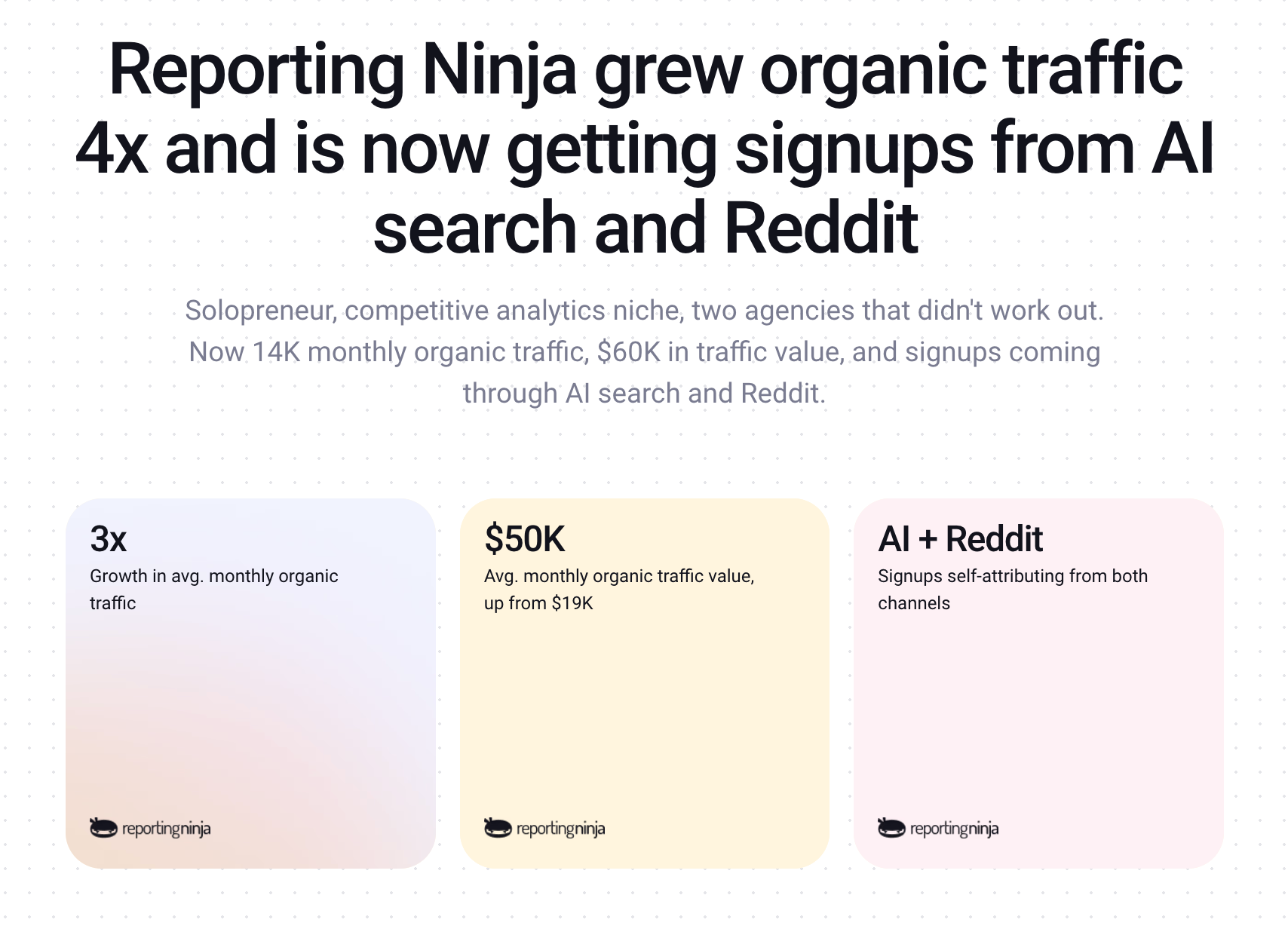
Reporting Ninja, a SaaS reporting and dashboarding platform, is a good example. Before working with us, their content covered the product only at a surface level, so readers didn’t get a clear picture of how the platform solved their reporting problem. Our team spent the early weeks embedded in product walkthroughs, mapping the top use cases and pulling the exact workflows and integrations customers cared most about.
The content that came out of that process was built around specific reporting scenarios instead of generic explainers. Organic traffic grew 4x over the engagement, and founder Luis Pereira described the partnership this way:
“Scalerrs has been the fastest agency in getting everything the way I wanted to have it. I'm considering you like a business partner, not only an agency. I see that you really do care about my business.”
Step 5: Structure the Piece for Both Google and AI Citations
Once the draft is written, structure it so both Google and AI search engines can parse it cleanly:
- Lead each section with a clear question in the heading, then answer it in the first two sentences before adding context
- Include short definitions of 40-60 words that AI models can lift as extractable answers
- Cite original data with inline source links, so the page signals credibility to both readers and LLMs
- Apply Article, FAQ, and HowTo schema where the content warrants it
- Include original quotes, screenshots, or proprietary data that AI models can only source from your page
This is the layer most SaaS teams still miss, and is, in fact, the fastest way to compound rankings with AI citations.
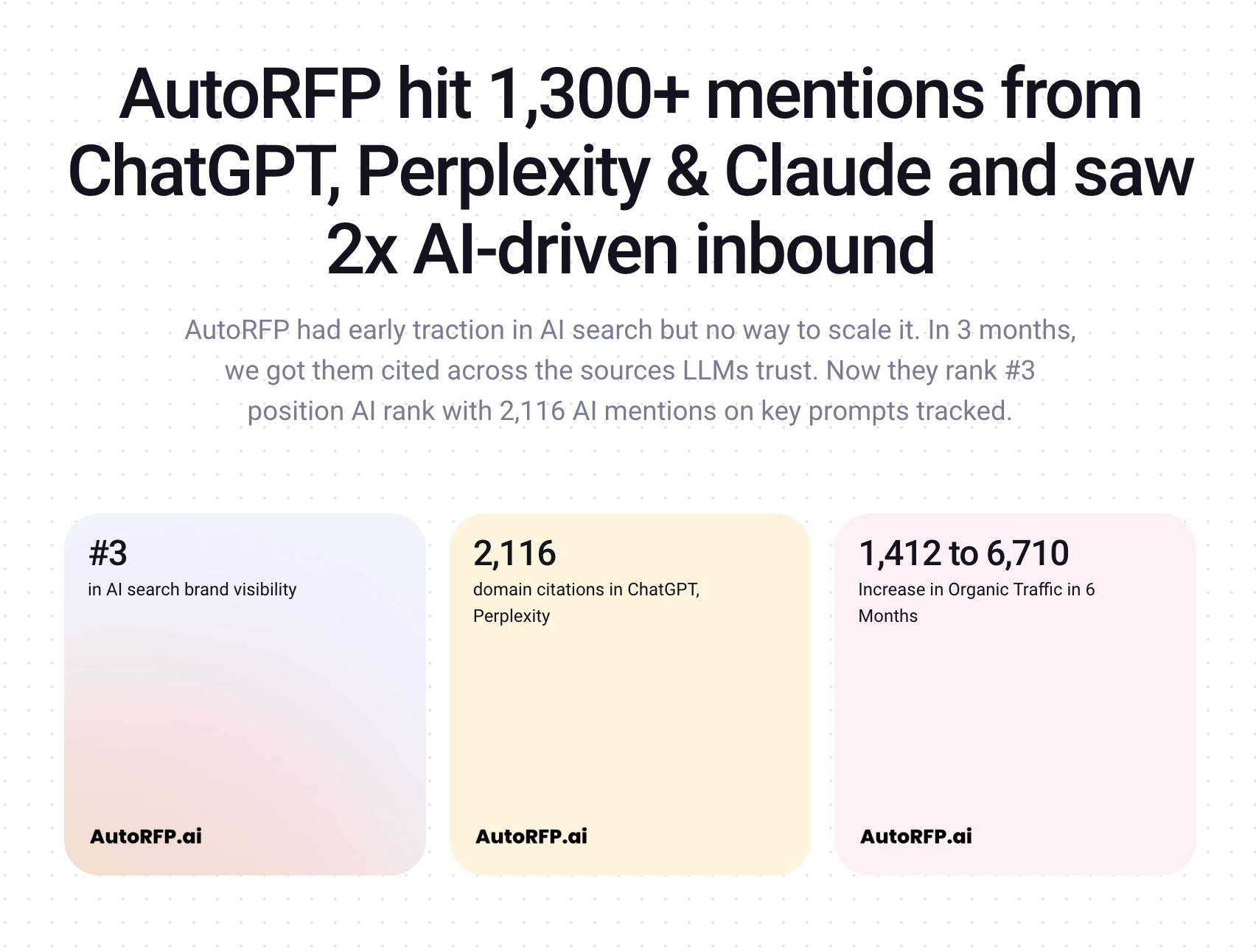
Our SaaS AEO agency team runs this structural layer on every piece we publish. Working with us, AutoRFP grew organic traffic from 1,412 to 6,710 monthly visitors in six months, reached an average AI position rank of #3, and accumulated 2,116 brand mentions across LLMs in a single 14-day window.
Step 6: Add Pipeline-Relevant CTAs and Refresh on a Schedule
The last step is closing the loop between the reader and the pipeline. Route readers to the most relevant next step based on where the piece sits in the funnel:
- Use-case pages should route to a demo or a live walkthrough
- Alternatives and comparison pages should route to a competitive comparison tool or side-by-side page
- Integration pages should route to setup docs or a free-tier signup
- Top-of-funnel explainers should route to a gated resource, newsletter, or lower-friction lead magnet
- Pricing pages should route directly to signup or sales
Generic footer CTAs that ask every reader to book a demo leave a lot of pipeline on the table. Once the piece is live, schedule the refresh on a cadence, following the audit workflow covered in Mistake #5 above. Refreshed pages consistently outperform new ones on cost-per-signup, because they keep the rankings and citations they’ve already earned.
Types of SaaS Content That Drive Signups
We’ve touched on some of these formats already, but here’s the consolidated view of the SaaS content formats that consistently drive signups:
- Comparison and alternatives pages: decision-stage content that captures buyers who’ve already shortlisted the category and are picking between vendors
- Use-case pages: built around a specific job the reader is trying to get done, walking them through how the product solves it
- Product-led how-to guides: teach the reader to accomplish something specific inside the tool, using real screenshots and workflows, with a signup or trial as the natural next step
- Customer stories and case studies: decision-stage proof that shows named clients, specific outcomes, and real numbers with context
- Original data reports and benchmark studies: long-lasting authority content that gets cited by AI models, listicles, and industry publications for years
The through-line across all five is specificity. Generic explainers rarely drive signups, but content that’s built around a specific buyer, a specific workflow, or a specific outcome does.
How to Write SaaS Content That AI Search Cites (AEO)
To get cited by AI search, SaaS content needs to hit two layers of optimization. The on-page layer covers structure (question-led headings, cited data, schema markup), and the off-page layer covers presence (how often your brand shows up across the web, which sources it’s mentioned in, and how consistently it’s described). Content only gets cited when both layers are in place.
We’ve covered the on-page side earlier in the article, so let’s talk about the off-page work that decides whether AI models cite your brand in the first place.
Off-page AEO is often described using two terms: consensus (how often you’re mentioned across the web) and context (how you’re described each time). When both are strong across a wide set of sources, AI has enough signal to consistently recommend you. When either falls off, it defaults to competitors.
The practical playbook for building both:
- Get placed in high-authority third-party listicles. For every commercial-intent keyword your ICP searches, pull the top 10-20 ranking pages (roundups, comparison posts, review aggregators like G2 and Capterra, category blogs), then pitch the authors to add your product with a specific, consistent description.
- Control how you’re described in every placement. Write a 200-word product description exactly the way you want AI to talk about you, list your top three use cases, name one or two recognizable customers, and share it with every publication you pitch. Repeat that description across every placement so the context stays consistent.
- Feed AI with owned-community activity. Genuine Reddit participation, YouTube content, and Wikipedia presence all get pulled into AI answers. AI models increasingly cite these sources because they read as unbiased signal.
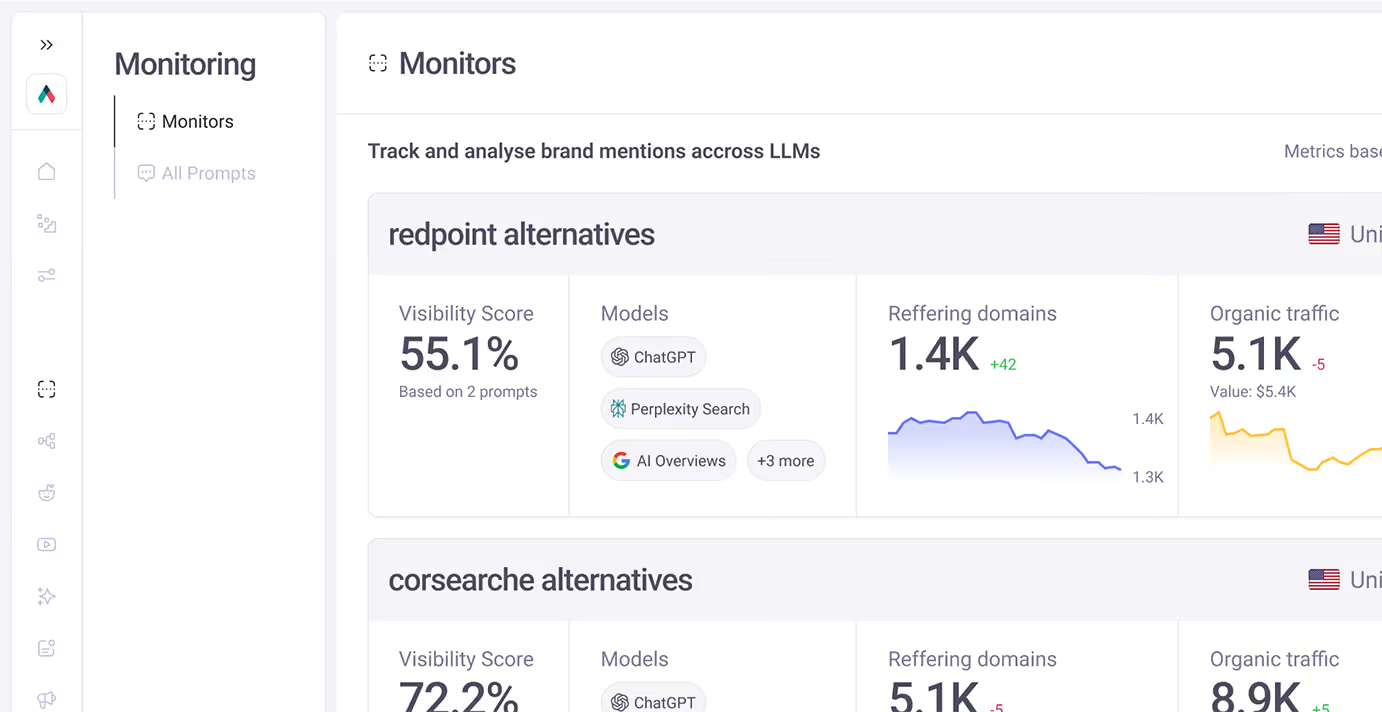
- Track prompt-level citation share weekly. Run your core buyer prompts through ChatGPT, Claude, and Perplexity every week and log where you’re being cited, how you’re positioned in the list, and how you’re being described. The prompts you’re missing from are your next placement priority.
Jules Davies breaks down the third-party listicle side of this playbook in this LinkedIn post, including the exact pitch template and the identify-target-track workflow.
The results this approach drives are meaningful. Morgen hit 4,000+ AI citations in the first 30 days of working with us. Qrvey now ranks #3 in AI search brand visibility across their category, with roughly 2,836 mentions across LLMs. Stan Rymkiewicz, Head of Growth at Default, put the pipeline impact simply:
“I can confidently say about 30% of our pipeline comes from AEO/SEO and AI search. In the last month we got over $300K in pipeline just from AEO/SEO for really no additional work.”
SaaS Content Writing Examples & Tools
Blogs Worth Learning From
A few SaaS blogs worth studying as reference points:
- Ahrefs. The industry standard for product-led how-to content. Every guide walks the reader through a task using their tool as the vehicle, so readers get real value and see the product working at the same time.
- Zapier. A benchmark for programmatic and use-case content at scale. Zapier’s blog covers thousands of specific workflows and integrations, each optimized for the exact job a reader is trying to get done.
- Marq. A category-defining example of enterprise thought leadership. Marq’s content owns the brand governance space with long-form pieces enterprise marketing leaders read, cite, and reference inside their own strategy docs.
SaaS Content Writing Tools
There isn’t a single tool that handles SaaS content writing end-to-end. Most teams stitch together a small stack across research, writing, and optimization:
You can also layer AI tools like ChatGPT and Claude across all three stages to speed up research, tighten drafts, and pressure-test outlines before writing.
FAQs
1. How much does SaaS content writing cost?
It depends on scope and quality. Freelance SaaS writers typically charge $0.10 to $1.00+ per word, while specialist SaaS content agencies charge $3,000 to $15,000+ per month depending on volume, strategy depth, and services included. For pricing tailored to your growth stage, book a call with Scalerrs today.
2. How long should a SaaS blog post be?
It depends on the topic and search intent. Bottom-of-funnel pages like comparisons and alternatives usually perform best at 2,000-3,000 words with clear structure. Top-of-funnel explainers can range from 1,200 to 2,500 words. Length is a byproduct of covering the topic well.
3. Should you outsource SaaS content writing or keep it in-house?
It depends on your growth stage and team capacity. In-house teams give you deeper product context but can cost $200K+ annually to build. Agencies deliver senior specialists, strategy, and execution capacity without the hiring lift, which is why most mid-market and enterprise SaaS teams pair a lean in-house function with a specialist agency rather than building the whole stack internally.
4. How do you measure the ROI of SaaS content?
Tie every piece to a pipeline metric. Track signups, demos booked, trials started, and influenced pipeline sourced from organic and AI search. Content ROI becomes clear once you connect published pages to specific revenue outcomes.
5. How do you write SaaS content that AI tools like ChatGPT cite?
Structure content for extractability and build off-page consensus. On-page: use question-led headings, answer each in the first two sentences, add short 40-60 word definitions, cite original data, and apply schema. Off-page: get placed in high-authority third-party listicles with a consistent product description across every mention.
How Scalerrs Builds SaaS Content That Ranks and Converts
In 2026, SaaS content has three jobs: rank on Google, get cited across LLMs, and move buyers one step closer to a purchase decision along the sales cycle.
With how quickly search is changing and how much ground content now has to cover (Google, ChatGPT, Claude, Perplexity, Reddit, third-party listicles), most in-house teams simply don’t have the bandwidth to run all of this well. But we do.
At Scalerrs, we work exclusively with mid-market and enterprise B2B SaaS companies to help them own their category across SEO, Reddit, third-party listicles, and AI search. Every account is staffed with a dedicated pod of senior SEO strategists, SaaS-specialist writers, and an AEO lead who run the full multi-surface playbook across every piece we publish.
It's why clients like Default, Morgen, Portainer, Marq, and AutoRFP now attribute meaningful growth to organic and AI search across multiple surfaces, not just one.
Want to see what this could look like for your pipeline? Book a strategy call with our team, or grab our SaaS content marketing playbook for the exact frameworks we use with clients.
Book a Discovery Call
Turn Organic Search Into Your #1 SaaS Acquisition Channel.

Let us scale your SEO channel for you.
reviewed onClutch
4.9 rating






Get Free Resources In Your Inbox
Get all of our FUTURE playbooks such as Figma files, checklists and SOPs directly into your inbox.

.avif)