


SaaS SEO Checklist (2025 Actionable Template Included)

Key Takeaways
- A complete SaaS SEO checklist goes beyond publishing content. It starts with strategy, then covers technical SEO, on-page optimization, UX, content, authority building, conversion optimization, and measurement. That's what creates sustainable organic growth.
- The best SEO checklist for SaaS companies now includes AI search readiness alongside traditional SEO. Google AI Overviews, ChatGPT, Reddit, and YouTube increasingly influence how buyers discover software, even before they visit your website.
- Treat your SEO checklist as an operating system, not a one-time task. Revisit it after product launches, website changes, and during quarterly SEO reviews to prevent technical debt and content decay.
- Prioritize fixes that improve the pipeline, not just rankings. The highest-impact tasks usually involve strengthening money pages, improving internal linking, and removing friction from your buyer journey.
Why Is an SEO Checklist Important?
An SEO checklist gives your team a repeatable process instead of relying on memory or reacting when traffic drops. That's especially important in SaaS, where websites evolve constantly as new features launch, product messaging changes, and landing pages get added.
Without a system, small issues compound until they start affecting rankings, conversions, and pipeline.
A good SaaS SEO audit checklist helps you:
- Build a strong foundation before investing in content
- Catch technical and UX issues before they hurt performance
- Keep product launches aligned with SEO best practices
- Make sure every optimization contributes toward qualified traffic and revenue
A good checklist gives your team a shared reference for what "done" looks like at every layer, makes it easy to brief agencies and defend decisions to your CMO.
Upfront Strategy
Before you touch a single page, you need a strategy that ties SEO to the pipeline. This is where most programs fail. Teams start executing before they've defined what "winning" looks like or which buyers they're chasing.
Here are some best practices to address that:
Align SEO to Your GTM Motion
Product-led, sales-led, and hybrid SaaS companies need different SEO strategies. A PLG company optimizing for demo requests when the real conversion event is a self-serve signup will waste budget.
A growth-stage SaaS with sub-$10K ACV with self-serve buyers will benefit from prioritizing signup pages, integrations, and use-case content.
Enterprise SaaS SEO needs a different playbook: Invest more in comparison pages, security content, and analyst mentions to improve trust and consequently, conversions.
{{cta-general="/cta/book-a-discovery-call-general-catch-all"}}
Model the Pipeline Impact Upfront
If you can't tie SEO to the pipeline before you start, you'll spend six months defending your budget instead of shipping work.
Build a simple model: which keyword clusters map to which product pages, realistic conversion rates at each stage, and pipeline generated by month 12. This becomes your defensibility document with the CMO.
Treat AI Search As Its Own Domain
G2 discovered that 51% of B2B software buyers now start their software research with an AI chatbot more often than Google, while 71% use AI chatbots somewhere during the software buying process. And if you're not there, you're absent at the shortlist stage.
Model AI search visibility with its own targets and KPIs.
If you're figuring out where to start, our AI/LLM Search Study Analysis breaks down how leading SaaS brands are earning citations across ChatGPT, Perplexity, and Google AI Mode.
{{cta-general="/cta/aeo-ai-search-agency"}}
Benchmark Before You Start
Before making changes, establish a baseline.
Record your:
- Organic traffic
- Non-branded keyword rankings
- Demo or signup conversions
- Indexed pages
- Core Web Vitals
- Visibility for your most important commercial keywords
That gives you something meaningful to measure against later.
General SEO Setup
Don’t want to make a mistake that limits your performance for months? Ensure your tracking, tooling, and trust signals are set up correctly from day one.
Configure Your Measurement Tools Correctly
At minimum, every SaaS website should have:
- Google Search Console
- Google Analytics 4
- Bing Webmaster Tools
- Conversion tracking for demos, trials, or signups
Without reliable data, you can't identify what's working or measure the impact of future improvements.
We advise our SaaS clients to prioritize actual pipeline-linked events: demo requests, trial signups, SALs, and closed-won, over vanity metrics like impressions and traffic. Make sure these fire consistently across your marketing site, product, and CRM.
Add AI Referrer Tracking
Most SaaS teams miss this. Buyers clicking through from chatgpt.com, perplexity.ai, gemini.google.com, and claude.ai show up in GA4, but only if you've set up the segments to catch them. Layer in a citation-tracking tool like Ahrefs Brand Radar or Profound to monitor where your brand appears across AI answers.
Submit XML Sitemaps and Check Indexation
Google can't rank pages it doesn't know exist.
Submit an XML sitemap, review your Page Indexing report regularly, and confirm your important commercial pages are actually indexed.
Pay special attention after redesigns, website migrations, or major product launches. These are the moments when indexing problems often appear.
Build Out Your Trust and E-E-A-T Pages
Every SaaS site needs a real About page with named team members and credentials, plus Privacy, Terms, Security, and Contact pages that establish credibility and authority.
LLMs treat these as entity signals. So does Google.
If your About page is a stock photo and a two-sentence bio, you're leaving citation opportunities on the table.
UX Optimization
Good SEO gets people to your website. Good user experience gives them a reason to stay.
Google continues to reward pages that create satisfying experiences, and buyers are even less patient than search engines. If your page is slow, confusing, or difficult to navigate, they'll simply move on.
Prioritize Navigation That Maps to Buyer Journey Stages
Your top nav should surface what buyers actually look for: product, use cases/solutions, pricing, integrations, customer stories. Not "resources" as a vague catch-all.
Nearly every SaaS site we audit has a nav that grew organically and now makes buyers work to find the money pages. Fix it first.
Improve Page Speed and Core Web Vitals
Surprise surprise, fast websites engage and convert better.
Deloitte's Milliseconds Make Millions study found that improving mobile load speed by just 0.1 seconds increased retail conversions by 8.4%, travel conversions by 10.1%, and reduced bounce rates on lead-generation pages by 8.3%. Small speed improvements compound into big revenue gains.
Yet only a little over 40% of websites currently pass all Core Web Vitals thresholds. Google tells you to aim for these benchmarks:
How to do it?
Run your site through PageSpeed Insights and prioritize fixes on your product, pricing, comparison, and demo pages. The quickest wins usually come from compressing image size, removing unused JavaScript, deferring non-critical scripts, enabling browser caching, and using a CDN.
Design Mobile-first, Review Desktop Last
Most SaaS sites still design for a 27-inch monitor and squeeze the layout down. Flip that. Design your money pages for a thumb, test on a real device, then optimize desktop. CTAs, forms, and comparison tables should be mobile-first, always.
{{cta-general="/cta/saas-seo-checklist"}}
Conversion Rate Optimization (CRO)
CRO decides whether prospects who land on your website become buyers or bounce back to Google. For SaaS, if high-intent visitors land on confusing pages, can't find pricing, or don't know what to do next, your acquisition costs go up and your organic channel becomes less profitable.
We recommend treating SEO and CRO as one continuous system. The pages that attract your best buyers should also make taking the next step feel obvious.
Build Trust Before Asking for the Conversion
The average B2B buying group today involves 17+ stakeholders. Software purchases often take months to complete, and come at a significant financial cost. Buyers want reassurance before they’re ready to commit.
Strengthen your money pages with:
- Customer logos
- Testimonials
- Case studies
- G2 or Capterra reviews
- Security certifications
- Customer success metrics
Design CTAs around the Buyer's Intent
Someone searching "CRM software pricing" is looking for something very different from someone searching "What is CRM software?"
Your CTA should reflect that.
- Educational content can lead readers to related guides, templates, or case studies
- Commercial content should guide visitors toward demos, pricing, or free trials
- Comparison pages should make it easy to evaluate your product against competitors
Ask for Self-reported Attribution on Demo Forms
Add "How did you hear about us?" as a required field on your demo form, with a dropdown that includes ChatGPT, Perplexity, Reddit, Google, and "Colleague/word of mouth."
Given how much of the buyer journey now happens in dark channels, self-reported attribution is often the only way to prove what's driving the pipeline.
Continuously Test Your Highest-Value Pages
Your pricing, product, comparison, and demo pages deserve ongoing experimentation.
Test elements like:
- Headlines
- CTA copy
- Demo forms
- Navigation
- Page layouts
- Social proof placement
Focus on pages that already receive qualified organic traffic before optimizing lower-impact assets.
On-Page SEO
In our experience, teams do too much and too little SaaS on-page SEO at the same time. Too much stuffing keywords into H1s. Too little structuring content so LLMs can extract clean answers.
Remember that on-page optimization now serves two audiences (other than your human readers): Google's ranking systems and the AI models synthesizing your content.
Write Meta Titles and Descriptions That Earn the Click
Every important page should have:
- One unique H1
- A descriptive title tag
- A compelling meta description
- Clear heading hierarchy (H2s and H3s)
- URLs that reflect page intent
Think of your title tag as both a ranking signal and an advertisement. Even if you rank well, weak metadata can reduce click-through rate. So, lead with the keyword, write the second half like a conversion copywriter.
In an AI-Overview-dominated SERP, descriptions that earn the click can make all the difference between winning and disappearing.
Use One H1, and Structure H2s and H3s as Extractable Answers
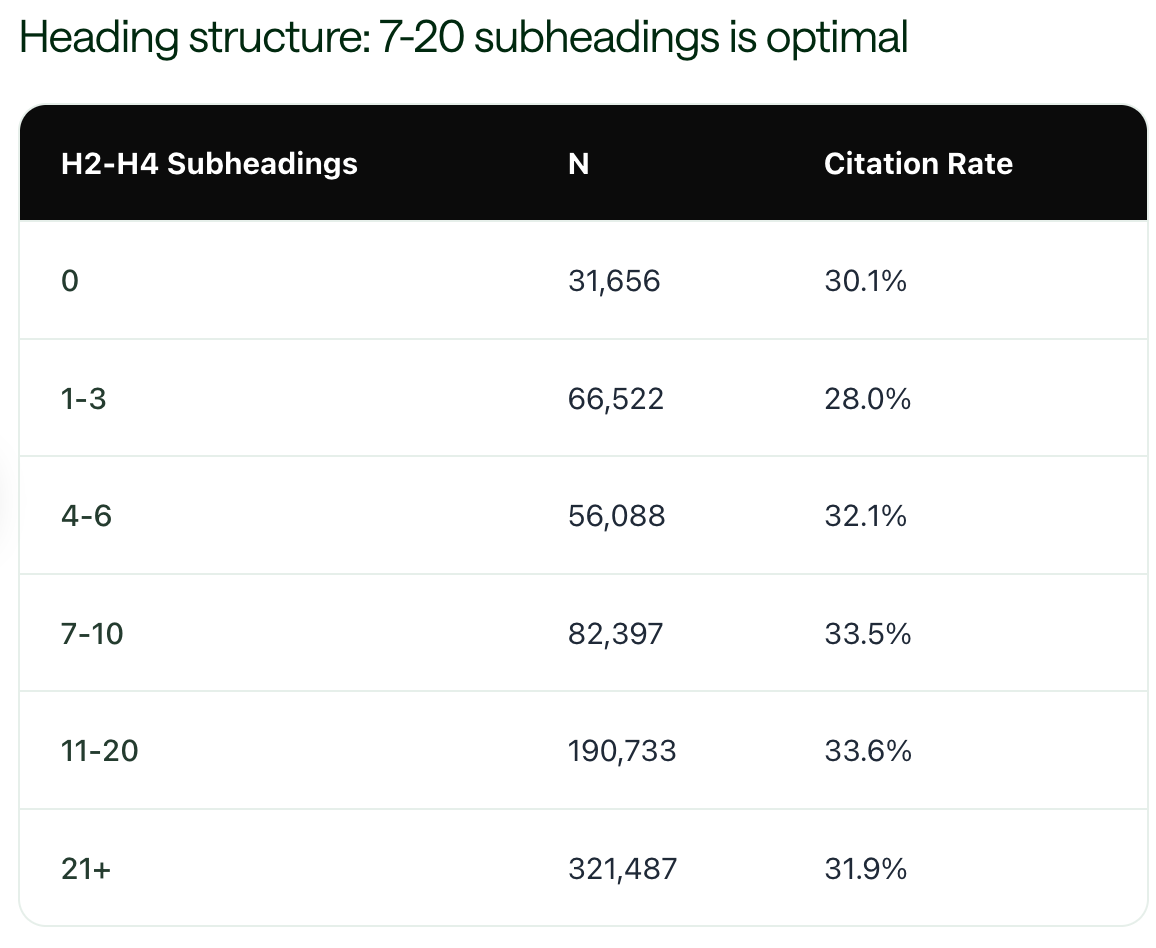
Only use one H1 per page. Then structure H2s and H3s as questions or answer-carrying phrases, because that's what LLMs pull from.
If your header reads "The Approach," an AI model has no idea what to extract. If it reads "How to prioritize money pages for SaaS SEO," it can grab and cite the paragraph beneath it.
Ship Schema That Matches Your Content
This is a golden rule: The schema you apply must match the visible content on the page. Mismatch it and both Google and AI engines will downweight the page.
JSON-LD schema for Organization, SoftwareApplication, Article, and Product remains the standard. Google removed FAQ rich results in May 2026, but FAQ schema still helps LLMs parse your Q&A content, so keep adding it.
Strengthen Internal Linking
Internal links help search engines understand relationships between pages while guiding visitors deeper into your website.
Every article should naturally link to:
- Relevant feature pages
- Related blog posts
- Comparison pages
- Case studies
- Supporting resources
Don't think of internal links as an afterthought. They're one of the easiest ways to distribute authority toward the pages that generate revenue.
Money Pages SEO
Money pages (homepage, pricing, product, comparison, alternatives, integrations) are where your SaaS pipeline actually comes from. SEO teams often underinvest here because blog posts feel easier to ship. Thanks to AI Overviews, top-of-funnel informational content has lost its edge. The value now lives at the middle and bottom.
Do Keyword Research at the Money-Page Level
Every product page, integration page, and alternatives page should have a target keyword, a documented search intent, and a competitor page you're benchmarking against.
Every keyword here should support a business objective, whether that’s capturing buying intent, supporting product education, or converting existing demand.
{{cta-general="/cta/saas-keyword-research-playbook"}}
Keep Product Pages Updated
Your website should evolve as quickly as your software.
Review product pages regularly to ensure they reflect:
- Current features
- Updated messaging
- Latest pricing
- New integrations
- Customer outcomes
Nothing erodes trust faster than outdated screenshots or feature descriptions that no longer match the product experience.
Load Money Pages with Proof, not Adjectives
Your pricing page shouldn't just list plans. It should show the ROI math, and support it with real customer proof.
Your alternatives page shouldn't just say you're better. It should also acknowledge where you're not the right fit.
Our client, Qrvey, doubled their pipeline from $740K to $1.5M in a year, largely from rebuilding comparison and alternatives pages with real data and getting cited in AI search as a result.
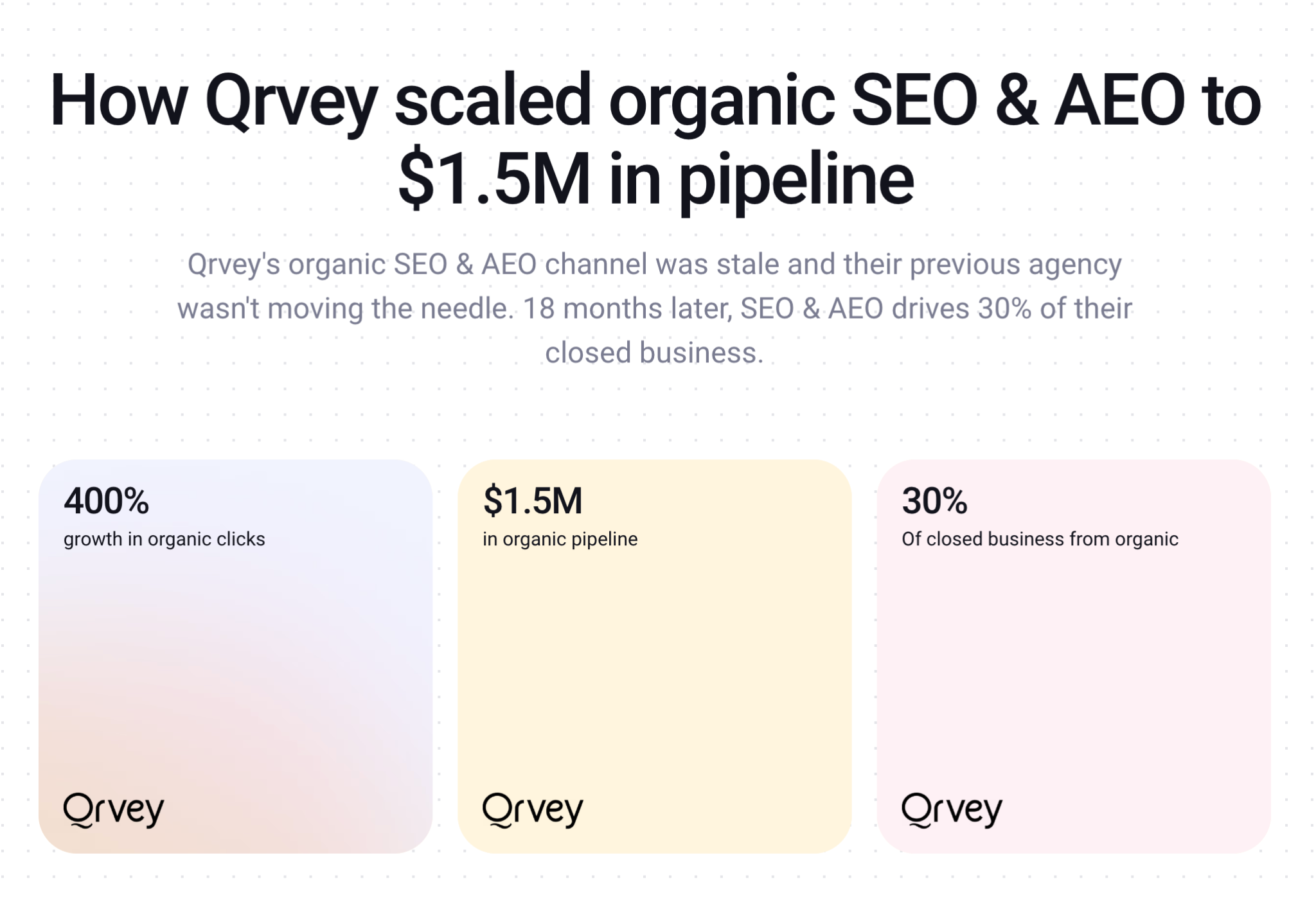
This is usually where we start with new SaaS clients. Our SaaS SEO agency service prioritizes money pages before expanding the content program.
Content Marketing
Content is where the SaaS SEO game has changed the most. The old play (publish 10 posts a month, chase informational keywords, watch traffic grow) doesn't work anymore. AI Overviews eat those queries.
What still works: content that earns citations, drives BOFU conversions, and builds authority around keywords buyers actually convert on.
Prioritize Content Clusters by Revenue over Search Volume
Don't choose keyword clusters based on search volume alone. Focus on topics your ideal customers search for when they're actively evaluating software.
For example, if you sell a project management platform, "best project management software for marketing teams" or "Asana alternative" will usually attract more qualified buyers than a broad keyword like "what is project management," even if those searches have lower volume.
Publish Original Data Your Competitors Can't Copy
LLMs preferentially cite content carrying unique, verifiable statistics. Aleyda Solis's July 2026 study of 15 leading SaaS brands found 84 to 93% of AI citation weight came from external, third-party sites, much of it traced back to companies publishing original research.
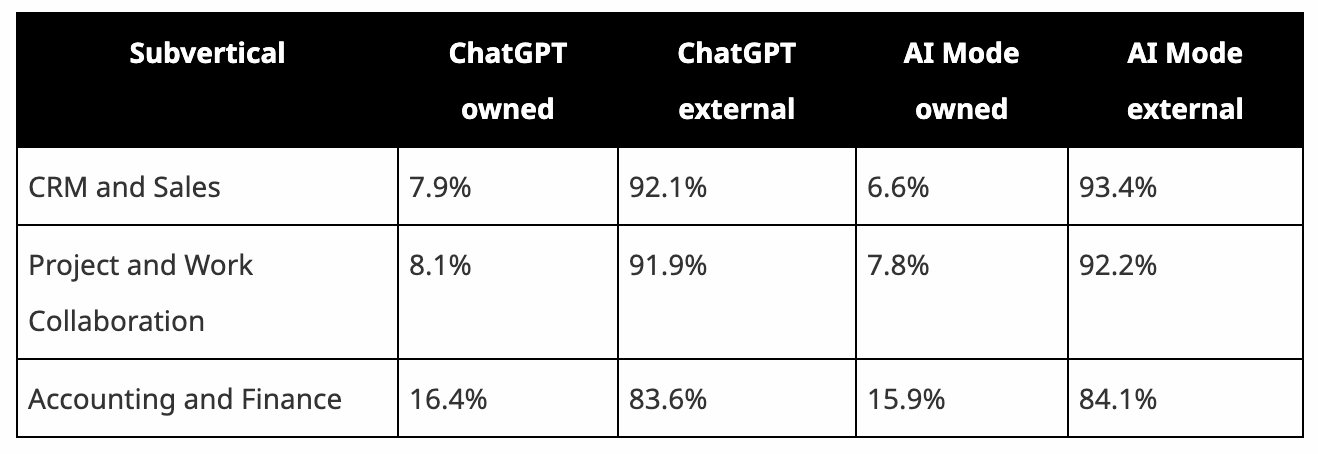
If you have proprietary data (product benchmarks, user survey results, industry reports), turn it into content. That's your moat.
Fight Content Decay with Systematic Refreshes
Every quarter, pull your top 20 traffic-driving pages and check whether they're gaining or losing traffic. Ahrefs' research found most pages older than two years experience declining traffic without active maintenance. Rewrite, restructure, or consolidate the losers.
Our SaaS content creation service handles this as part of the retainer, because it's usually the highest-ROI content activity we run.
{{cta-general="/cta/content-creation"}}
Technical SEO
If Googlebot or GPTBot can't crawl your money pages, none of your on-page or link work matters. Technical SEO is the plumbing, and in a SaaS context (where sites accumulate technical debt fast from feature launches, docs, changelogs, and integrations) it needs regular maintenance.
Maintain Crawlability and Indexation
Review your website regularly for:
- Indexation issues
- Broken links
- Redirect chains
- Duplicate pages
- XML sitemap errors
- Robots.txt problems
Technical debt accumulates quietly, especially after redesigns, migrations, or product launches. Make sure canonicals point where you want authority to consolidate.
Running a recurring SEO checklist for SaaS product launch helps catch these issues before they affect visibility.
Structure Your Website for Long-term Growth
Technical SEO isn't just about fixing errors.
It's about building an architecture that scales.
That means:
- Logical URL structures
- Strong internal linking
- Schema markup
- Clean canonicalization
- Mobile-friendly templates
- Crawl-efficient navigation
As your website grows, these structural decisions become increasingly important for both traditional search engines and AI systems trying to understand your content.
Link Building Strategy
A modern SaaS link building strategy focuses on earning mentions from websites your buyers already trust. Those links help search engines understand your authority, while also increasing the chances of your brand being referenced in AI-generated answers, industry roundups, and buying conversations.
This LinkedIn post by Scalerrs Founder, Jules Davies, explains why backlinks still matter:
And here’s how to go about it:
Prioritize Relevance over Authority
A backlink from a respected SaaS publication or industry blog is usually worth more than dozens of unrelated directory links.
When evaluating opportunities, ask:
- Would your ideal customer actually read this website?
- Is the content editorially reviewed?
- Does the site cover your industry consistently?
- Could the referral traffic convert into customers?
Google's spam policies continue to discourage manipulative link schemes in favor of links earned because someone found your content genuinely useful.
Create Assets People Naturally Want to Reference
The easiest links to earn come from publishing something worth citing.
That could be:
- Original research
- Industry benchmarks
- Free templates
- Interactive tools
- Customer surveys
- Detailed implementation guides
These assets also perform well in AI search because they contribute original information rather than repeating what's already available online.
Build Your Brand Beyond Your Own Website
One of the biggest shifts in SEO is that your website is no longer the only place where authority is built. Community discussions on Reddit, independent reviews on sites like G2, and third-party mentions increasingly shape whether your brand appears in AI-generated answers.
Semrush's analysis of 248,000 Reddit posts cited across ChatGPT Search, Google AI Mode, and Perplexity found that Reddit remains one of the most influential external sources for AI search. It ranked as the #1 cited domain on Perplexity, #2 on SearchGPT, and #3 on Google AI Mode.
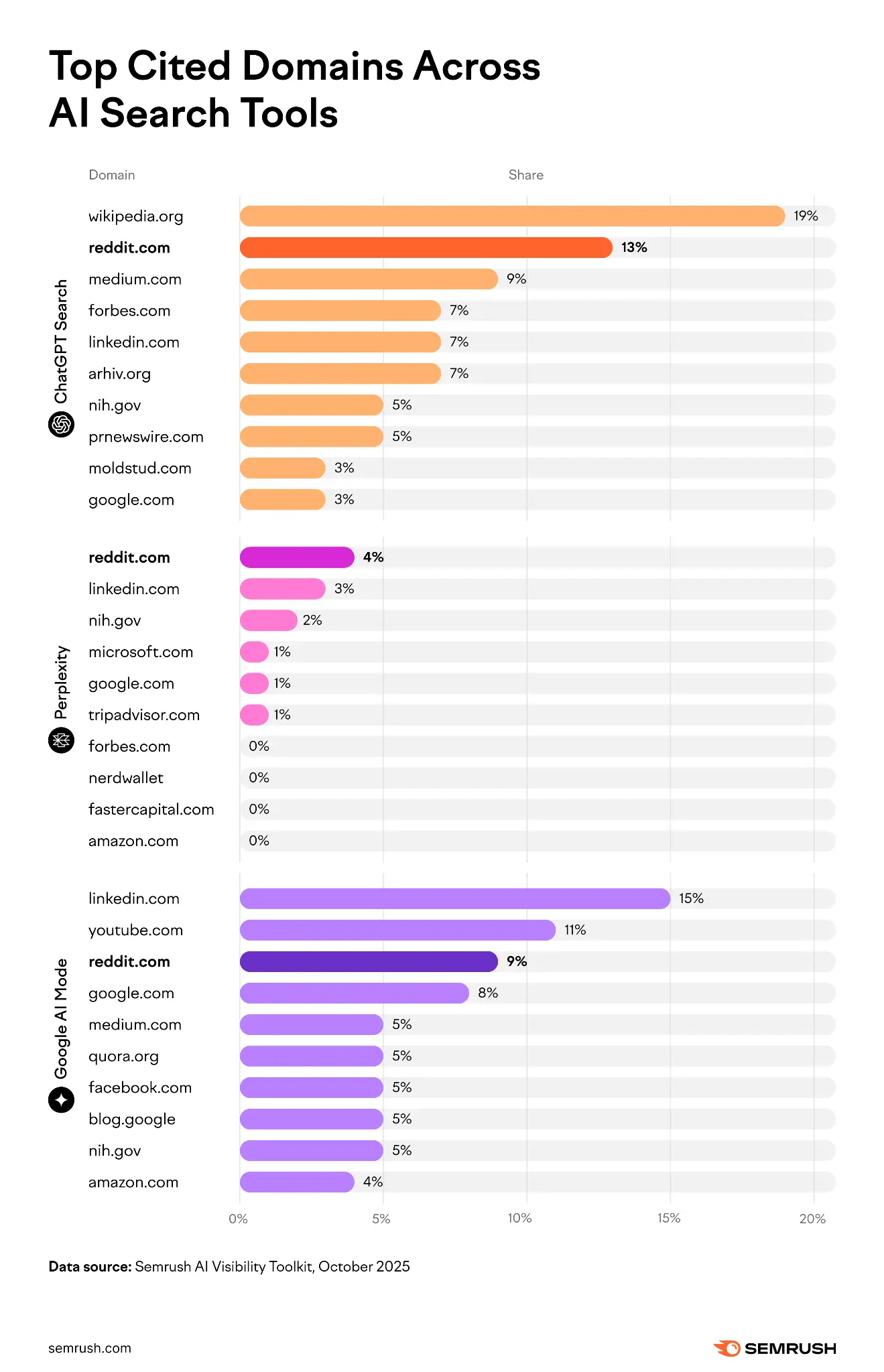
That's why we think link building should include broader brand visibility efforts across industry publications, communities, podcasts, review platforms, and expert contributions, not just backlinks.
{{cta-general="/cta/3rd-party-listicles-ai-brand-mentions"}}
Measuring SEO Success
A checklist only creates value if you measure whether the work actually moved the needle.
When SaaS teams still report rankings and organic traffic as their primary SEO KPIs, it doesn’t tell anyone whether SEO is contributing to revenue.
The best measurement frameworks connect SEO activity directly to pipeline, customer acquisition, and long-term growth.
Measure Business Outcomes First
Start with metrics your leadership team already cares about:
- Demo requests
- Free trial signups
- Qualified pipeline
- Revenue influenced by organic search
- Customer acquisition cost
Traffic becomes much more meaningful when you know which pages are generating customers instead of just visitors.
Segment Branded versus Non-branded Organic Growth
Branded search grows as your marketing works. Non-branded grows as your SEO works.
Segment them in Search Console, benchmark quarter over quarter, and use the split to explain what SEO is doing versus what broader brand-building is contributing.
Monitor AI Citation Share Separately
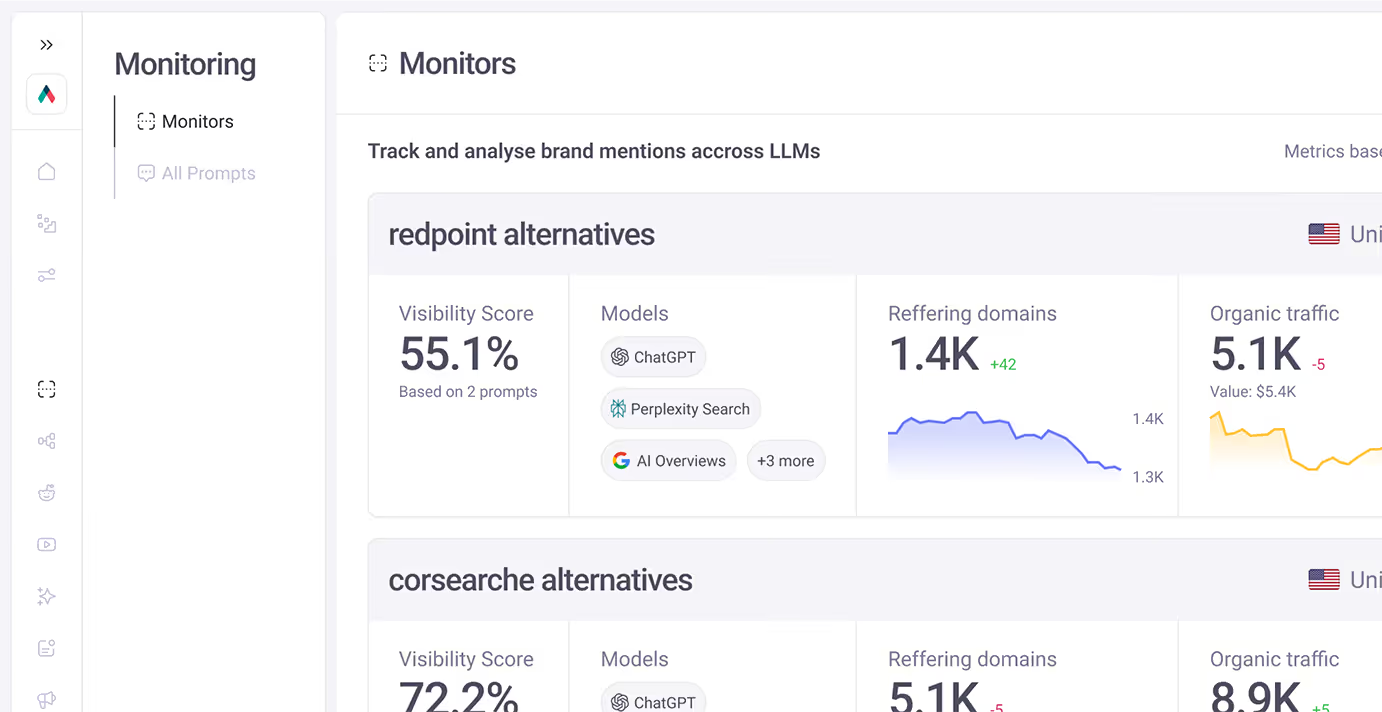
Track how often your brand gets cited across ChatGPT, Perplexity, Gemini, and Google AI Overviews for your target category queries. Tools like Profound, Peec AI, and Ahrefs Brand Radar make this trackable.
Review the Website against Your Checklist Every Quarter
Every product launch, website redesign, acquisition, or messaging change creates new opportunities for technical issues, outdated content, and missed optimization.
We recommend running a quarterly review of your website against this SaaS SEO audit checklist, then revisiting it before every major product launch as well.
FAQs
1. What is the complete SaaS SEO checklist?
The complete SaaS SEO checklist covers strategy, general setup, UX, CRO, on-page, money pages, content, technical SEO, link building, and measurement, layered with AI search visibility across ChatGPT, Perplexity, and Google AI Overviews.
2. What's the SEO checklist for a SaaS product launch?
For a launch, prioritize technical hygiene (crawlability, schema, sitemaps), money-page setup (product, pricing, integrations, comparisons), a launch content cluster, and digital PR outreach. Set up GA4 events and AI referrer tracking before launch day so you can measure impact from hour one.
3. What's the difference between an SEO checklist and an SEO audit?
An SEO checklist is a proactive framework that helps you implement best practices consistently. An SEO audit evaluates your existing website to identify issues, prioritize fixes, and uncover new growth opportunities.
4. How often should I run a SaaS SEO audit?
Most SaaS companies should run a comprehensive SEO audit every quarter and perform lighter technical checks monthly. You should also complete an audit before and after major website migrations, redesigns, or product launches.
5. Can AI tools replace traditional SEO?
No. AI search builds on many of the same signals as traditional SEO, including crawlability, helpful content, authority, and structured information. Strong SEO remains the foundation, while Answer Engine Optimization (AEO) expands your visibility across ChatGPT, Google AI Overviews, Perplexity, and other AI-powered discovery experiences.
Ready to Turn Your SEO Efforts into Actual Pipeline?
If you need SEO and AEO to drive demos and pipeline (not just traffic), Scalerrs is built for that. Two years working with 80+ SaaS clients has taught us where the pipeline actually lives in 2026.
Our team of experts can benchmark your current SEO performance, identify your biggest growth opportunities, and build a roadmap tailored to your product and stage of growth. Whether you're launching a new product, refreshing an existing strategy, or preparing for AI-first search, we'd love to help.
Want to see what a full-stack SaaS SEO and AEO program could look like for you? Book a free strategy call.
Book a Discovery Call
Turn Organic Search Into Your #1 SaaS Acquisition Channel.

Let us scale your SEO channel for you.
reviewed onClutch
4.9 rating







Get Free Resources In Your Inbox
Get all of our FUTURE playbooks such as Figma files, checklists and SOPs directly into your inbox.

.avif)