

SaaS Link Building: Strategies, Tactics & Guide for 2026

Key Takeaways
- SaaS link building is the process of earning backlinks from relevant, trusted websites to improve search visibility, topical authority, and pipeline from high-intent pages.
- The best SaaS link building strategies focus on buyer journeys, not just domain metrics. Prioritise links to comparison pages, integration pages, features pages, original data assets, and product-led content.
- A scalable SaaS link building strategy needs repeatable systems: link target selection, asset creation, prospecting, outreach, quality control, and ROI tracking.
- Track more than Domain Rating (DR) or Domain Authority (DA). The real question is whether your backlinks improve rankings, qualified traffic, demo requests, sales-qualified leads (SQLs), and revenue-influenced pipeline.
SaaS link building helps software companies build authority around the pages buyers use to discover, compare, and trust their product.
That matters in 2026, when Gartner reports that 67% of B2B buyers prefer a rep-free experience and 45% used AI during a recent purchase—meaning your backlinks need to support visibility across Google, trusted third-party pages, partner ecosystems, comparison content, and AI-cited sources.
In this guide, we’ll break down what SaaS link building is, how it differs from traditional link building, which strategies work, how to build a repeatable system, and which key performance indicators (KPIs) prove whether your backlinks are actually moving pipeline.
What Is SaaS Link Building?
SaaS link building is the process of earning relevant backlinks to a software company’s website so its key pages rank better, attract qualified buyers, and build topical authority.
In practice, that means getting relevant and credible third-party websites to link to pages like:
- Product-led blog posts
- Comparison pages
- Alternative pages
- Integration pages
- Templates and tools
- Original research reports
- Case studies
- Data-led industry resources
- Glossary or educational pages tied to the buyer journey
The key word here is “relevant.”
A backlink from a random high-authority lifestyle blog won’t help a B2B SaaS company as much as a contextual link from a niche software publication, partner site, industry blog, integration marketplace, or buyer-focused resource.
That is why link building for SaaS should start with business context.
Before asking, “How do we get more SaaS backlinks?” ask:
- Which pages influence qualified demand?
- Which topics do we need to be known for?
- Which search terms indicate buyer intent?
- Which third-party sources do our buyers already trust?
- Which pages need more domain authority to compete?
How SaaS Link Building Differs from Traditional Link Building
SaaS link building differs from traditional link building because the buyer journey is longer, the pages that need authority are more commercial, and success has to connect back to pipeline.
A local service business might build links to rank a service page.
An ecommerce brand might build links to category pages, buying guides, or product collections.
A SaaS company needs backlinks that support a more complex journey: problem awareness, category education, product comparison, integration research, internal buy-in, and final vendor selection.
The biggest mistake is treating B2B SaaS link building like a generic outreach campaign.
You can build 100 links and still miss the point if those links do not support the pages buyers use to understand, compare, and justify your product.
8 Proven SaaS Link Building Strategies
The best SaaS link building strategies help your product show up across the surfaces your buyers already use to evaluate software.
That includes Google. But it also includes Reddit threads, third-party listicles, review platforms, partner ecosystems, YouTube results, and AI answers from tools like ChatGPT, Perplexity, Gemini, and Claude.
For a growth-stage B2B SaaS company, the goal is not to build 50 backlinks and call the campaign successful. The goal is to build authority, mentions, and category associations across the places your buyers trust when they are building a shortlist. That is how link building becomes a genuinely valuable part of your organic marketing efforts.
The strategies below focus on building links that support both authority and pipeline.
1. Guest Posting and Editorial Outreach
Guest posting still works for SaaS link building when it is specific, editorial, and ICP-aligned.
But the goal is not to publish generic “10 marketing tips” posts on any site that accepts contributors. The goal is to earn contextual links from publications your buyers, partners, and industry peers actually read.
For example, a customer support SaaS company should not chase broad business blogs first. It should prioritize:
- CX publications
- SaaS operations blogs
- Help desk software blogs
- Support leadership communities
- Customer success newsletters
- Partner or integration blogs
The link target matters too. Instead of sending every editorial link to your homepage, use guest posting to support specific pages:
- Comparison pages
- Use-case pages
- Integration pages
- Product-led guides
- Templates
- Original research
- Jobs-to-be-done content
A better approach is to build a smaller list of ICP-relevant sites, pitch stronger editorial angles, and map every link back to a priority page before outreach begins.
{{cta-general="/cta/link-building"}}
2. Original Research and Data Studies
Original research is one of the strongest SaaS link building strategies because it gives other writers and marketers a reason to cite you.
Most SaaS blogs publish opinions. Fewer publish data that other teams can use in their own content marketing.
That creates an opening you should fill. As a SaaS company, you can build linkable research assets from:
- Customer usage data
- Survey results
- Industry benchmarks
- Public dataset analysis
- Product-led trend reports
- Anonymized platform insights
- Expert or customer interviews
For example, if you’re a project management SaaS, you could publish a report on how long teams take to complete projects across different industries.
Or, as a cybersecurity SaaS company, you could publish benchmark data on common compliance gaps across mid-market companies.
Similarly, if you’re a sales software company, you could publish a report on conversion rates by sales motion, company size, or industry.
These assets attract links because they help other writers support their own arguments.
They also work for AI visibility because answer engines need quotable, source-worthy information. A clear benchmark, statistic, or proprietary dataset gives your brand a better chance of being associated with the topic.
3. Linkable Assets, Templates, and Free Tools
A linkable asset is any page useful enough that people reference it without needing a hard sell.
For SaaS companies, the best linkable assets often sit close to the product. Examples include:
- ROI calculators
- Cost calculators
- Benchmark dashboards
- Free templates
- Checklists
- Scorecards
- Glossaries
- Prompt libraries
- Spreadsheet tools
- “Lite” versions of a core product feature
This strategy works especially well when the asset solves a small version of the pain your product solves at scale.
- If you’re a payroll SaaS company, you could create a payroll tax calculator.
- If you’re a sales enablement platform, you could create a sales onboarding checklist.
- If you’re a customer success tool, you could create a churn risk scorecard.
Such assets earn links because they are genuinely useful. The business benefit is that they attract buyers with problem awareness. That gives you both authority and qualified traffic.
A real example is HubSpot’s Website Grader. It is a free tool that grades a website across performance, mobile readiness, SEO, and security. That makes it useful for marketers even before they buy HubSpot.
But it also supports HubSpot’s business. HubSpot says Website Grader was originally built to generate buzz, organic traffic, inbound links, and leads for its inbound marketing software. And it worked: without any real promotion, it had evaluated over 10,000 different websites in just 3 months.
That is the playbook: give your ICP a small, useful version of the value your product delivers at scale. The asset earns links because it solves a real problem. And the company earns qualified attention because the problem sits close to the product.
4. Integration Partner Link Placements
Integration partner links are one of the most natural link opportunities in SaaS.
If your product integrates with another platform, there is usually a valid reason to create a page, listing, guide, or announcement that links between both companies.
Good opportunities include:
- Partner directories
- Integration marketplace listings
- Co-marketing landing pages
- Joint webinars
- Use-case guides
- Integration setup tutorials
- “Works with” pages
- Product ecosystem roundups
These links are valuable because they are contextually relevant. They also help buyers understand where your product fits inside their existing tech stack.
For example, a CRM integration page can help a RevOps buyer see that your product works with Salesforce, HubSpot, or Pipedrive.
That matters for search. It also matters for AI answers because LLMs build associations between brands, categories, use cases, and related tools from repeated contextual mentions across the web.
If your brand consistently appears around “Salesforce integration,” “HubSpot alternative,” or “best tools for RevOps teams,” you strengthen the web-wide context AI systems and buyers use to understand your product.
5. Third-Party Listicle and Comparison Placements
Third-party listicles are no longer just referral traffic plays. For SaaS companies, they influence:
- Google rankings
- Buyer shortlists
- Branded search
- Competitor comparison journeys
- AI answer visibility
- Category association
A meaty mention in a well-researched, comprehensive “best CRM software for B2B teams” article matters even if the link is nofollow.
Why? Because buyers use those pages to compare vendors.
And AI answer engines often summarize or cite such third-party pages when users ask software recommendation questions.
So, the goal is not just “get a backlink.” The goal is to appear in the pages that shape vendor consideration.
Useful targets include:
- “Best [category] software” articles
- “[Competitor] alternatives” articles
- “[Use case] tools” listicles
- Industry-specific software roundups
- Comparison pages
- Analyst-style software guides
- Niche media recommendations
The same third-party pages that influence Google searchers now also influence how your brand appears in ChatGPT, Perplexity, Gemini, Claude, and Google AI Overviews.
Wondering how your SaaS website is currently performing across AI search? Book a quick AEO audit with our team.
{{cta-general="/cta/3rd-party-listicles-ai-brand-mentions"}}
6. SaaS Review Sites, Directories, and Third-Party Listicles
SaaS review sites, directories, and third-party listicles help prospects validate your product outside your own website. In that sense, they are quite important as most B2B SaaS buyers do not go straight from a Google search to your demo page.
They check:
- G2
- Capterra
- Software Advice
- TrustRadius
- Product Hunt
- GetApp
- App marketplaces
- Niche SaaS directories
- “Best [category] software” listicles
- “[Competitor] alternatives” articles
- Industry-specific software roundups
These pages often rank for high-intent search terms.
They also influence how buyers and AI tools understand your brand. If your product consistently appears in trusted third-party pages for “best CRM software,” “top HR platforms,” or “[competitor] alternatives,” you strengthen the association between your brand and that category.
But this is where most SaaS teams stop too early. They create a few review profiles, add screenshots, and call it a day.
A stronger play is to actively manage your third-party presence:
- Find the listicles, comparison pages, and review profiles that already rank for your highest-intent keywords
- Check whether your product is missing, poorly positioned, or described inaccurately
- Improve your review profiles with clearer positioning, categories, screenshots, use cases, and integrations
- Build a case for inclusion using product fit, customer proof, reviews, category relevance, and competitive gaps
- Track whether those placements drive referral traffic, branded search, demo interest, or AI visibility
This is also where SaaS link building overlaps with answer engine optimization (AEO).
A nofollow link or brand mention in a high-ranking “best software” article may not behave like a classic authority-building backlink. But still helps your product appear in the places buyers and large language models (LLMs) use to build shortlists.
7. Digital PR and Expert Commentary
Digital PR helps SaaS companies earn links by becoming part of timely industry conversations. This includes:
- Founder commentary
- Executive quotes
- Data-led pitches
- Trend analysis
- Survey-based stories
- Customer behavior insights
- Product category predictions
- Responses to regulatory or market changes
For SaaS brands, digital PR works best when it connects expertise to a timely angle.
A generic pitch like “our CEO can talk about AI” will probably get ignored.
A more compelling pitch would be:
“Based on usage data from 4,000 sales teams, we found that AI-assisted follow-ups are reducing first-response time by 32%. Our CEO explains what this means for RevOps leaders in 2026.”
That pitch gives the journalist or editor a story. Not just a source.
Digital PR also strengthens entity signals because your brand appears in relevant industry contexts. That helps buyers and search systems associate your company with the category you want to own.
8. Unlinked Brand Mention and Lost Link Reclamation
Mention reclamation is one of the fastest SaaS link building tips to execute because the brand reference already exists.
You are not asking someone to discover you from scratch.
You are asking them to make an existing mention more useful by linking to the right page.
Start by using a tool like Ahrefs to find:
- Unlinked brand mentions
- Unlinked product mentions
- Unlinked founder or executive mentions
- Old guest posts with outdated links
- Broken backlinks
- Redirected or 404 pages with existing links
- Mentions of acquired products or old brand names
- Customer or partner pages that mention you without linking
Then prioritize by relevance. A mention in a niche SaaS publication, customer story, partner page, or integration article is usually more valuable than a generic mention on a low-relevance site.
Lost link reclamation works the same way. If a valuable backlink now points to a broken page, redirect it to the best current equivalent. If a publisher removed or changed the link, reach out with a specific reason to restore it. This is not the flashiest link building tactic, but it is often one of the highest-ROI ones. If you want more low-effort, high-return moves like this, our roundup of SaaS link building tips covers the ones that actually compound.
How to Build a Scalable SaaS Link Building System (Step-by-Step)
Scalable SaaS link building is not a collection of random tactics applied haphazardly.
It is a system that decides which pages need authority, creates assets worth citing, gets those assets in front of the right publishers, and tracks whether the links improve qualified demand.
The steps below build on each other and compound over time.
Step 1: Map Link Building to Revenue Pages
This step produces a prioritized list of pages that deserve backlinks because they influence pipeline.
Start by grouping your pages by business value:
As a general rule of thumb, aim to build backlinks to pages that support a product discovery path.
For example, if your best pipeline comes from “X alternative” and “best software for Y” searches, link building should support those pages first.
A strong SaaS SEO strategy should decide link priorities before outreach begins.
Step 2: Build Assets Publishers Actually Want to Reference
This step produces the reason someone should link to you. Because outreach gets much easier when you have something useful to offer.
Potent SaaS link assets include:
- Original research
- Benchmark reports
- Free calculators
- Templates
- Comparison frameworks
- Industry glossaries
- Integration guides
- Interactive tools and infographics
- Customer data stories
- Expert quote roundups
Weak assets include:
- Generic blog posts
- Thin, superficial “ultimate guides”
- Self-promotional product pages
- AI-written listicles with no original insight
- Basic definitions everyone else has already covered
This is why link building, content, and SEO cannot operate in silos. The strongest campaigns usually combine SaaS content creation, linkable asset strategy, and outreach into one workflow.
Step 3: Segment Prospects by Link Opportunity Type
This step produces cleaner outreach lists and better pitch angles.
Do not put every prospect into one spreadsheet and send the same pitch. Instead, segment opportunities by why the site would link to you.
Here are a few examples.
This is especially important for B2B SaaS link building because buyers discover products across many surfaces.
Some links pass authority, some mentions build trust, some placements influence AI answers, and some drive direct referral traffic. A mature SaaS link building system knows which placements support rankings, which support trust, and which support category visibility.
Step 4: Run Outreach Like a Relationship System
This step produces a repeatable way to earn placements without burning publisher relationships.
Good SaaS outreach is specific. It should explain:
- Why you are reaching out
- Why the asset matters to their audience
- Where it fits on their site
- What makes it credible
- What action you want them to take
Bad outreach asks for a backlink before proving relevance.
Good outreach starts with the publisher’s page, audience, and editorial gap.
For example, instead of:
“Can you link to our guide?”
Try:
“You mention customer onboarding metrics in your guide, but the section does not include a benchmark. We recently analyzed onboarding completion data across 1,200 teams and found three patterns that would strengthen that section. Happy to send the chart if useful.”
That pitch gives the editor a reason to care. It also shows you have done the work.
If your team does not have time to build prospect lists, personalize outreach, follow up, track placements, and protect editorial relationships, compare the tradeoffs between in-house teams, freelancers, and agencies before scaling outreach.
Step 5: Control Link Quality, Anchor Text, and Page Mix
This step produces a healthier backlink profile, as more links are not automatically better.
You need quality control around:
- Site relevance
- Page relevance
- Placement context
- Anchor text
- Link attribute
- Traffic quality
- Publisher credibility
- Target page mix
- Follow vs. nofollow balance
- Commercial vs. informational pages
Anchor text matters big time because it gives users and search engines context about the page being linked to.
But over-optimized anchor text looks unnatural and shoehorned, so don’t focus too much on exact-match anchors. The safest approach is to use a mix of:
- Branded anchors
- Natural phrase anchors
- Partial-match anchors
- URL anchors
- Product/category anchors where context supports them
For example, not every link to your CRM comparison page should say “best CRM software.” Mix it up with:
- “[Brand]”
- “this CRM comparison”
- “CRM tools for B2B teams”
- “compare sales CRM platforms”
- “a guide to CRM software”
The goal is to build authority without creating a backlink profile your SEO lead has to explain away later.
Step 6: Connect Link Building to Revenue Tracking
This step gives your team a simple way to see whether link building is supporting the pages and outcomes that matter.
Start by tagging every link you build by target page type.
For example:
- Product page
- Feature page
- Integration page
- Comparison page
- Alternative page
- Product-led blog post
- Template or tool
- Original research page
Then, track how each group performs over time.
Do this with a simple spreadsheet or dashboard that pulls from Google Search Console, Google Analytics 4 (GA4), your SEO tool, link building tools, and your customer relationship management (CRM) platform.
At minimum, track:
- Which pages received backlinks
- Which keywords improved after those links went live
- Whether organic traffic increased to those pages
- Whether visitors from those pages completed key actions
- Whether those actions became demo requests, free trials, sales-qualified leads (SQLs), or pipeline
This does not need to be perfect attribution.
The goal is to stop reporting link building as “we built X links” and start reporting it as “we built links to these priority pages, rankings improved for these terms, and these pages influenced this many qualified actions.”
That is the difference between link building as an SEO activity and link building as a growth lever.
SaaS Link Building in Action: Korona POS Case Study
Here’s how Scalerrs helped Korona POS with pipeline-focused link building as a part of a comprehensive recovery campaign.
Overview
Korona POS is a retail point-of-sale (POS) platform serving businesses like liquor stores, vape shops, convenience stores, and multi-location retailers.
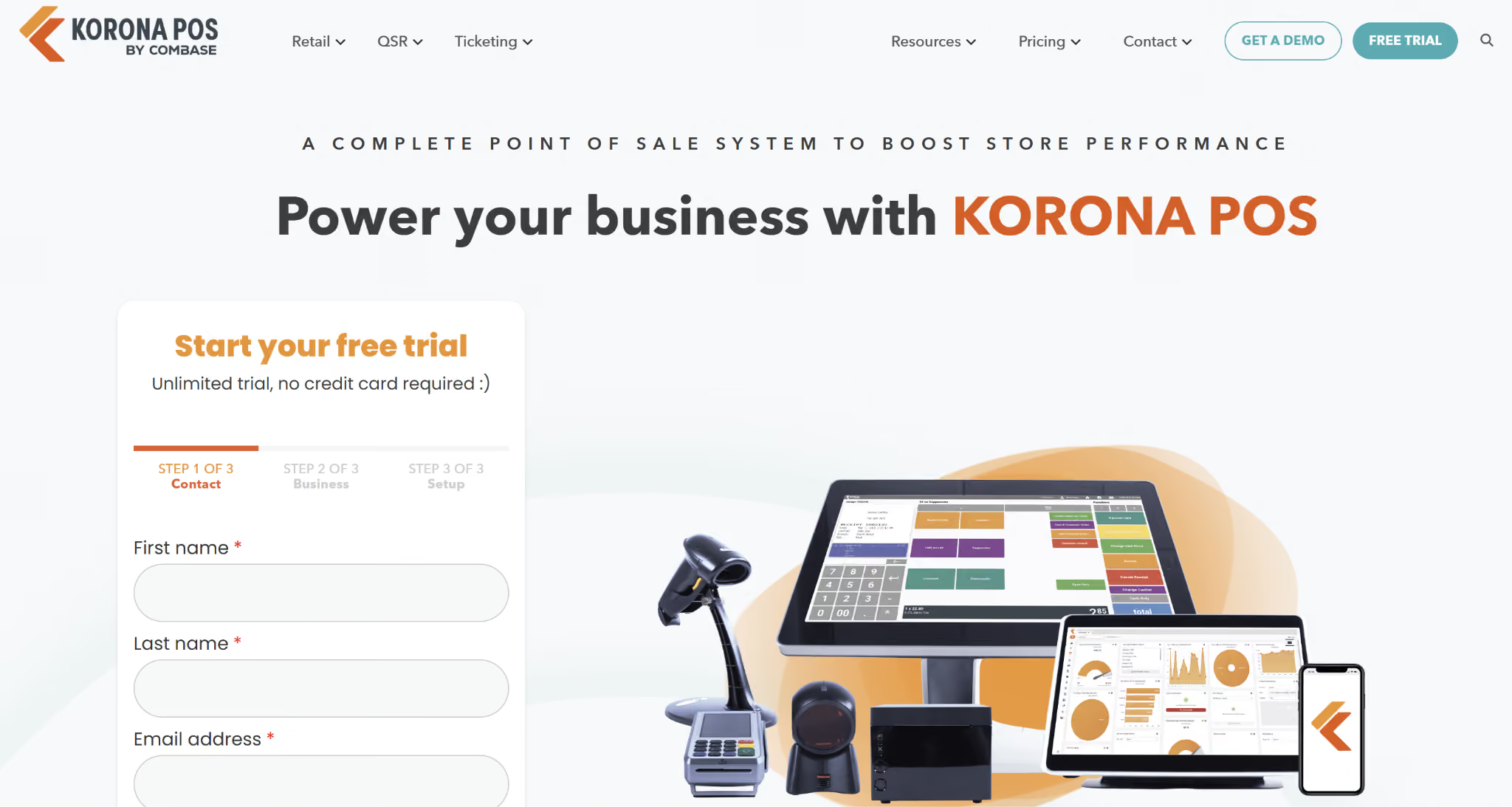
Before working with Scalerrs, Korona POS had been running SEO internally and had grown organic traffic to around 45,000 monthly visitors.
Challenge
Then a series of Google updates hit.
Traffic dropped to under 35,000. Leads dropped with it. And the team had no clear way to diagnose what broke because the site’s SEO had no structure.
Strategy
Scalerrs rebuilt the strategy around Korona’s highest-intent keywords.
The team identified 50+ “golden keywords” and mapped them to specific product pages, including retail POS system, liquor store POS, vape shop POS, franchise POS, and convenience store POS.
Then we used link building to power up those priority pages.
Instead of building links to random blog posts, Scalerrs placed backlinks from relevant, high-authority domains with targeted anchor text pointing to Korona’s product pages.
For example:
- “Liquor store POS” from Capsule
- “Retail POS system” from BrandCrowd
That mattered because Korona was competing against bigger POS brands like Square, Clover, Lightspeed, and Toast.
Those competitors had larger budgets and longer domain histories. So link authority helped close the gap around the pages Korona needed to rank.
Results
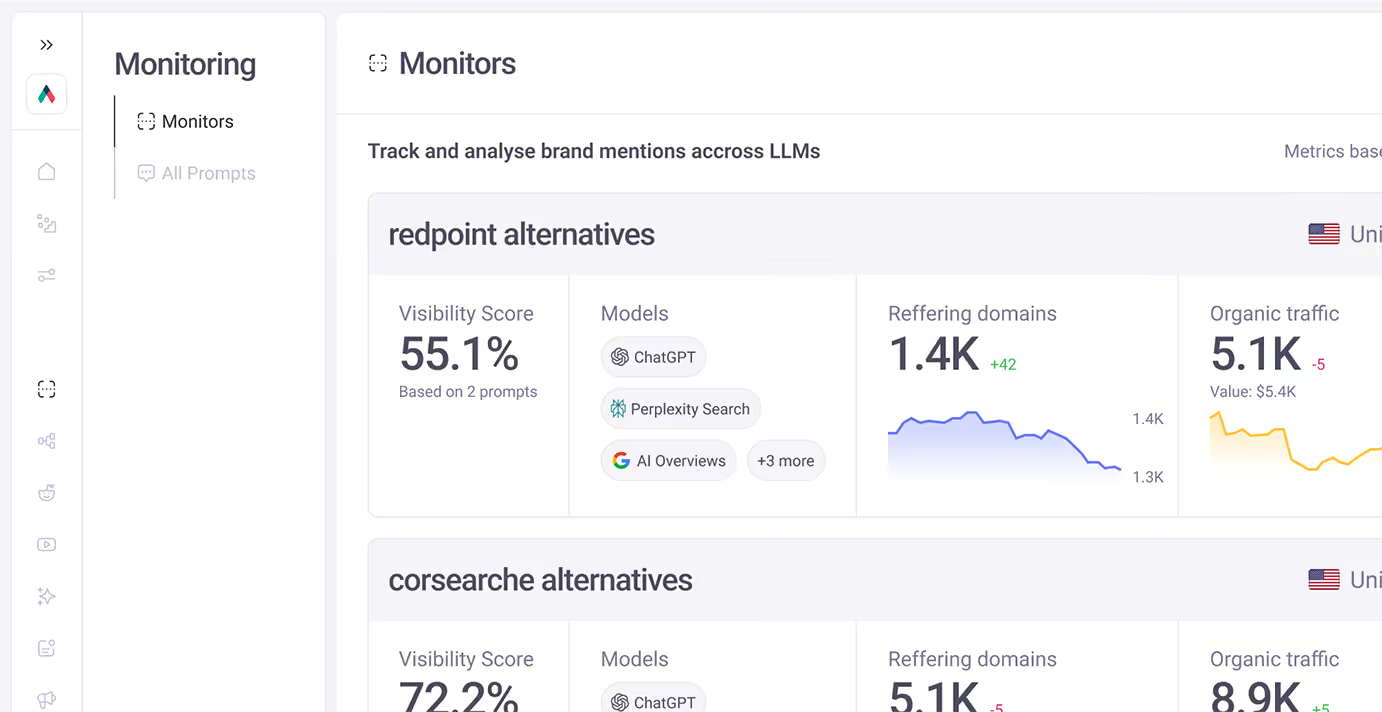
The standout result was not just traffic recovery. It was an ~8x bump in AI search visibility, which matters because B2B SaaS buyers are increasingly using AI tools to research vendors, compare products, and build shortlists before speaking to sales.
In four months, Korona POS:
- Reached #2 AI search visibility across the retail POS category, with 4,001 LLM mentions, up from 532.
- Surpassed its pre-update traffic high, moving from a drop under 35,000 monthly visitors to 50K+.
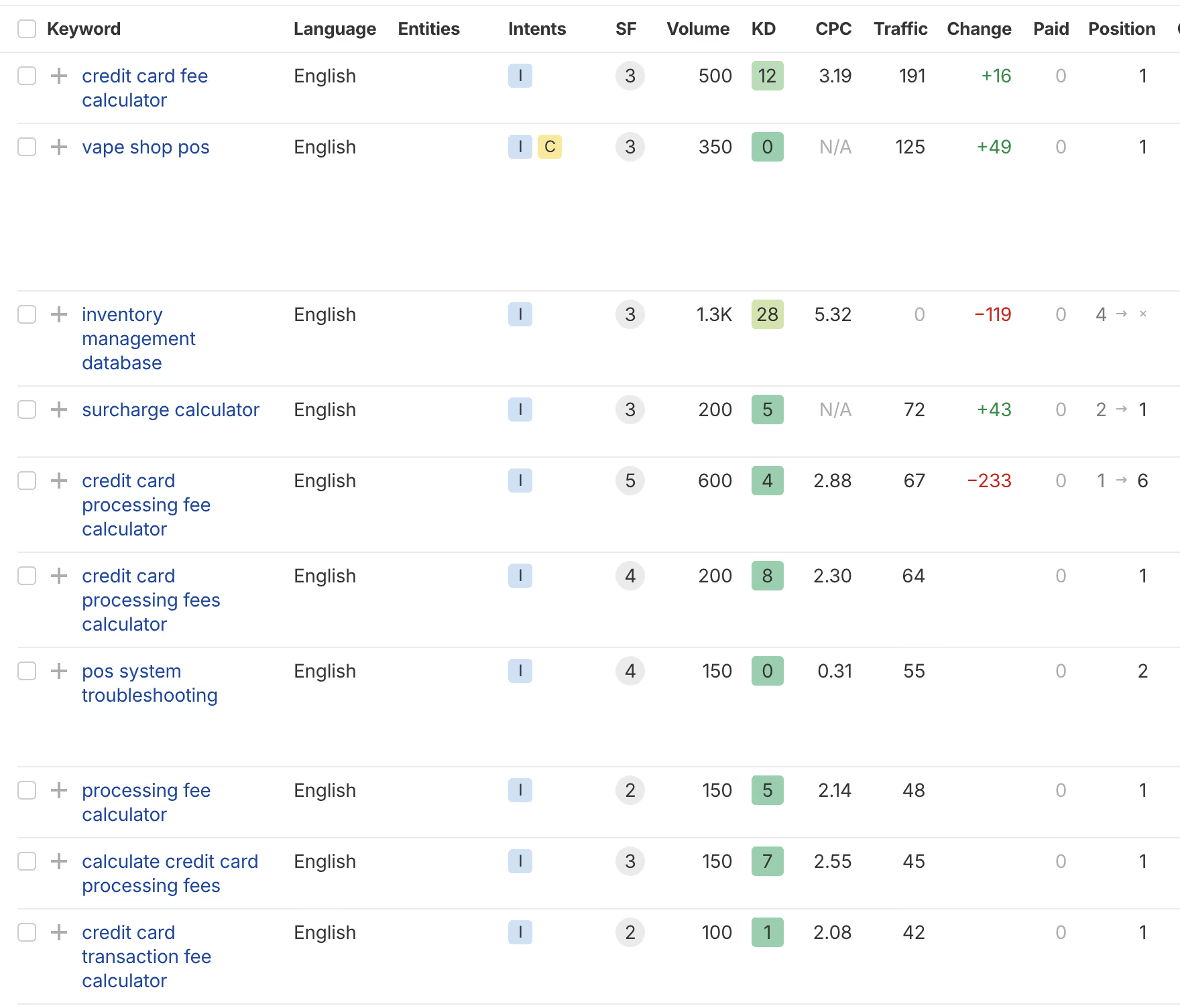
- Ranked #1 for non-branded keywords like “vape shop POS,” “credit card fee calculator,” and “pos system troubleshooting”.
- Ranked #1-2 across 50+ golden keywords, including “liquor store POS” and “retail POS system”.
- Increased monthly organic SQLs by 136%.
Key Takeaway
Link building was especially important in driving these results, and it worked because it supported Korona’s most important product and bottom-of-funnel pages, not because links were treated as a standalone metric.
That is the difference between “building backlinks” and using strategic link authority to help buyers find your product when they are actively comparing options.
Review more examples on our case studies page to see how link building assisted organic growth connects to pipeline outcomes across various SaaS companies in different industries.
{{cta-general="/cta/case-studies"}}
Key SaaS Link Building KPIs to Track
The best SaaS link building KPIs show whether backlinks are helping priority pages gain authority, rank for buyer-intent keywords, and drive qualified organic demand.
Track SEO metrics first. Download our SaaS SEO checklist to check whether your technical foundation, content strategy, UX, and authority-building work are ready to compound.
Then connect these four core link building KPIs to conversion and pipeline data.
KPI #1: Domain Rating and Domain Authority Growth
Domain Rating (DR) and Domain Authority (DA) are useful directional metrics for understanding whether your backlink profile is getting stronger.
Track them monthly, but read them alongside link quality.
A SaaS site gaining links from relevant software blogs, partner pages, and industry publications is in a stronger position than one gaining authority from broad, low-relevance placements.
The simplest way to make this useful is to track DR/DA movement beside:
- Number of new referring domains
- Average relevance of new links
- Priority pages receiving links
- Keyword movement on those pages
That gives your team a cleaner view of whether authority is growing in the areas that matter.
KPI #2: Referring Domain Growth
Referring domain growth shows whether more unique websites are linking to your SaaS site.
This is almost always more useful than counting total backlinks because 20 links from 20 relevant sites are more valuable than 50 links from the same domain.
Track referring domains by:
- Category relevance
- Estimated traffic
- Link target page
- Follow/nofollow status
- Anchor text
- ICP relevance
This helps you separate useful SaaS backlinks from low-quality placements that only inflate the monthly report.
Ultimately, a link from a niche SaaS publication, integration partner, or buyer-focused listicle deserves more attention than a generic link from a site your buyers would never read.
KPI #3: Organic Keyword Rankings for Target Pages
Keyword movement shows whether your link building is helping priority pages compete in search.
Track rankings at the page level, not only the site level.
For example, if you build links to an “X alternative” page, monitor whether that page improves for:
- “[Competitor] alternative”
- “[Competitor] vs [Your Brand]”
- “best [category] software”
- “[use case] software”
- “[industry] [category] tool”
The same logic applies to feature pages, integration pages, templates, and product-led guides.
This is where link building and content strategy meet. If a BOFU resource is stuck on page two for a buyer-intent keyword, targeted link building helps it gain the authority needed to move into a more visible position.
KPI #4: Organic Traffic and Qualified Conversions
Organic traffic shows whether linked pages are attracting more visitors. Qualified conversions show whether those visitors matter.
For SaaS teams, this usually means tracking:
- Demo requests
- Trial signups
- Contact form submissions
- Product-qualified leads
- Sales-qualified leads
- Pipeline influenced by organic sessions
Start by filtering organic traffic to the pages that received links. Then check whether those pages drove more conversions after the links went live.
This will not give you perfect attribution every time. And that is fine. The goal is to identify whether your link building is supporting the pages that create buyer momentum.
If backlinks improve rankings and traffic to a comparison page, and that page starts driving more demo requests, you have a stronger business case than “we built 12 links this month.”
FAQs
Is SaaS link building still important in 2026?
Yes. SaaS link building still matters because backlinks help strengthen domain authority, improve rankings, support buyer discovery, and increase visibility across third-party sources that buyers and AI tools use to evaluate software.
What makes SaaS link building different from regular link building?
SaaS link building is different because it supports longer B2B sales cycles, product-led pages, integration ecosystems, comparison content, and pipeline-focused metrics instead of only traffic or domain authority.
Which SaaS pages should I build backlinks to first?
Start with pages tied to revenue. Prioritize product pages, feature pages, integration pages, comparison pages, alternative pages, templates, tools, and original research before building links to generic blog content.
Should SaaS companies outsource link building?
Sometimes. Outsourcing SaaS link building to an agency makes sense when your internal team lacks the time, publisher relationships, outreach systems, or SaaS-specific expertise needed to build quality links consistently.
Do nofollow links matter for SaaS companies?
Yes. Nofollow links may not pass authority the same way as dofollow links, but they still support referral traffic, brand visibility, buyer trust, third-party credibility, and AI/search discovery.
Build a SaaS Link Building Engine That Drives Pipeline with Scalerrs
SaaS link building works when it is tied to the pages, topics, and third-party sources your buyers already trust.
That means going beyond isolated guest posts or generic outreach.
You need a system that connects content strategy, linkable assets, editorial relationships, partner ecosystems, AI visibility, and pipeline reporting.
Scalerrs helps B2B SaaS teams build that system.
As a SaaS SEO agency, we help software companies identify priority pages that deserve authority, create content worth linking to, earn relevant SaaS backlinks, and measure the business impact across rankings, qualified traffic, and pipeline.
We also support visibility beyond classic Google rankings, including third-party listicles, Reddit, YouTube, and AI-cited sources.
Need help building a SaaS link building engine that drives pipeline? Book a demo to learn how Scalerrs can help.
Book a Discovery Call
Turn Organic Search Into Your #1 SaaS Acquisition Channel.

Let us scale your SEO channel for you.
reviewed onClutch
4.9 rating








Get Free Resources In Your Inbox
Get all of our FUTURE playbooks such as Figma files, checklists and SOPs directly into your inbox.

.avif)