






Enterprise Content Marketing: 7 Steps to Pipeline in 2026


- Enterprise content marketing is how large B2B companies plan, govern, produce, distribute, and measure content across teams and channels.
- Programs stall when ownership fragments, volume replaces buyer intent, and reporting stops at channel metrics.
- A scalable enterprise content strategy starts with pipeline goals, buying-committee research, keyword and prompt research, governance, distribution, and measurement.
- The strongest programs tie visibility and engagement to qualified pipeline and ARR.
Operationally, content marketing gets harder as your company gets bigger.
Enterprise content marketing means more products, stakeholders, approval layers, and content requests that can increase output while slowing down decisions and weakening the link to pipeline.
A strong program gives you a system for prioritizing buyer intent, governing production, distributing content across search, AI, and communities, and reporting results to leadership.
This guide shows you how to build a strong enterprise content marketing strategy in seven steps, plus the production models, KPIs, and enterprise content marketing examples that make it work.
What Enterprise Content Marketing Is and How It Differs
Enterprise content marketing is the process large organizations use to plan, create, govern, distribute, and measure content across multiple teams, products, audiences, and channels. Its goal is to create a scalable content system that supports specific business outcomes such as pipeline, revenue, retention, and brand authority.
The core principles of content marketing stay the same as a company grows. The operating model does not.
Enterprise SaaS, in particular, adds another layer. Because B2B SaaS sales cycles can run for months, deals involve multiple personas, and product-led discovery may sit alongside sales-assisted enterprise buying. Content has to simultaneously educate users, satisfy technical evaluators, support sales, and help buyers justify the investment.
That is why an enterprise SaaS content strategy eventually has to connect organic visibility to pipeline and ARR (the numbers that actually matter).
Why Enterprise Content Programs Stall: 3 Challenges
Scale creates opportunities, but it also adds operational drag.
Content Marketing Institute’s enterprise research repeatedly points to the same underlying problems: coordination, measurement, buyer alignment, and governance get harder as more teams enter the system.
Challenge 1: Governance and Fragmented Ownership Slow Everything Down
Enterprise content slows down when ownership is split across teams.
Marketing may own the editorial calendar, SEO owns organic opportunities, product marketing owns positioning, product owns feature accuracy, legal owns risk, and the web team owns publishing.
Add regional teams and subject matter experts, and a simple page can become a six-week approval process.
CMI’s 2025 enterprise research reflects the same friction. Communication across organizational silos and workflow or approval problems were among the most common challenges enterprise content teams reported. Nearly 50% of enterprise marketers say they do not have a scalable model for content creation.
The fix is governance before production. Define:
- Who owns the content strategy
- Who can request content
- Who decides priority
- Which stakeholders approve which content types
- What can publish without executive review
- Which topics require legal, product, or compliance sign-off
A governance system should reduce unnecessary reviews while preserving the reviews that genuinely protect the business.
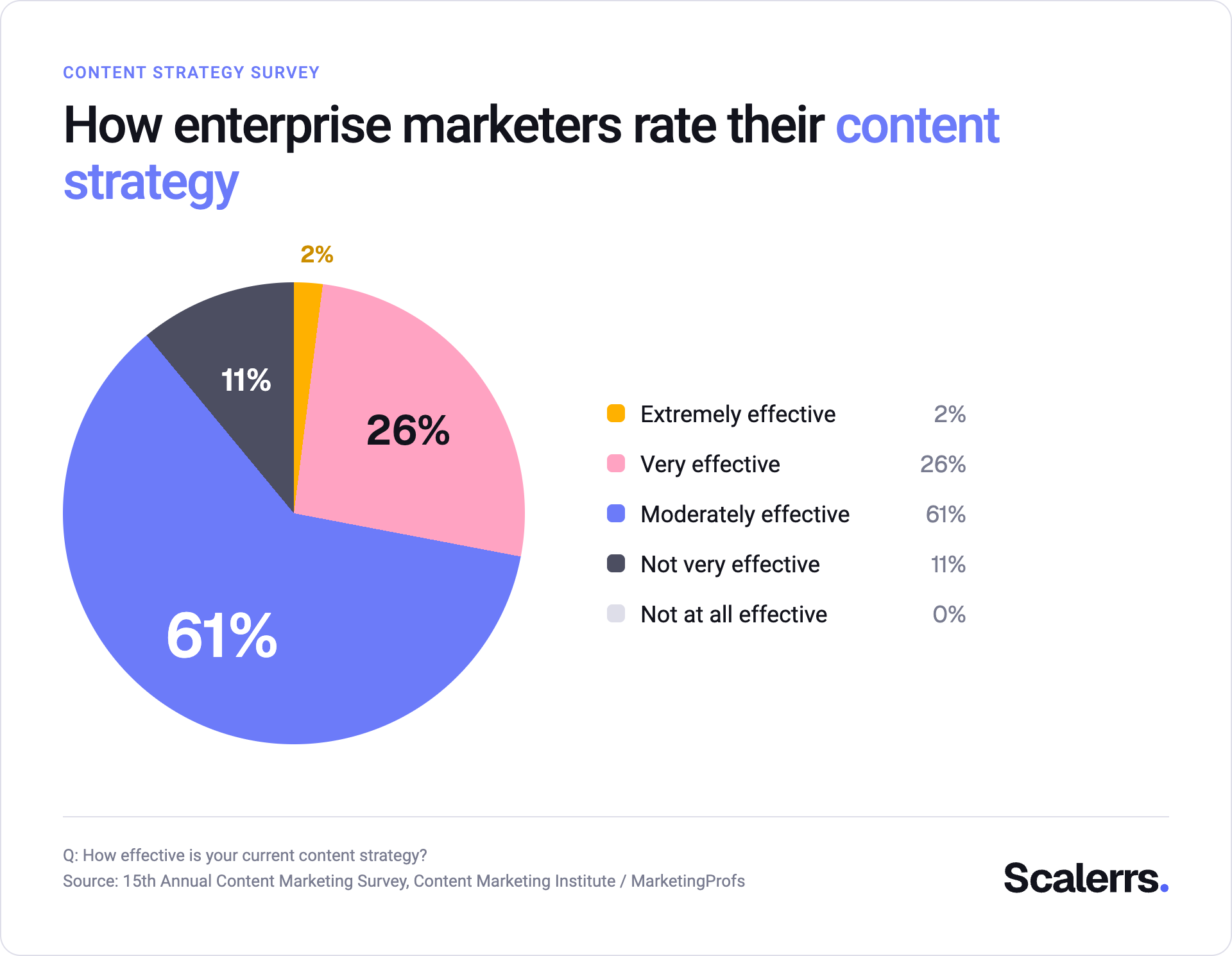
Challenge 2: Content Volume Starts Replacing Buyer Intent
Large companies rarely run out of ideas for content.
Sales wants enablement. Product wants GTM support. Leadership wants, well, thought leadership. SEO has a keyword backlog. Regional teams would appreciate localized campaigns. Someone has always requested another article.
The problem starts when internal demand becomes the prioritization system.
After all, content volume is easy to report. Ten articles shipped. Four webinars launched. Twelve customer stories published.
Tying it all to commercial relevance? Now that’s the hard part. A better enterprise program asks before production:
- Which ICP does this serve?
- Which buying-stage question does it answer?
- Is there evidence the audience wants it?
- What commercial page, campaign, opportunity, or sales conversation does it support?
- What happens if we do not create it?
The solution is to prioritize content by buyer intent and business value before assigning production capacity. A regular content audit also helps you identify where your company is maintaining or producing assets that no longer deserve investment.
Challenge 3: Measurement and Distribution Miss the Real Buyer Journey
We’ve seen this so many times: enterprise reporting treats each channel as a separate system.
- Organic search focuses on rankings and clicks
- Social focuses on likes and comments
- Email focuses on open and click-through rates
- Gated content focuses on downloads
The buyer experiences none of those boundaries.
A software buyer might discover a problem through Google, ask ChatGPT for vendors, go down a Reddit rabbit hole, read a comparison page on your competitor’s website, visit your website, forward a case study internally, and finally convert through a branded search weeks later.
First-click attribution credits the beginning. Last-click attribution credits the end. Neither explains the journey particularly well.
Measurement is still a major enterprise problem. The same 2025 CMI research identifies measuring content results and aligning content with the buyer journey as common challenges for enterprise teams.
The fix has two parts:
- Expand distribution beyond the company blog into the channels buyers use for evaluation.
- Combine attribution methods, including CRM touchpoints, multi-touch reporting, account engagement, and self-reported discovery.
The final reporting line should eventually answer: Did content influence qualified pipeline and ARR?
How to Build an Enterprise Content Marketing Strategy in 7 Steps
Enterprise content needs a repeatable operating system. Each step below produces an artifact your team can actually use, from the initial goal document through to the reporting dashboard.
Step 1: Set Content Goals That Tie to Pipeline
Start by deciding what content is expected to do for the business.
Avoid goals such as:
Publish 20 articles per month.
That, in reality, is an output target, not a SMART (Specific, Measurable, Achievable, Relevant, and Time-Bound) goal.
A much more practical enterprise goal is closer to:
Increase qualified non-branded pipeline from enterprise security buyers by 25% over the next 12 months.
Your qualitative goals might include:
- Generate enterprise demos
- Increase product-qualified signups
- Influence target-account opportunities
- Support expansion into a new segment
- Improve win rates with stronger enablement
- Grow non-branded organic pipeline
- Increase visibility for high-value AI prompts
Then define the leading and lagging indicators that support each goal.
Traffic and rankings can remain useful diagnostics, but they should sit underneath the business outcome.
Artifact: Goal document
Create a one-page document with the business objective, target audience, content objective, primary KPI, supporting metrics, timeframe, and owner.
Step 2: Map Your ICP and Buying Committee
Enterprise content rarely targets one reader. A single SaaS deal might involve:
- Day-to-day users
- A functional champion
- Technical evaluators
- Security or IT
- Procurement
- Finance
- An economic buyer
Each person enters the buying process with different questions. And so, your ICP map should document:
- Company characteristics
- Buying triggers
- Pain points
- Existing alternatives
- Decision criteria
- Common objections
- Required integrations
- Security or compliance concerns
- Who influences the purchase
- Who can block it
Then map content to the committee.
A technical evaluator may need architecture and security documentation. A champion may need comparison or use-case content. An executive decision maker may care about ROI, implementation risk, and customer evidence.
Artifact: ICP and buying committee sheet
This becomes the reference point for research, briefs, distribution, and measurement.
Step 3: Research Keywords, Buyer Questions, and AI Prompts by Intent
Build one research universe around how buyers ask questions across both search engines and AI tools.
Traditional keyword research still identifies valuable demand in Google. Prompt research adds questions such as:
- “What are the best tools for [use case]?”
- “[Product A] vs. [Product B] for an enterprise team”
- “Which platform integrates with [technology]?”
- “Best [category] software for companies with [constraint]”
- “Alternatives to [competitor] for [specific ICP]”
Group keywords and prompts by commercial intent:
- Category discovery
- Problems/jobs to be done
- Use cases
- Comparisons
- Alternatives
- Integrations
- Pricing
- Implementation
- Security and compliance
Then prioritize them against ICP fit, buying stage, business value, and the company’s realistic ability to compete.
At Scalerrs, we increasingly run keyword and prompt research together for SaaS clients because the same buyer question may now appear in Google, ChatGPT, Perplexity, Reddit, or a third-party comparison page.
Artifact: Prioritized keyword and prompt list
We’ll also link the downloadable keyword and prompt research template after the seven-step framework.
Step 4: Build a Governance and Content Request Tiering System
Create rules for what gets produced, who approves it, and how much process each asset deserves.
Every content request should not travel through the same workflow.
For example:
Score incoming requests against criteria such as:
- Pipeline potential
- ICP relevance
- Strategic importance
- Search/prompt demand
- Sales usefulness
- Existing content gaps
- Effort required
- Regulatory or reputational risk
Artifact: Tiering rubric
This gives teams a defensible reason to say no, later, or this quarter.
Step 5: Choose the Right Production Model and Capacity
Now decide who will actually produce the roadmap. Enterprise teams can use:
- Internal writers and strategists
- Product marketers
- Subject matter experts
- Freelancers
- Specialist agencies
- Designers and video teams
- A hybrid of several models
Keep the most strategically sensitive work close to the people with the deepest context.
Repeatable or specialist execution can often move to external partners if the strategy, positioning, standards, and review process are established clearly.
Also plan capacity realistically.
If legal review takes five working days and every article needs two SMEs, a roadmap built around 30 monthly pieces is fictional before production even starts.
Document expected volume by content tier, owners, reviewers, dependencies, turnaround times, and bottlenecks.
Artifact: Production plan
We will compare in-house teams, agencies, freelancers, and hybrid setups in more detail later in this guide.
Step 6: Distribute Content Across the Surfaces Buyers Actually Use
Publishing is just the first step in distribution, not the finish line.
Map each important topic to the surfaces where your target buying committee researches it, which can include:
- Google Search
- ChatGPT and other AI answers
- Third-party comparison listicles
- Review platforms
- Email and newsletters
- Sales enablement
- Webinars and events
A comparison page may support Google and AI-search visibility, feed a sales follow-up, and give an SME material for a Reddit or LinkedIn discussion.
A research report might become an article, webinar, executive deck, sales asset, video, and source for third-party citations.
The idea is to reuse with intent, rather than copying the same asset into every channel.
Artifact: Distribution map
Step 7: Measure Performance and Feed the Data Back Into Strategy
Build the reporting system before the quarterly review. Your dashboard should ideally connect three levels of performance:
Visibility
- Rankings
- Non-branded clicks
- AI visibility
- Third-party mentions
Buyer action
- Demo requests
- Trial signups
- High-intent page engagement
- Target-account activity
Business impact
- Opportunities sourced
- Pipeline influenced
- Closed-won revenue
- ARR influenced
Then use the data to decide what happens next.
If comparison pages influence more opportunities than broad educational articles, give them more production capacity.
If a topic ranks but never appears in pipeline, review whether the intent is commercially relevant.
If buyers repeatedly discover the company through AI or community sources, strengthen those distribution surfaces.
Artifact: Performance dashboard
The feedback loop is what turns an editorial calendar into an enterprise content system.
Enterprise Content Marketing in the AI Search Era
Enterprise content now has to work across two discovery systems: traditional search and AI-generated answers.
Semrush’s 2026 AI Visibility Index analyzed 126 million US prompts and found that brand discovery across major AI search experiences is shaped by a mix of owned content, publishers, communities, reference platforms, and other third-party sources.
Profound reached a similar conclusion from 11.84 billion AI citations across eight models and 29 industries. Company-operated websites remain an important source category, but editorial and community sources also influence what models retrieve.
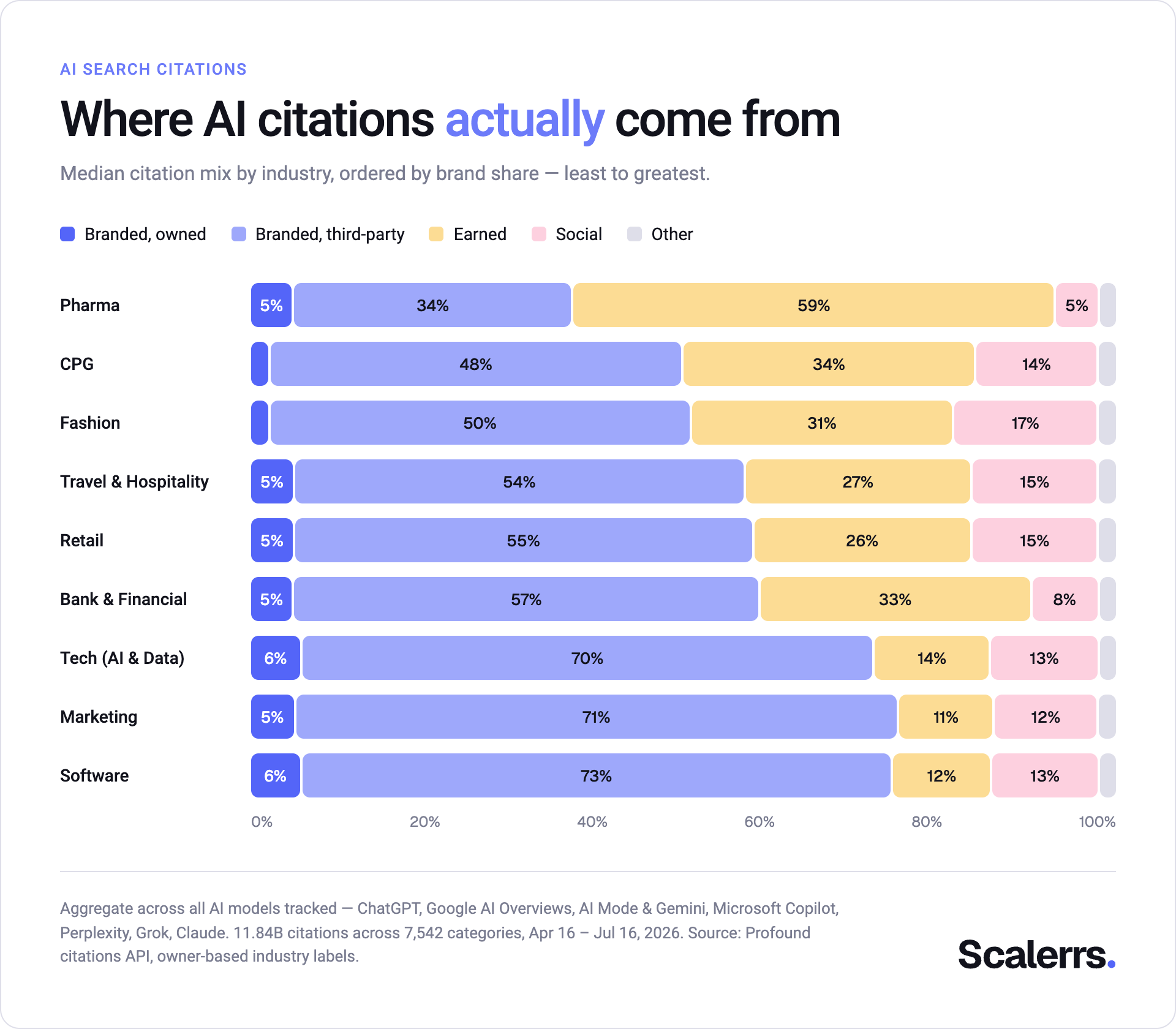
For your team, that creates three practical shifts:
- Write important passages answer-first. Definitions, comparisons, product claims, integrations, and implementation questions should make sense when retrieved outside the full page.
- Build visibility beyond your domain. Reddit, relevant third-party listicles, review sites, industry publications, and other cited sources can shape how AI tools describe your category.
- Prioritize commercial content. Comparison, alternative, integration, use-case, pricing, and category pages give buyers and AI tools concrete material for vendor-evaluation questions.
This approach has already proven to be effective for our clients.
{{cta-general="/cta/book-a-demo"}}
Governance and Production Models: In House, Agency, Freelancers or Hybrid
There is no universally best enterprise content production model. The right setup depends on how much strategic context, specialist expertise, control, and production capacity you already have.
Our take: a tiered model usually works better than routing every asset through the same team.
Keep flagship research, positioning, and high-risk thought leadership close to internal leadership and SMEs. Route repeatable production, specialist SEO/AEO work, refreshes, or derivatives to external partners where they add capacity along with expertise.
Agencies also have limits. If you have no internal owner, unreliable analytics, unclear positioning, or expect content to generate closed-won revenue within weeks, fixing those issues comes first.
For deeper tradeoffs, compare the in-house vs. agency model, and check out how other agencies compare against. Scalerrs, and freelancer fare vs. Scalerrs.
Measuring Enterprise Content: KPIs That Reach Pipeline
Your enterprise reporting should move from visibility metrics toward the commercial outcomes leadership funds.
First- and last-click attribution are useful views, but enterprise buying journeys almost never happen in one touch. Combine them with multi-touch CRM data and self-reported attribution to see which content repeatedly appears in real opportunities.
Doing so also helps prove the value of all content marketing efforts to leadership by tying content to pipeline.
For instance, Default’s Head of Growth Stan Rymkiewicz confidently says “about 30% of our pipeline comes from AEO/SEO and AI search. In the last month we got over $300K in pipeline just from AEO/SEO for really no additional work."
Likewise, at Marq, inbound SEO and AI search now drive 50% of total pipeline, while inbound pipeline increased 20% year over year. Steven Loewy, VP of Marketing at Marq, says inbound is the company’s largest pipeline channel and accounts for half of total pipeline.
Those numbers convey much more weight to leadership than a mere “organic traffic increased 20%.”
{{cta-general="/cta/content-creation"}}
Enterprise Content Marketing Examples
The examples below show three ways you can solve enterprise content problems: sharpen commercial intent, expand distribution, or build a scalable hybrid production model.
Example 1: Innoloft Prioritized Bottom-of-Funnel Intent
Innoloft had content and technical SEO in place, but it was ranking mainly for low-traffic terms with little traction on queries closer to a buying decision.
Our program refocused their content around high-intent keywords for Innoloft’s ICPs, including NGOs, educational institutions, and public-sector organizations.
Example 2: Korona POS Distributed Content Across Buyer Surfaces
Korona POS had grown organic traffic internally before Google updates pushed monthly traffic below 35,000 and leads declined.
The rebuilt program mapped 50+ high-intent “golden keywords” to specific commercial pages, refreshed and expanded the content library, then coordinated SEO with AEO, Reddit, and off-site authority building.
Example 3: ServiceNow Built a Hybrid Enterprise Content Operation
A CMI case study published in 2023 shows how ServiceNow built a hybrid enterprise content operation around its Workflow publication.
The publication was built around product-agnostic thought leadership for increasingly senior enterprise buyers. The internal global brand team eventually grew to 15 people while agencies supported journalism, design, and research.
Over six years, Workflow reached 1.5 million unique visitors and 2 million pageviews, while average time on site approached six minutes, up 71% year over year. ServiceNow also found Workflow readers were more likely to visit its corporate site and take deeper brand actions than non-readers.
The lesson: Hybrid production can work at enterprise scale when internal teams own strategy and external specialists have clearly defined roles.
FAQs
1. How Long Does Enterprise Content Marketing Take to Show Results?
It depends. Enterprise SaaS sales cycles can run for months, so ranking or engagement gains may appear before influenced pipeline or closed-won revenue. Track leading indicators early, but judge the program against qualified conversions, opportunities, and ARR over a timeframe that reflects your actual buying cycle.
2. Who Should Own Enterprise Content Marketing?
It depends. The job title matters less than having one accountable internal owner for strategy, prioritization, governance, and measurement. Other teams can request, review, or contribute content, but ownership needs to be clear enough that decisions do not stall across marketing, product, legal, sales, and web teams.
3. How Much Content Should an Enterprise Publish Each Month?
It depends. There is no useful universal quota. Set production volume based on buyer intent, pipeline priorities, review capacity, SME availability, and the time each content tier needs to move through approval. Publishing 30 pieces a month is a poor target if your team can only review 10 well.