


SaaS Marketing Budget: Benchmarks, Allocation & Examples

Key Takeaways
- The median B2B SaaS company spends 8% of ARR on marketing, according to SaaS Capital's 2026 survey of 1,000+ private companies. Gartner puts the cross-industry average at 7.7% of revenue.
- That 8% is a benchmark, not a target. Your growth rate, sales motion, funding, CAC, ACV, and unit economics should determine what you actually spend.
- The better way to set your budget is to work backward from the revenue target: new ARR → customers → pipeline → marketing contribution → budget.
How Much Should a SaaS Company Spend on Marketing?
Your SaaS marketing budget is the strategic bet you make on how buyers find you. Get it wrong and you either underspend into invisibility or overspend into a payback no CFO signs off on twice.
We’ve seen early-stage SaaS routinely spend 15-25%+ of ARR chasing PMF. Mature SaaS often settles at 5-7%.
Gartner gives us another useful reference point, although its dataset covers companies across industries and skews heavily toward large enterprises. Its 2025 CMO Spend Survey found marketing budgets at 7.7% of overall company revenue, with 59% of CMOs saying they did not have enough budget to execute their strategy.
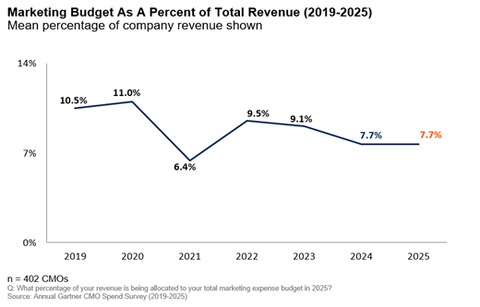
Here’s a quick look at various benchmarks:
The trap is thinking that a single percentage holds true for everyone. And mixing marketing-only benchmarks with sales and marketing benchmarks.
A product-led company may need more marketing because marketing carries more of the acquisition load. Growth rate can matter too, as can your funding model.
A bootstrapped $5M ARR SaaS at 5% ($250K) doesn’t share its economic reality with a Series B $5M ARR SaaS spending 40% ($2M) to chase a growth mandate.
That distinction matters when you're building your own budget.
What Should Determine Your SaaS Marketing Budget?
Your budget should reflect what you need marketing to accomplish, not what another SaaS company happens to spend. Five variables matter most: growth target, stage, go-to-market motion, unit economics, and how much demand you already have.
Variable #1: Your Growth Target
Start with the outcome.
🎯 If you're targeting modest growth, your budget may need to maintain existing demand rather than create a new acquisition engine.
🎯 If you're trying to grow ARR aggressively, marketing needs enough capital to create the pipeline required to support that target.
Benchmarkit's 2025 data backs this up. Companies planning for faster growth allocated more of their revenue to marketing than slower-growing companies.
But don't treat that relationship as proof that spending more automatically creates growth.
We'd rather ask: How much pipeline does your growth target require, and what portion should marketing create? That question gets you much closer to a defensible number.
Variable #2: Your Company Stage and Funding Source
Wondering how much should a startup spend on marketing?
Your SaaS startup marketing budget changes as the business moves from learning to scaling.
🎯 Before product-market fit, you're paying to learn. You may need research, positioning, content experiments, paid tests, customer interviews, and enough distribution to find a repeatable acquisition channel.
🎯 After product-market fit, the job changes. You're putting more money behind channels that have already shown they can create customers.
Funding changes the equation, too. SaaS Capital's 2026 research shows a large difference in operating spend between bootstrapped and equity-backed companies, with equity-backed businesses spending more aggressively overall.
Variable #3: Your GTM Motion
PLG, sales-led, hybrid, and founder-led SaaS businesses don't need the same marketing budget.
Why the gap?
🎯 In a PLG model, marketing can carry more of the acquisition and activation workload. Product education, lifecycle campaigns, content, paid acquisition, community, and organic search may all play a larger role.
🎯 In enterprise sales, a smaller marketing percentage can still support a large revenue engine because each deal may be worth far more.
Your B2B SaaS marketing budget should therefore reflect how customers buy, not just how much revenue you have.
Variable #4: Unit Economics
A budget can look reasonable on paper and still be unaffordable.
Your CAC payback tells you how long it takes to recover the cost of acquiring a customer.
The 2026 Aleph × Benchmarkit SaaS & AI Performance Benchmarks, based on full-year 2025 actuals from 342 SaaS and AI-native software companies, put median CAC payback at 16 months. Among the 198 companies that reported CAC payback, the top quartile recovered acquisition costs in six months or less, while the bottom quartile took 24 months or more.
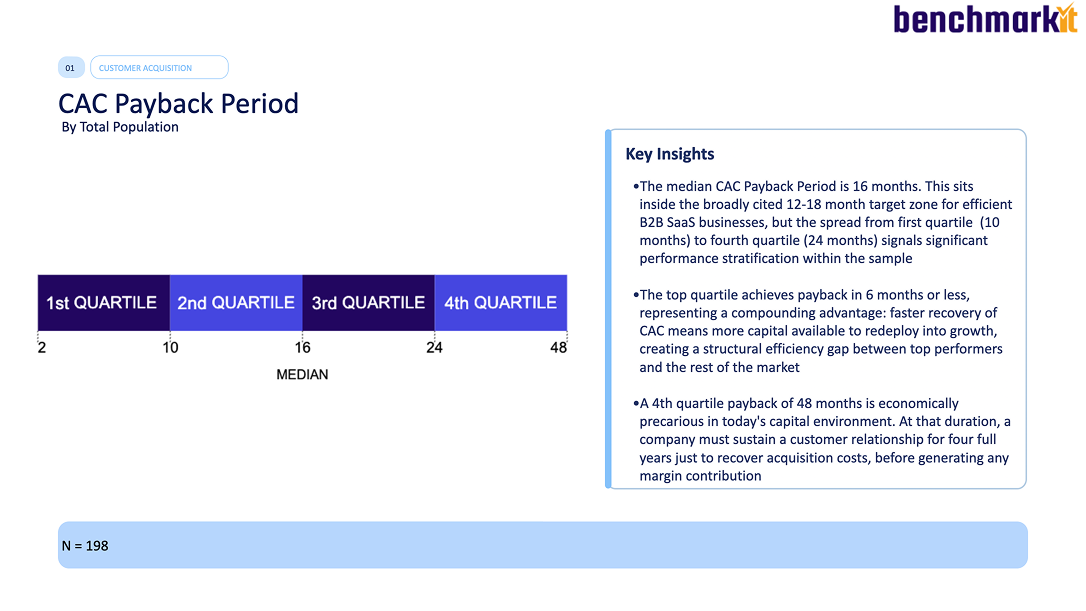
That gives you a useful guardrail.
If adding another $100,000 to marketing pushes your acquisition economics beyond what the business can comfortably fund, more spend isn't the answer. You may need a better channel mix, stronger conversion rates, higher ACV, or better retention first.
Variable #5: Your Existing Demand Engine
Your budget also depends on what is already working.
A SaaS company with strong organic traffic, a known category, an active customer base, and steady referral demand can spend differently from a company starting with zero brand awareness.
This is where channels such as SEO and content become interesting. They can take longer to build than paid acquisition, but the resulting demand can continue working after the original spend.
We saw this with our SaaS client, Reporting Ninja, for whom organic traffic grew from 4.2K to 12K monthly visitors, while traffic value increased from $19K to $50K per month in a span of six months. Non-branded clicks also rose 44% over three months, showing net-new buyers were finding Reporting Ninja through category searches, not just people already familiar with the brand.
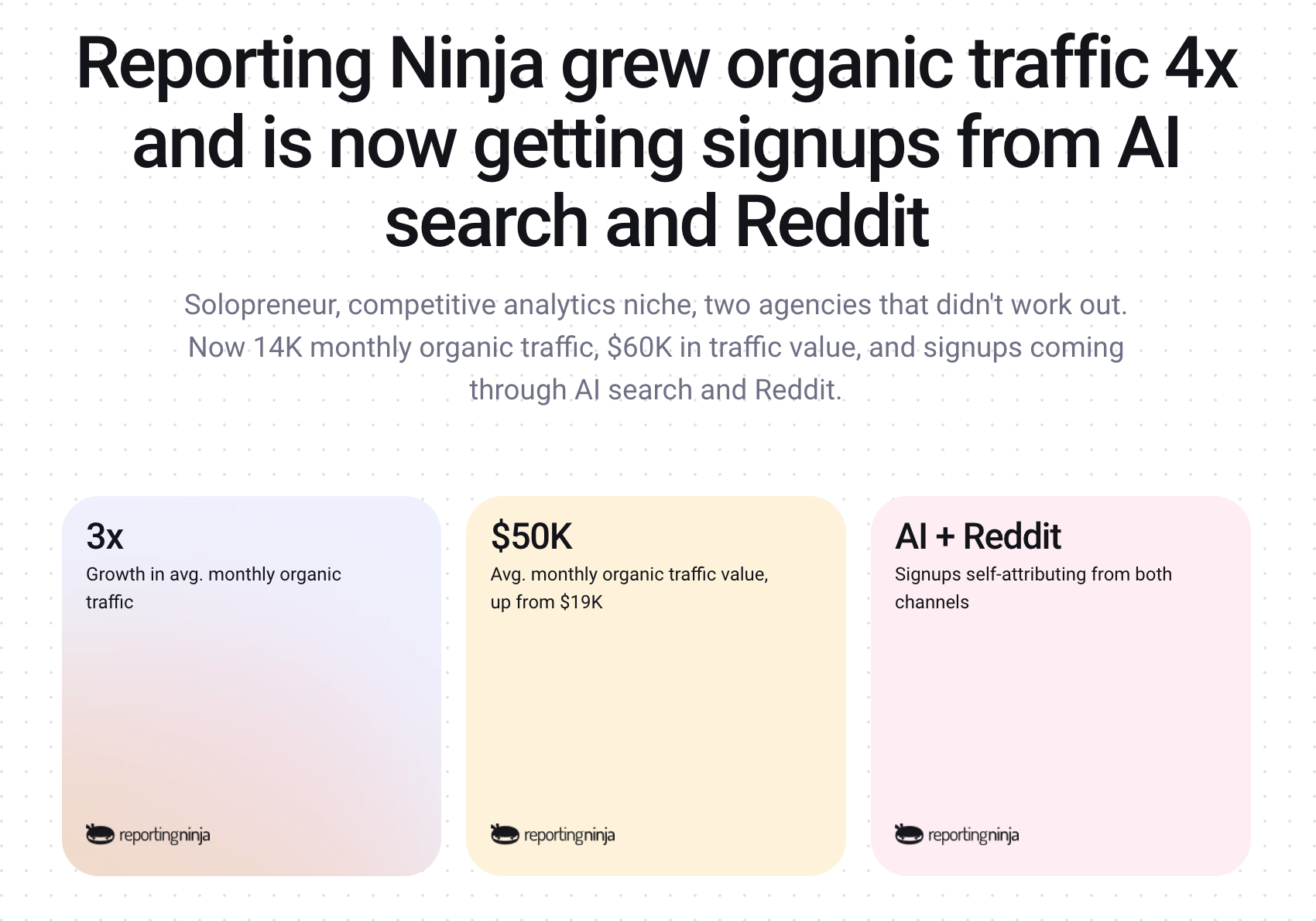
The content engine tripled avg. monthly organic traffic from ~4.2K in November 2025 to ~12K by March 2026, and pushed organic traffic value from ~$19K to ~$50K per month over the same period.
That’s also why we'd look at your existing demand before deciding how much to put into a new channel:
- Where are qualified leads coming from today?
- Which channels influence pipeline?
- Which channels create customers at an acceptable CAC?
- Where are competitors winning demand that you currently miss?
- Which channels can compound over time?
How to Calculate a SaaS Marketing Budget From Your Growth Target
The cleanest approach is to build your budget backward from the revenue you need to create. The basic model is:
Revenue target → Required new ARR → Customers required → Pipeline required → Marketing contribution → Budget
Here's how to put numbers behind it.
Step #1: Set Your ARR Growth Target
Start with the number leadership has agreed on. If ARR today is $10M and target is $15M by year-end, growth target is $5M in new ARR.
Check two things here:
- First, does it account for gross churn? If you churn 10% annually, you need $6M in bookings to net $5M
- Second, does it account for expansion revenue? Median private B2B SaaS NRR sits around 101-106% in 2025 as per SaaS Capital.
Step #2: Calculate How Many Customers You Need
Divide net-new ARR target by average ACV.
$5M in new ARR at $25K ACV means 200 new customers.
Don’t use blended ACV if you serve multiple segments. Enterprise ACV commonly runs 5-10x SMB ACV, and mixing them produces a customer count that maps to no real segment.
Build the calculation by segment, then roll up.
Step #3: Calculate Pipeline Required
Multiply customers required by your inverse win rate.
If your qualified pipeline converts to closed-won revenue at 20%, generating $2M in new ARR requires $10M in qualified pipeline.
$2M ÷ 20% = $10M pipeline
Also factor in MQL-to-SQL conversion. Don’t assume every SQL closes inside the fiscal year: enterprise cycles run 3-9 months, so most Q4 closed pipeline needs to be sourced by Q2.
Step #4: Determine Marketing's Contribution to Pipeline
Marketing doesn't need to own 100% of pipeline in every SaaS business.
Your contribution might come from organic search, paid acquisition, events, partner referrals, lifecycle campaigns, community, product-led acquisition, or brand demand.
Decide what percentage of pipeline marketing owns versus what’s sales-sourced.
- Product-led SaaS often runs marketing at 60-80% of pipeline
- Enterprise SaaS with heavy outbound often runs 30-50% as marketing-sourced.
If marketing owns 50% of a $5M target, marketing must source $2.5M in net-new ARR. Every channel rolls up to that number. Any channel that can’t map to sourced pipeline needs a very good reason to exist.
{{cta-general="/cta/case-studies"}}
Step #5: Back-Solve Budget from CAC and Payback
Multiply customer count by blended CAC, then split between sales and marketing based on your model.
200 customers at $10K CAC = a $2M envelope.
At a 60/40 marketing/sales split, marketing gets $1.2M in budget.
Sanity-check against ARR percentage: $1.2M on $10M current ARR is 12%, defensible for a $10M ARR company growing 50%.
This is also where you should separate proven spend from experimental spend.
Keep funding channels that reliably contribute to pipeline. Reserve a defined portion for testing new opportunities. And give every experiment a success metric before you spend the money.
For a SaaS team, that's the number we'd take into the budget meeting.
SaaS Marketing Budget Allocation by Channel
Once you know the total budget, the harder question starts: where should the money go?
There is no universal SaaS channel split. A PLG company with a $5K ACV should not budget like an enterprise SaaS company selling $100K contracts. Your ICP, sales cycle, existing demand, and growth target should shape the mix.
Benchmarker found that high-performing companies allocated their marketing budgets almost evenly between brand and demand. Companies that missed their growth targets leaned much harder toward demand generation, 65-70% of the allocation.
Omar Akhtar, founder of Benchmarker, explained the finding on the Tech Marketing Rewired podcast:
"Brand is the foundation upon which demand generation succeeds."
That doesn't mean you should suddenly move half your budget into brand campaigns.
It means your budget needs to create demand and make that demand easier to capture.
That’s why our starting framework is to divide spend across demand capture, demand creation, retention, and experimentation, then adjust the percentages based on what your business already knows works.
Here’s the typical split we see:
These are planning ranges, not industry benchmarks. Your actual mix should be built from your growth model and historical channel performance.
Channel #1: Paid acquisition (Google Ads, LinkedIn, Meta)
Paid acquisition is often the easiest channel to scale and the easiest place to burn money.
Google Ads can capture buyers already searching for a solution. LinkedIn can put an offer in front of a defined account or job function. Retargeting can bring previous visitors back into the buying journey.
But paid media has a hard ceiling. Stop spending money and the traffic stops flowing to you. That makes it useful for demand capture, especially when you have proven conversion economics, but dangerous as the entire acquisition engine.
Don't judge paid acquisition on clicks or even leads alone.
Your paid budget should answer three questions:
- Which searches or audiences have already shown buying intent?
- What does a qualified opportunity cost by channel?
- Does the resulting CAC fit your payback target?
Channel #2: SEO, content, and organic search
SEO and content deserve a larger share when your category has meaningful search demand, your buyers research before talking to sales, and you have enough runway to wait for organic channels to mature.
Don't allocate $100,000 to "content" and then measure success by the number of articles published.
Allocate it across work that can create commercial demand:
- BOFU comparison and alternative pages
- Product-led use-case content
- Original research and benchmark reports
- Customer stories
- Technical content for high-intent searches
- Digital PR and link acquisition
- Content distribution across Reddit, YouTube, and other surfaces
For our SaaS SEO clients, we typically split spend across bottom-of-funnel comparison content (30-40%), category authority content (25-30%), technical SEO and product-page optimization (15-20%), and link building (15-20%).
This is a proven SEO playbook for B2B SaaS companies with a 12+ month time horizon and product-market fit.
{{cta-general="/cta/book-a-discovery-call-general-catch-all"}}
Channel #3: AEO and AI Search
In addition to SEO fundamentals, AEO now deserves a line item inside your search budget rather than being treated as a side project.
Forrester's Buyers' Journey Survey 2025 of nearly 18,000 buyers found 94% now use AI during purchase. Twice as many named AI their most meaningful research channel over any alternative, ahead of vendor websites, product experts, and sales.
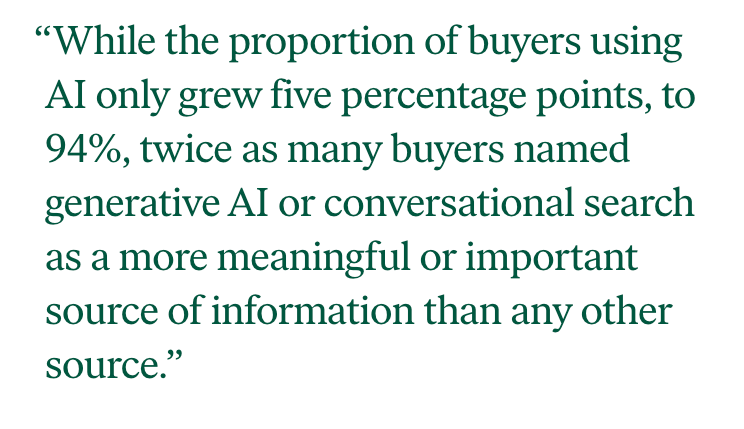
If your brand is not cited when ChatGPT, Perplexity, and Claude generate answers for your category, you are invisible during the most influential phase of the journey.
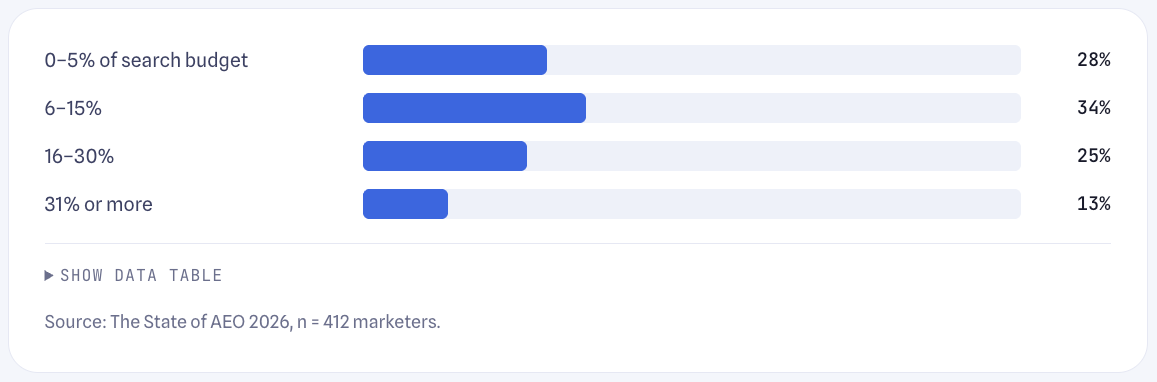
The 2026 State of AEO report from AEO Canon surveyed 412 marketers and found that teams allocated a median 15% of their search budget to AEO, up from 6% in 2025. It also found that 48% of respondents reported fewer organic clicks because of AI search, while 29% said AI referrals were bringing higher-quality traffic.
We’ve seen similar trends among our 45+ SaaS clients.
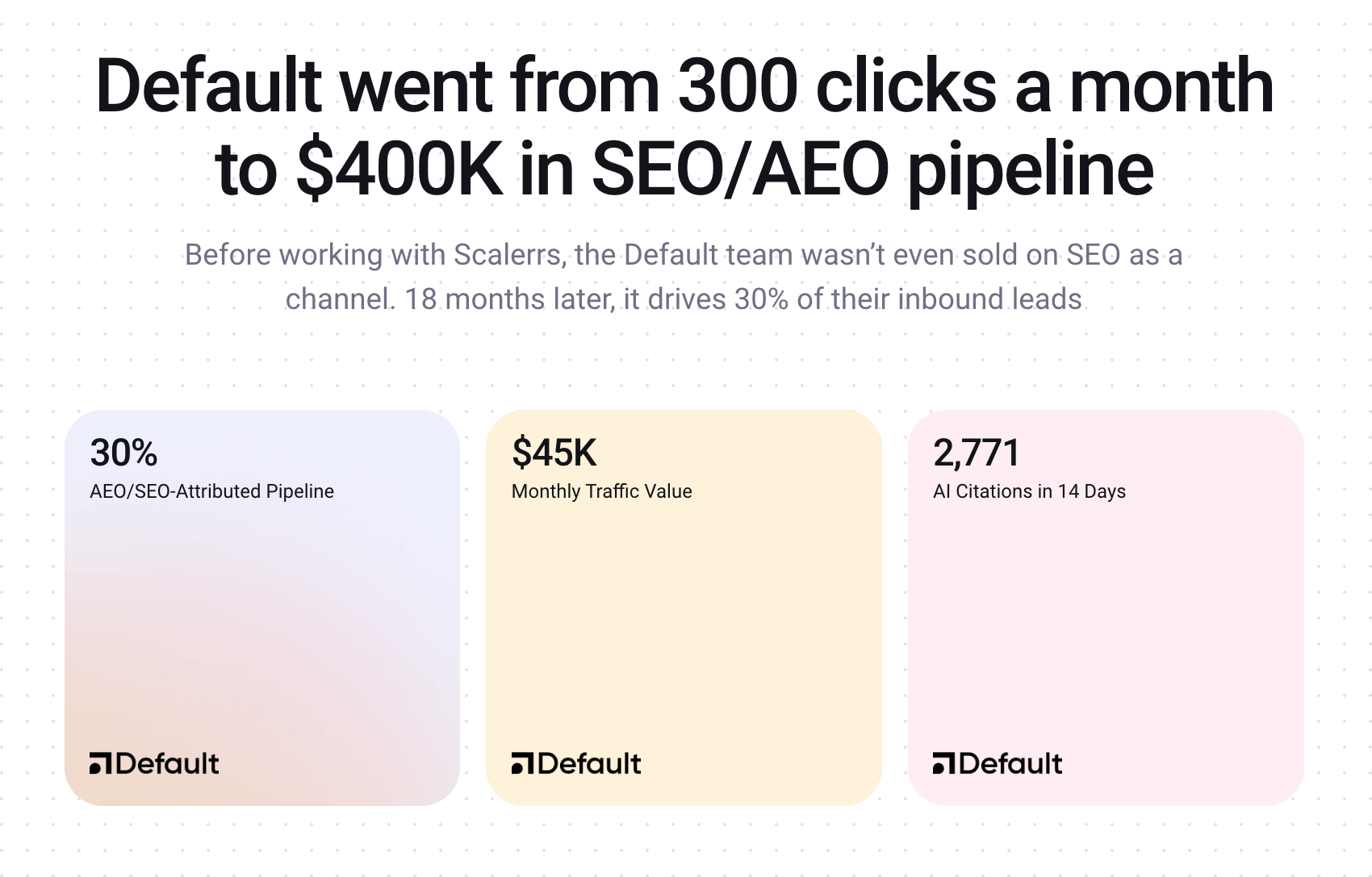
Default now attributes 30% of its pipeline to SEO/AEO and AI search, while Qrvey doubled organic pipeline from $740K to $1.5M, with organic now responsible for 30% of closed business.
Most SaaS teams are burying AI search optimization under "SEO" or "content" and materially underinvesting. That is going to cost them.
AEO isn’t a subset of SEO. It requires different content, investment in different sources to build citations (Reddit, Wikipedia, third-party listicles), and different measurement (share of voice in AI answers, not keyword rankings).

For 2026, we recommend carving out 10-15% of budget explicitly for AEO. This buys workshop-ready content, third-party citations, Reddit and Wikipedia authority signals, and measurement infrastructure.
Scalerrs’ AEO service handles all of it. We not only offer content creation for your SaaS blog/website but also cover the off-site surfaces that AI answers pull heavily from.
{{cta-general="/cta/book-a-discovery-call-general-catch-all"}}
Channel #4: Brand, Community, and Third-Party Visibility
Your buyers don't only encounter your company through your website. They see you in search results, Reddit discussions, review sites, comparison articles, podcasts, YouTube, and newsletters too.
- YouTube ranks in Google carousels and feeds AI transcripts
- Wikipedia feeds authority signals to every AI model
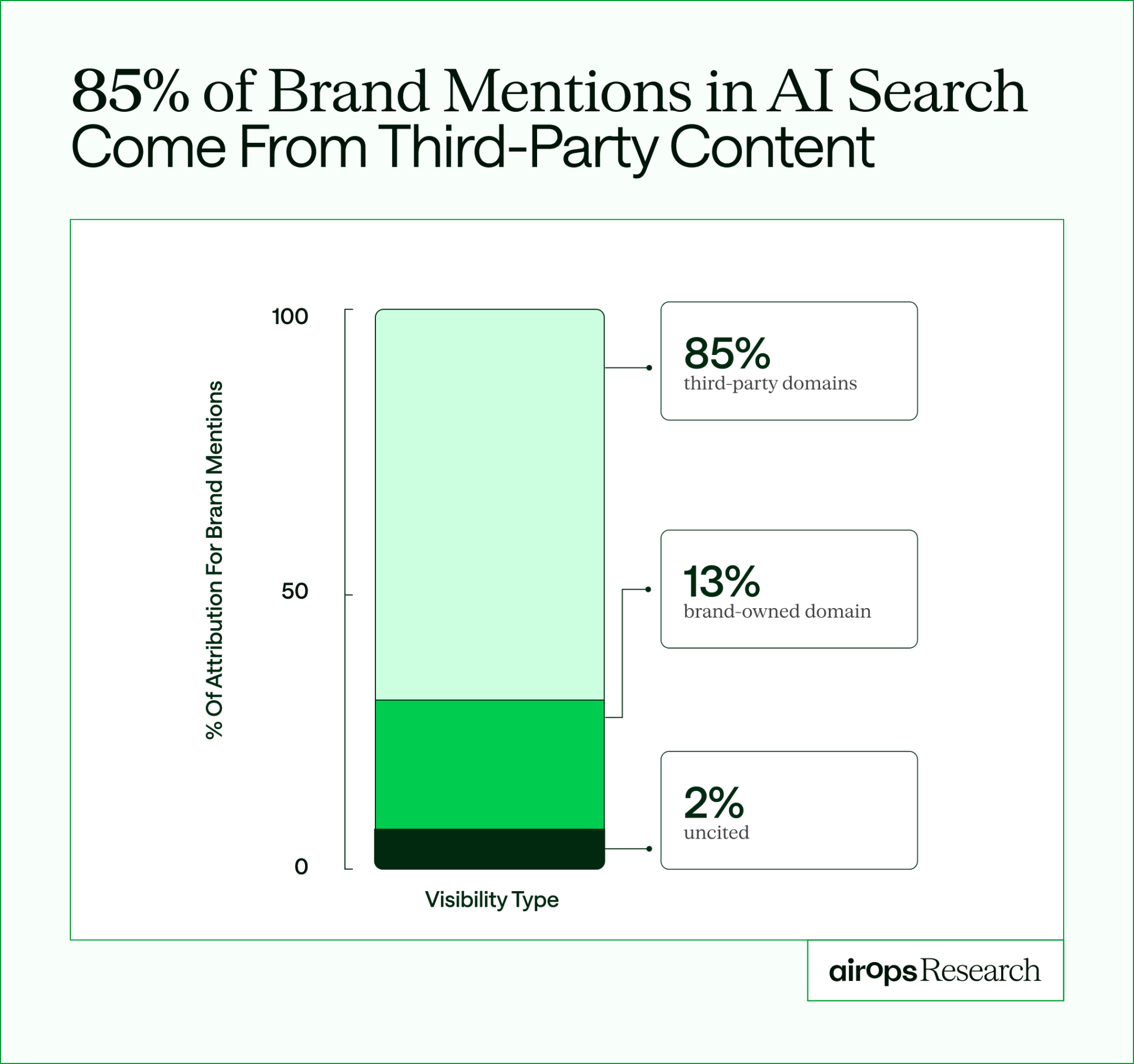
- Third-party "best of" listicles are where buyers land after ChatGPT recommends the category, and in fact, they make up over 85% of AI brand mentions
For SaaS, all these channels work together.
And our YouTube SEO and Wikipedia page creation services can help you start tapping into your off-site channels faster than building a dedicated in-house function for the same.
For B2B SaaS especially, Reddit deserves 5-10% of your budget because it does two jobs at once:
- Direct-response (buyers hire vendors mentioned in subreddit answers)
- AEO (Reddit threads get pulled into AI answers and shape what LLMs say about your category).
✅ The playbook that works: engaging through your branded Reddit handle, having thought leaders participate under their own names with disclosure, and building your own subreddit over time.
⚠️ The playbook that gets you banned: fake accounts, upvote manipulation, self-promotion masquerading as advice.
And if you’d rather let experts manage your brand—and your reputation—on Reddit, explore Scalerrs’ Reddit marketing service. We run Reddit the white-hat, enterprise-grade way, so you don’t have to worry about getting banned in week one.
{{cta-general="/cta/reddit"}}
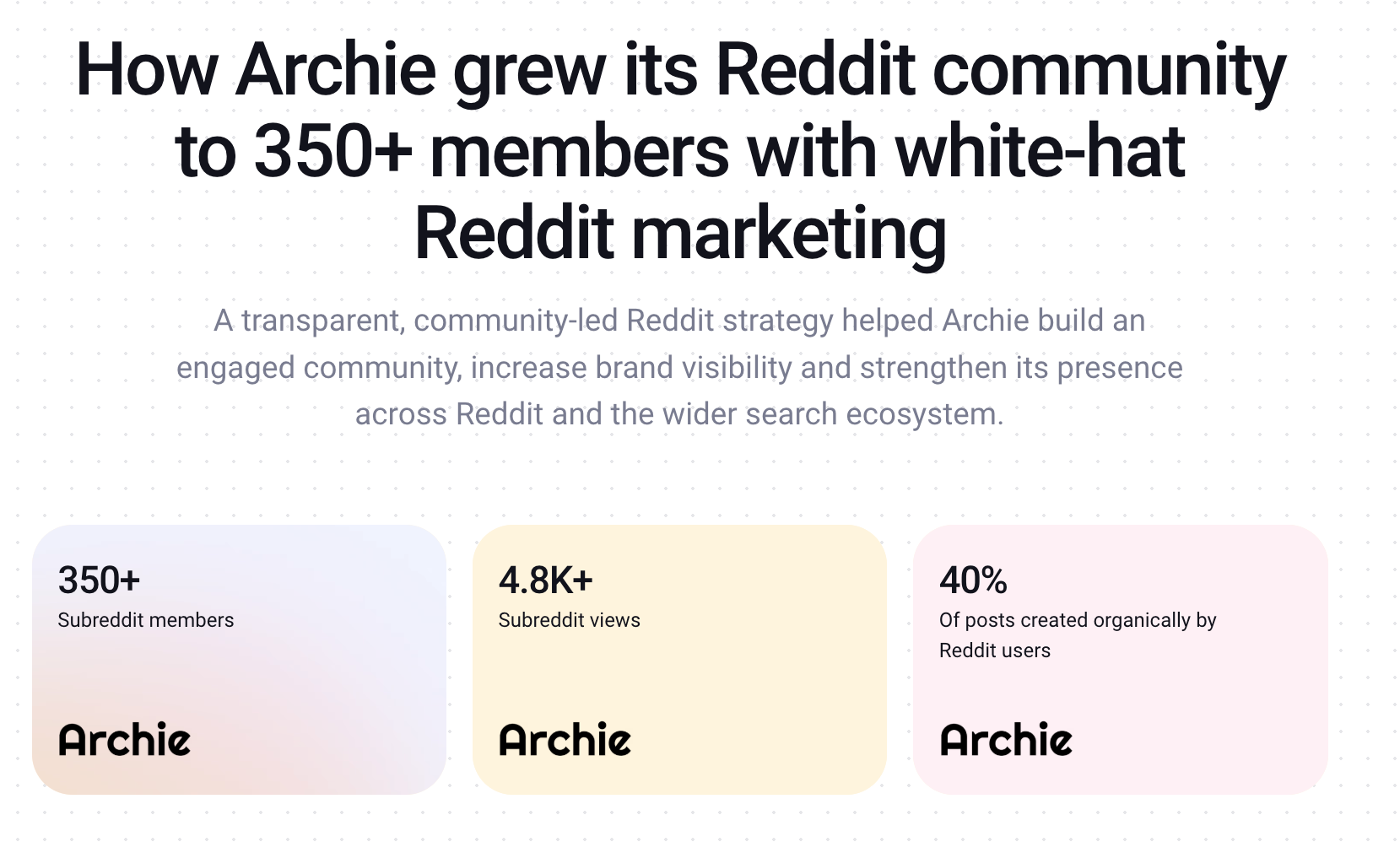
We helped our client, Archie, a workplace management software provider, build a subreddit from scratch where 40% of posts came in from organic users within two months. In the same period, the subreddit grew to 350+ members and generated ~5K views.
Channel #5: Events and Partnerships
Events make more sense when your ACV is high, your buying committee is large, and relationships materially influence deals.
They make less sense when you're selling a low-priced self-serve product to a broad audience.
Partnerships deserve similar treatment.
A technology integration, agency partner, marketplace listing, or referral relationship can put you in front of buyers who already trust the partner. But partnerships usually take longer to build than paid campaigns, so don't judge them on a 30-day pipeline report.
Channel #6: Lifecycle and Customer Marketing
Lifecycle marketing includes onboarding, activation campaigns, product education, customer newsletters, expansion campaigns, cross-sell, and win-back programs.
You paid to acquire the customer already. Helping that customer activate, adopt more features, renew, and expand can improve the economics of the original acquisition.
That means your marketing budget should not stop at "new logo." Track the full customer journey.
Bonus: Keep a Separate Experimentation Budget
Reserve 5-10% of marketing spend for experiments. The point isn't to guarantee that every experiment works. It's to create a controlled way to find out what does.
An experiment should have:
- A clear hypothesis
- A defined spend limit
- A specific audience
- One primary success metric
- A decision date
- A rule for scaling, changing, or stopping
For example, if you're testing Reddit, don't spend six months vaguely "building a presence."
Set a defined test. Pick the communities that match your ICP. Measure qualified traffic, branded search lift, assisted pipeline, and direct responses. Then decide whether the channel deserves more budget.
The same principle applies to AEO, YouTube, partnerships, events, and new paid channels.
How Should a SaaS Company Balance Short-Term and Long-Term Marketing Investment?
A healthy SaaS marketing budget has both cash-flow channels and compounding channels.
- Paid search, retargeting, outbound support, and events can create pipeline faster
- SEO, content, brand, community, partnerships, and AEO generally take longer to build, but can continue creating value after the original campaign ends
The 70/20/10 split we recommend most SaaS clients:
- 70% on channels producing pipeline this quarter
- 20% on channels compounding into pipeline in 6-12 months
- 10% on experimental bets
Budgets that go 100% short-term (all paid) end up with no compounding assets and become permanently expensive to run. Every quarter starts from zero. Budgets that go 100% long-term (all content, no paid) starve pipeline during the 6-12 months organic takes to compound. Neither survives a tough board review.
Examples of Marketing Budgets for SaaS Companies Across Different Growth Stages
Here are three illustrative budgets showing how marketing budget allocation shifts by stage. Think of these as frameworks, not prescriptions.
Example #1: Early-stage Bootstrapped SaaS ($3M ARR, targeting $5M)
Total budget: $400K (13% of ARR)
Motion: Product-led, self-serve with small sales-assisted tier
Priorities: Efficient CAC—build compounding organic before spend gets expensive.
Bootstrapped SaaS cannot outspend equity-backed competitors on paid, so it wins on organic compounding. This mirrors what we see with clients like Reporting Ninja, which grew average monthly organic traffic 3x by weighting spend toward organic rather than chasing paid CAC.
Example #2: Growth-stage Series B SaaS ($15M ARR, targeting $25M)
Total budget: $2.5M (17% of ARR)
Motion: Mid-market with expanding enterprise motion
Priorities: Aggressive pipeline growth, defensible unit economics
Example #3: Enterprise SaaS ($40M ARR, targeting $60M)
Total budget: $4M (10% of ARR)
Motion: Enterprise, 6-9 month sales cycles, 6-10 person buying committees
Priorities: Account-based motion, category leadership, AI search dominance.
The $600K AEO line reflects what we see working for enterprise clients like Qrvey, where a heavy organic and AI search bet doubled pipeline from $740K to $1.5M in one year while achieving 400% growth in organic clicks.
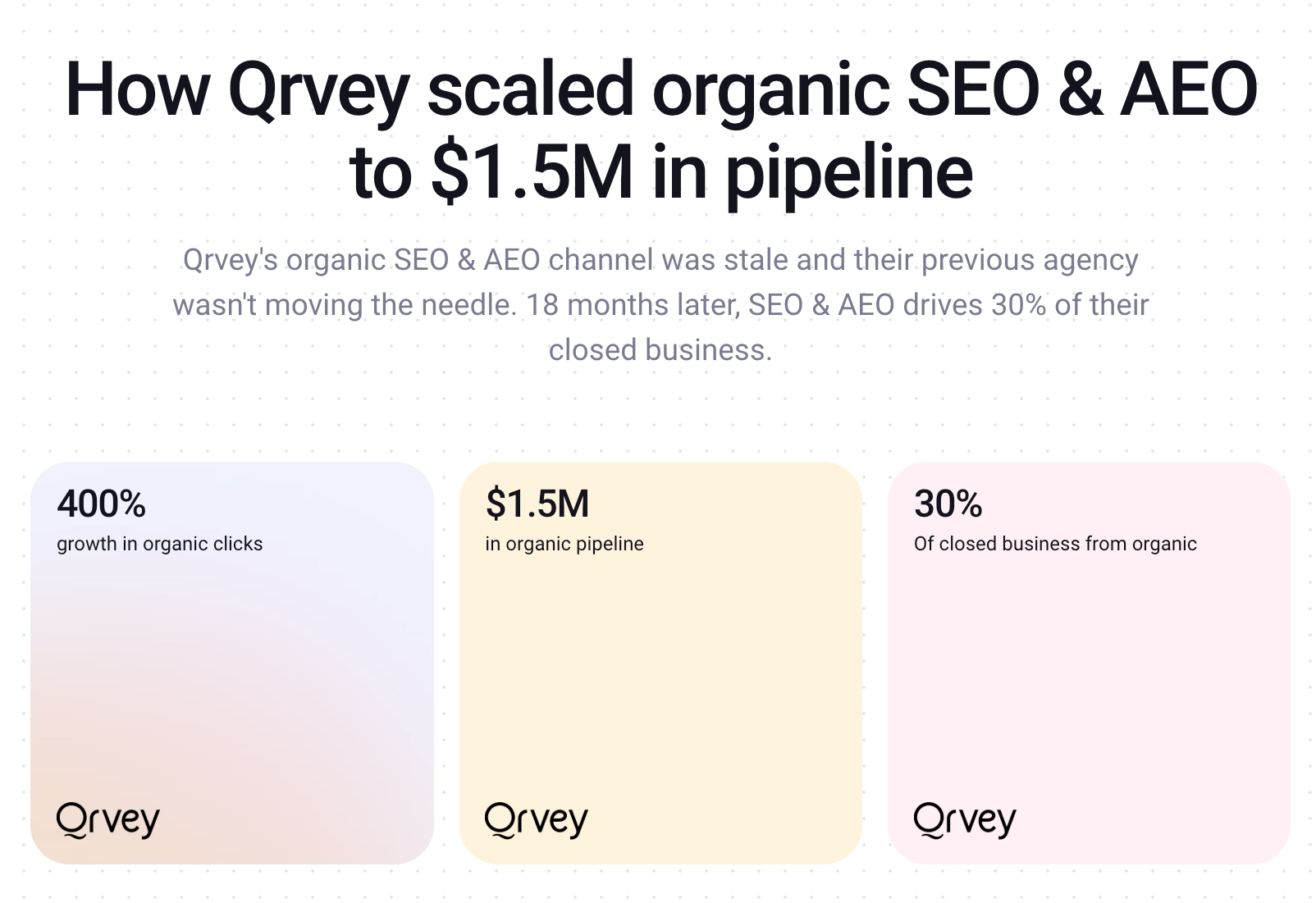
At enterprise ACVs, organic-plus-AI-search compounds into disproportionate pipeline because buyers spend more time researching before contacting sales.
What Changes As SaaS Companies Scale?
The percentage matters less than the reason behind the change.
Benchmarkit's 2025 data shows the same broad pattern. Marketing as a percentage of revenue was highest among smaller companies and declined as companies scaled. Median marketing allocation was 15% for companies at $1M-$5M in revenue, 11% at $5M-$20M, and 4% above $250M.
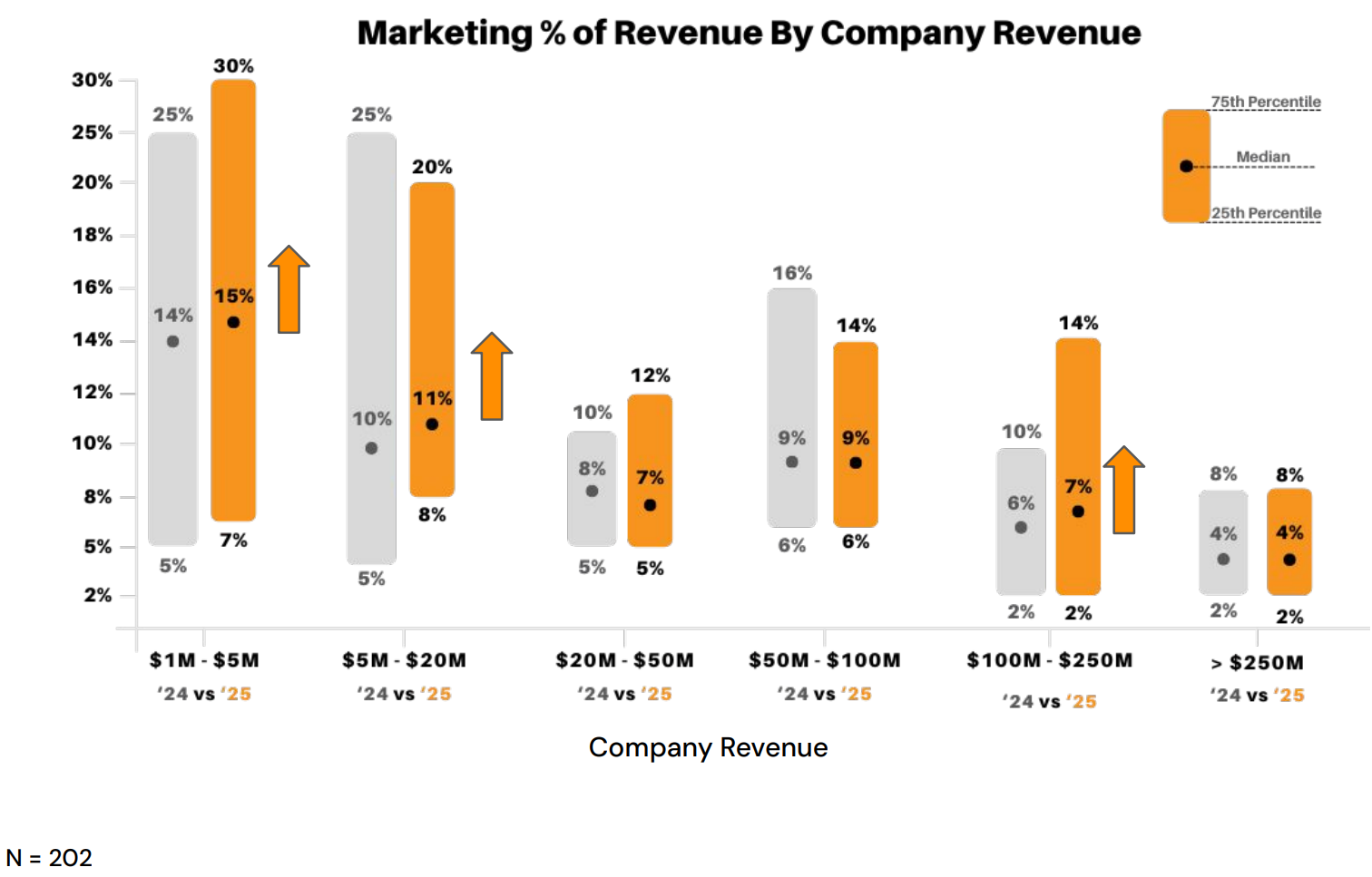
That doesn't mean mature SaaS companies care less about marketing. It means the denominator gets larger, the acquisition engine gets more established, and the company can spread fixed marketing infrastructure across more revenue.
Measuring Marketing Budget Performance for SaaS Growth Teams
The simple trick to know when your budget is working is when it creates profitable growth. The metrics below give you a better way to decide where the next dollar should go.
1. Pipeline Sourced by Marketing
The single most important number you can track is the pipeline value marketing is responsible for creating. Break it down by channel monthly. If you cannot answer "Which channel sourced the most pipeline last quarter?" and "Which cost the most per dollar of pipeline sourced?" in under 30 seconds, your attribution needs work before your allocation does.
2. Blended CAC and CAC Payback
Customer acquisition cost tells you what you're paying to acquire customers.
CAC payback tells you how long you have to wait before the gross profit from those customers covers the acquisition cost.
Track both.
A channel with a higher CAC isn't automatically worse. An enterprise channel might cost more but produce customers with higher ACV, better retention, or more expansion revenue.
That is why we prefer channel-level CAC payback over a simple "cheapest lead wins" approach.
3. Pipeline per Marketing Dollar
If you spend $100,000 on a channel and generate $500,000 in qualified pipeline, you've generated $5 of pipeline for every $1 spent.
Run the same calculation across paid, SEO, events, partnerships, content, and other measurable programs to compare channels.
Remember to keep the time horizon consistent.
Paid search may produce pipeline this month. SEO content published this month may contribute to pipeline over the next year. Comparing the two after 30 days will make the slower channel look worse than it is.
4. AI Search Share of Voice
When a buyer asks ChatGPT, Perplexity, or Claude about your category, how often does your brand appear in the answer?
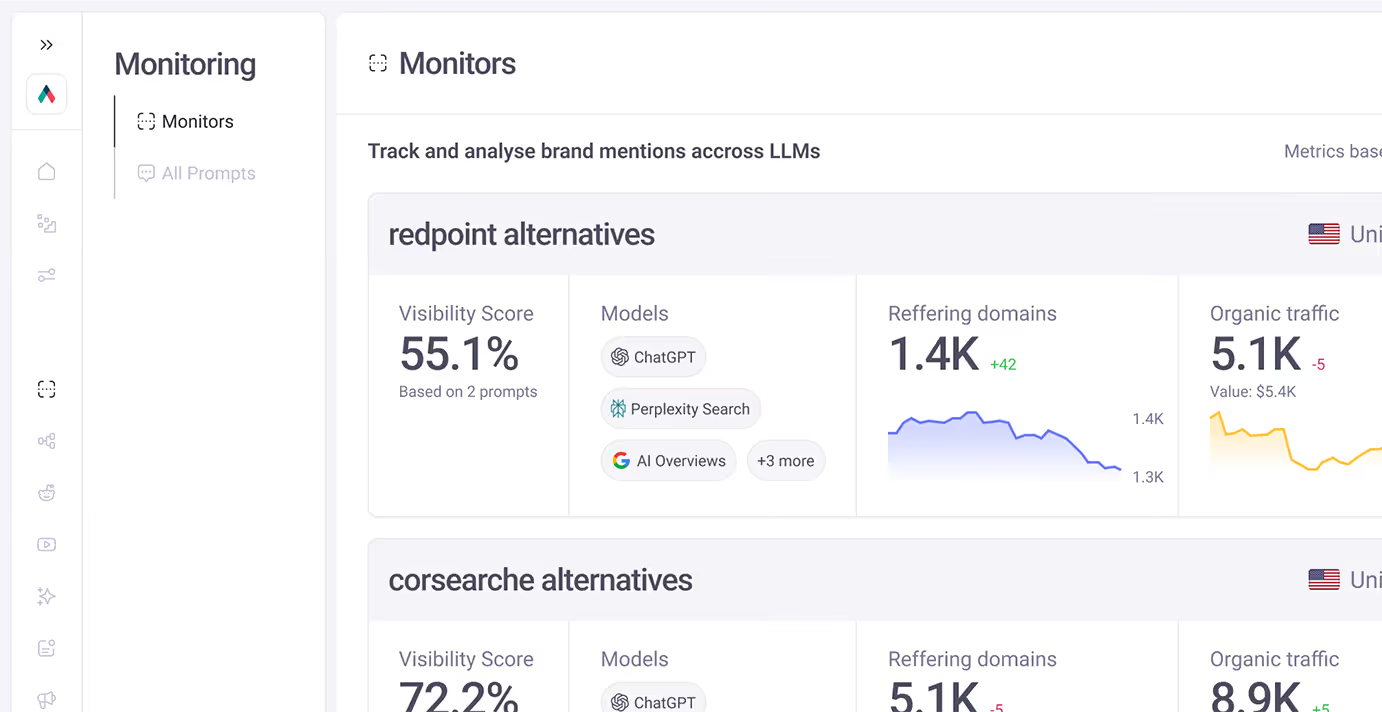
Tools like Profound, Peec.ai, and internal tracking against curated prompt sets let you measure this metric.
Start with 25-50 buyer-intent prompts and track them weekly.
5. Conversion and Revenue Efficiency
Marketing performance doesn't stop when someone becomes an MQL.
Track the conversion rates between each major stage:
Visitor → signup/demo → qualified opportunity → closed-won → expansion
This tells you where the budget is being lost.
If organic traffic is growing but demo conversion is falling, you may have a content-intent problem. If demos are growing but SQL conversion is falling, the issue may sit with qualification, positioning, or sales follow-up.
For SaaS teams investing in SEO, our SaaS SEO approach puts commercial intent and pipeline alongside rankings and traffic for exactly this reason.
SaaS Marketing Budget Mistakes to Avoid
A bigger budget won't fix a weak marketing model. Before you ask for more money, check whether your current budget is solving the right problem.
Mistake #1: Combining Sales and Marketing Costs
This is one of the easiest ways to make a SaaS marketing budget look much larger than it is.
Marketing salaries, content, paid media, events, software, and agencies belong in the marketing budget. SDRs, account executives, sales commissions, and other sales costs belong in sales unless your reporting structure deliberately combines them.
Mistake #2: Putting Every Dollar into Demand Generation
You need pipeline. Paid campaigns create leads. So you put more money into paid campaigns.
The problem is what happens next.
Gripped found that 42% of companies focused heavily on short-term demand generation failed to meet revenue goals, while 64% of underperforming companies invested heavily in paid acquisition but neglected brand awareness.
Demand capture works better when buyers already know, trust, or recognize the company they're being asked to buy from. Keep funding demand generation. Just don't starve the channels that make future demand cheaper to capture.
Mistake #3: Cutting the Wrong Line Item During Downturns
The instinct during a tough quarter is to cut content, SEO, and brand because they are hardest to attribute short-term. This is the exact wrong move.
If you must cut, cut experiments that are not paying back, event sponsorships that cannot map to pipeline, and paid campaigns with worst-in-class efficiency. Cut compounding channels last. Once you stop feeding your organic channel, it takes 6-9 months to restart.
Mistake #4: Not Allocating a Dedicated Experimentation Budget
Your current acquisition engine will eventually slow down. Competitors will bid on the same keywords. Ad costs can rise. Search behavior changes. Buyers start researching in new places.
You need some budget to find what comes next.
Teams that spend 100% on proven channels get outmaneuvered by teams that spend 5-10% on the next channel. Yes, nine out of ten experiments fail. But the one that works pays for the other nine.
Mistake #5: Not Aligning Spend to your GTM Motion
A budget optimized for product-led looks nothing like one optimized for enterprise. If your motion is enterprise but your budget is 60% paid, you are trying to convert 6-month sales cycles with 30-day campaigns.
Enterprise motions need content, brand, ABM, and events across a 6-9 month research cycle. Product-led motions need velocity: fast experiments, rapid feedback, and a lifecycle engine that converts trials to paid.
Copy-pasting a mix from a different motion is one of the most common (and expensive) budget mistakes we see.
FAQs
1. What percentage of SaaS revenue should go to marketing?
The median B2B SaaS company spends 8% of ARR on marketing, per SaaS Capital's 2026 survey of 1,000+ private companies. Early-stage SaaS routinely spends 15-25% chasing product-market fit. Mature SaaS settles at 5-7%. Use these as directional benchmarks. Derive your actual budget from CAC, payback, and pipeline goals.
2. Should SaaS companies increase their marketing budget before or after finding product-market fit?
Usually after. Before product-market fit, keep marketing focused on customer research, positioning, experiments, and learning which acquisition channels can work. Once you have evidence of repeatable demand, increase spending behind the channels that produce customers.
3. How should SaaS companies budget for a new market launch?
Start with the revenue target for the new market, then work backward. Budget for market research, localization, positioning, content, demand creation, paid acquisition, partnerships, and sales enablement. Give the launch its own pipeline target so you can distinguish market-entry costs from your core acquisition budget.
4. How much should a SaaS company reserve for marketing experimentation?
At least 5% of total marketing budget. Teams that reserved experimental budget for AEO in 2023-2024 are the ones now dominating AI search visibility. Teams that spent 100% on proven channels are playing catch-up. Experimental budget is an option, not an expense.
5. Should SaaS marketing budgets include sales and marketing technology costs?
Yes, but report them separately. Include marketing-owned technology such as CRM, analytics, automation, SEO, advertising, and content tools in marketing costs. Keep sales technology and sales headcount separate so you can see what marketing itself costs and what the wider go-to-market engine costs.
Build a Multi-Channel SaaS Growth Strategy With Scalerrs
Every dollar of your SaaS marketing budget should be tied to a specific outcome.
Some dollars help you capture demand today. Some build demand for next quarter. Some improve conversion or retention. A smaller pool should be kept for testing what comes next.
That's the model we recommend to our SaaS clients. We connect traditional SEO, content, link building, Reddit, and AI search based on your goals, growth stage, and GTM strategy, then measure the work against pipeline rather than publishing volume.
Want to see what a multi-channel SaaS growth strategy could look like for your company? Book a free discovery call and we will walk through your CAC math, channel mix, and reallocation opportunities.
Book a Discovery Call
Turn Organic Search Into Your #1 SaaS Acquisition Channel.

Let us scale your SEO channel for you.
reviewed onClutch
4.9 rating






Get Free Resources In Your Inbox
Get all of our FUTURE playbooks such as Figma files, checklists and SOPs directly into your inbox.

.avif)