


Answer Engine Optimization: Key Steps, Tips and Metrics (2026)

Key Takeaways
- Answer engine optimization (AEO) helps your brand get mentioned, cited, and recommended in AI-generated answers from platforms such as ChatGPT, Perplexity, Gemini, and Google AI Overviews.
- AEO builds on SEO rather than replacing it. Strong content and technical SEO create the foundation, while third-party sources such as Reddit, YouTube, reviews, and comparison listicles help AI systems validate which brands to surface.
- A practical AEO strategy starts by mapping buyer prompts and cited sources, then improves your technical foundation, owned content, third-party coverage, and presence across high-value external platforms.
- Measure AEO through AI visibility, citation share, AI referrals, and pipeline impact, rather than treating the number of citations as the final business outcome.
What Is Answer Engine Optimization (AEO)?
Answer engine optimization (AEO) is the practice of making your brand and content easier for AI-powered answer engines to understand, retrieve, cite, and recommend in response to relevant user questions.
An answer engine takes a question and generates a direct response rather than simply returning a list of ten blue links to web pages. Major examples of AI answer engines include ChatGPT, Perplexity, Gemini, Claude, Google AI Overviews, and Google AI Mode.
Put simply, AEO focuses on whether your brand appears inside the answer itself and which sources support that appearance.
AEO includes optimizing your own pages so AI systems can clearly understand them, but it also means building a credible presence on the third-party sources those systems use for retrieval and validation.
The objective is AI visibility: consistently appearing when your buyers ask category, comparison, product, problem, or vendor-selection questions.
📚 Further Reading: Check out the LLM SEO playbook we use to help SaaS brands win visibility in answer engines like ChatGPT, Perplexity, and Google AI Mode, or feel free to browse the best AEO agencies.
How AEO Differs from SEO and GEO
AEO, SEO, and GEO overlap, but they optimize for different outcomes.
In practice, the terminology gets messy. AEO, GEO, LLM SEO, and AI SEO are often used to describe overlapping work around visibility inside AI-generated answers. The useful distinction is what you are optimizing for and how you measure it.
AEO does not make traditional SaaS SEO obsolete.
So, the practical takeaway is this: keep doing SEO well, then expand the strategy to the sources and signals answer engines rely on.
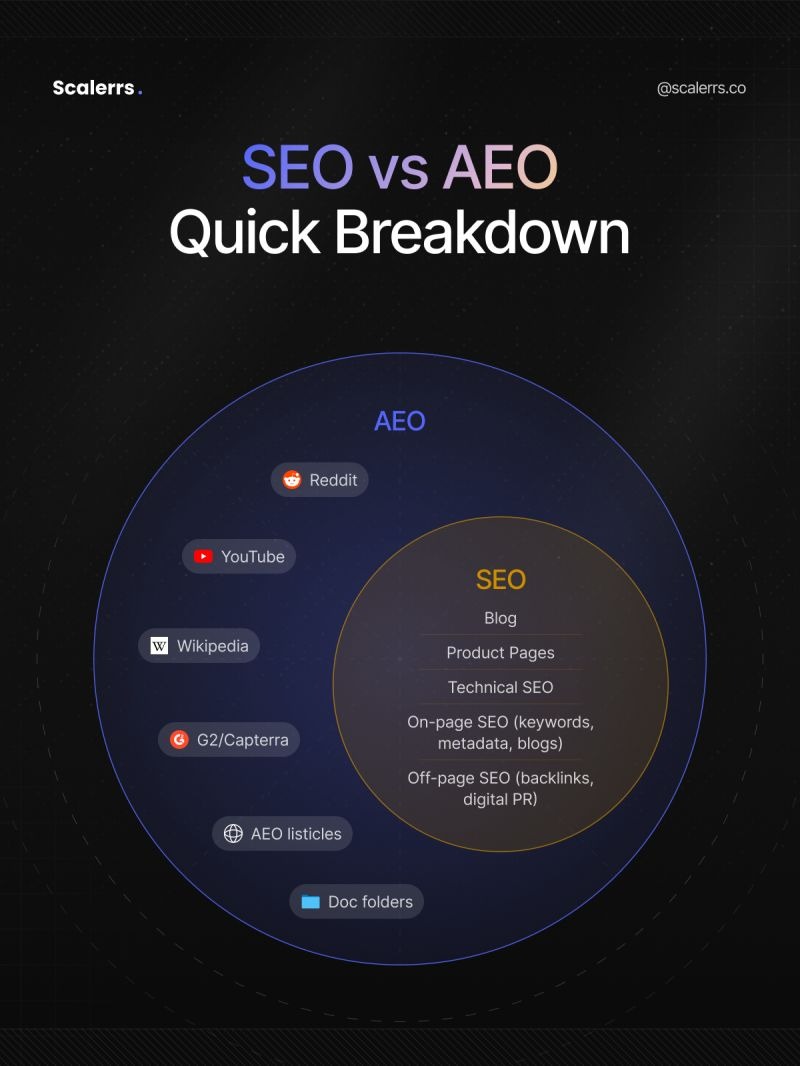
Where Answer Engines Pull Their Answers From
Answer engines do not rely on one universal database or citation pattern.
They retrieve information from a mix of websites, communities, comparison content, listicles, reference sources, product documentation, and multimedia platforms. The exact mix changes by engine and query.
For B2B SaaS, four source types deserve particular attention.
Source Type 1: Search-Indexed Pages and Product Documentation
Your own website remains an important source, especially when it provides clear, crawlable answers about your product, category, integrations, features, pricing, and use cases.
For technical SaaS products, that can include:
- Product and feature pages
- Integration pages
- API and developer documentation
- Help-center and knowledge base articles
- Comparison and alternative pages
- Original research and expert-led blog content
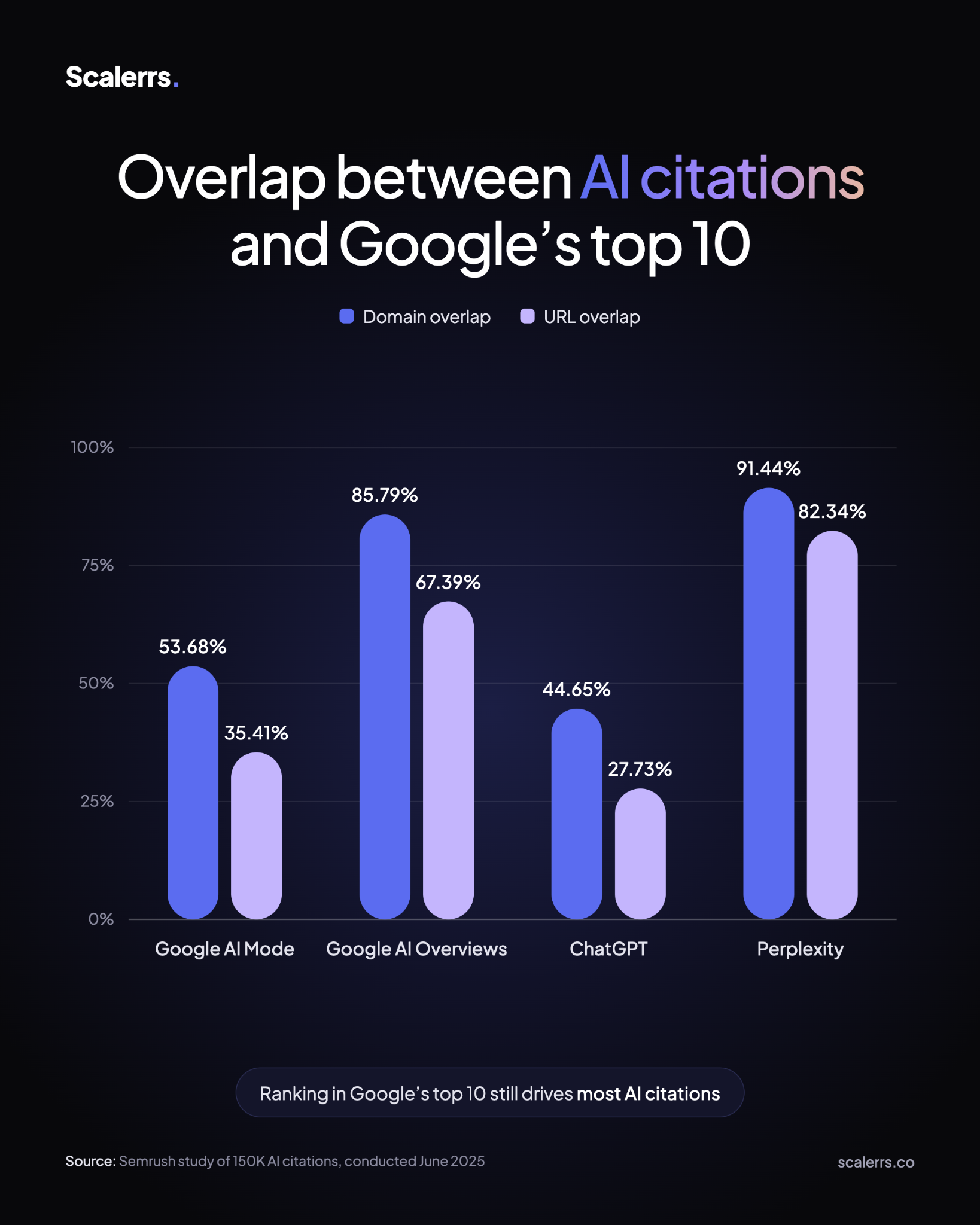
The point here is SEO still supplies a meaningful retrieval layer. Semrush found a strong domain-level relationship between organic rankings and AI citations across the platforms it studied, although the researchers explicitly note that correlation does not prove causation.
So your owned content still provides the factual foundation answer engines need. It simply is not the only source they consult.
Source Type 2: Community and User-Generated Content
Community discussions give answer engines something corporate pages rarely provide: real questions, opinions, comparisons, objections, and product experiences written in unfiltered, natural language.
Reddit is particularly influential.
In September 2026, Reddit accounted for 17.9% of citation share among Google AI Mode’s leading sources and 16.8% among ChatGPT’s leading sources, according to Ahrefs Brand Radar.
For B2B SaaS, these discussions often mirror high-intent buyer questions:
- “What CRM actually works for a 50-person sales team?”
- “What are people using instead of [competitor]?”
- “Is [product] worth the price?”
- “Which platform handles [specific use case] best?”
Those conversations can shape the sources AI systems retrieve when users ask similar recommendation questions.
Source Type 3: Review, Comparison, and Third-Party Listicle Pages
Third-party comparison content plays a disproportionately large role in software discovery because it already organizes vendors around the questions buyers ask.
Think:
- “Best project management software”
- “[Product A] vs. [Product B]”
- “Best [category] tools for enterprise teams”
- “[Product] alternatives”
Review platforms such as G2 and Capterra serve a similar function.
In fact, Semrush found that G2 was the fourth-most-cited source in its digital technology sample, while Wikipedia and Reddit regularly outranked official corporate websites across several industries.
For SaaS companies, that makes third-party listicles and comparison pages more than referral opportunities. They can directly influence which vendors an answer engine understands as relevant options within a category.
Source Type 4: Video and Reference Sources
YouTube and Wikipedia serve different purposes, but both consistently appear among the sources AI engines rely on.
YouTube gives models access to product demonstrations, tutorials, comparisons, webinars, and transcripts. Wikipedia provides structured, neutral entity and category context.
These sources help explain why AEO requires distribution beyond the company website.
How to Do Answer Engine Optimization in 7 Steps
A practical AEO strategy starts with understanding what buyers ask and ends with measuring whether your visibility is creating real discovery and pipeline.
Run the process in this order.
Step 1: Define Buyer Prompts and Benchmark Your Current AI Visibility
Start by identifying the kinds of questions your buyers actually ask AI tools.
Build the prompt set from sources you already trust:
- High-intent SEO keywords
- Sales-call questions
- Support tickets
- Competitor comparisons
- Customer interviews
- Product objections
- Integration and implementation questions
Then convert those topics into natural prompts across the buyer journey.
For example, the keyword “CRM for SaaS companies” might become:
What is the best CRM for a 100-person B2B SaaS company?
A comparison term could become:
HubSpot vs. Salesforce for a Series A SaaS sales team?
Group prompts by intent, such as category discovery, comparison, alternatives, features, implementation, or pain point.
Run a fixed sample across the answer engines you care about and record:
- Which brands appear
- Where your brand appears
- Which competitors dominate
- Whether your brand is named, cited, or both
- Which URLs support each response
This gives you the baseline you will compare against later.
📥 Free Download: To better understand and build on a ready-made process, steal our SaaS Keyword and Prompt Research Playbook.
Step 2: Map the Sources Answer Engines Cite for Those Prompts
Next, identify which websites are powering the answers.
For each priority prompt, record the domains and URLs cited by ChatGPT, Perplexity, Gemini, Google AI Mode, or whichever platforms you are tracking.
Then classify each source:
- Your own website
- Competitor website
- Reddit/community
- Review platform
- Third-party listicle or comparison page
- YouTube
- Wikipedia/reference source
- Industry publication
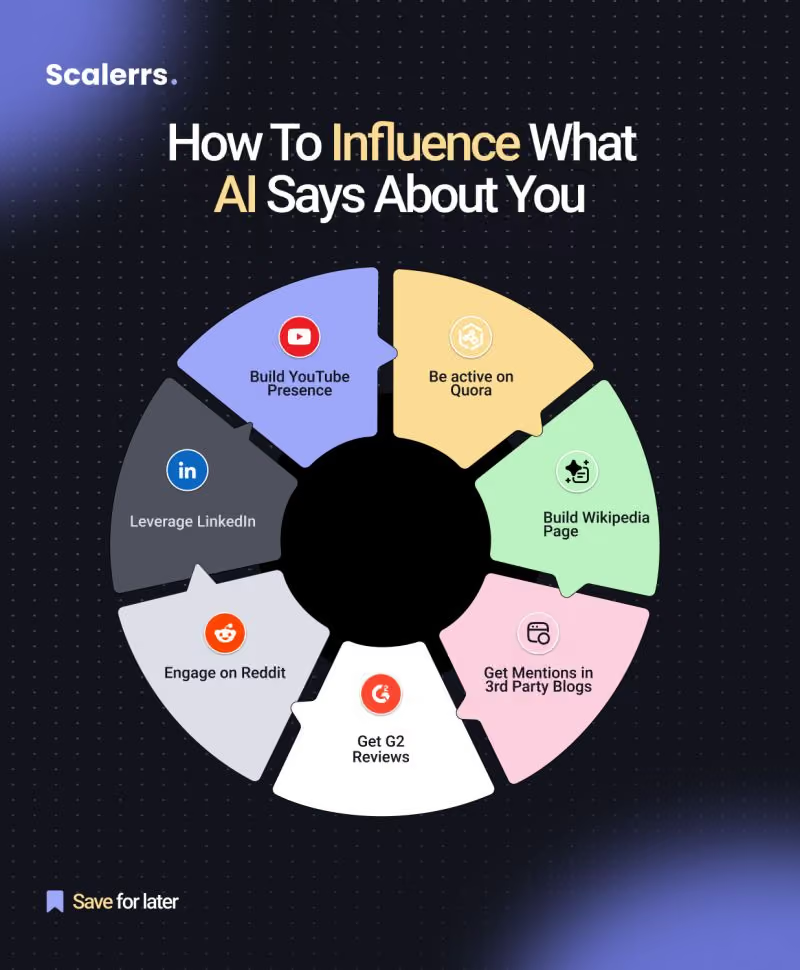
The biggest question here is: Which sources repeatedly influence answers where our brand should appear?
That produces a source map you can act on.
For example, if four of your highest-value “best software” prompts repeatedly cite the same two comparison articles and one Reddit thread, optimizing another general blog post probably should not be your first move.
Step 3: Fix Your Technical and Entity Foundation
Before scaling content or off-site campaigns, make sure answer engines can reliably crawl and understand what your company does.
Audit:
- Crawlability and indexation
- Site architecture
- Internal linking
- Canonicalization
- Structured data where appropriate
- Product and company naming
- Category terminology
- Feature, integration, and use-case relationships
Product relationships should also be explicit.
Instead of:
It connects with your CRM.
Prefer:
Product X integrates with Salesforce and HubSpot through native integrations.
Treat technical SEO as the foundation that makes the rest of the AEO strategy easier to interpret and retrieve.
Step 4: Create and Refresh Content for AI Retrieval
Now improve the pages that answer engines and buyers are most likely to use.
Start with pages tied to your priority prompts rather than rewriting the entire content library.
Focus on:
- Direct answers near the start of each section
- Clear H2 and H3 structure
- Short, self-contained passages
- Comparison tables
- FAQs where genuinely useful
- Specific product details
- Named entities
- Original data
- Expert commentary
- Primary-source citations
There is evidence behind these practices.
Semrush compared cited and non-cited content and found positive associations between AI citations and clarity/summarization (+32.83%), E-E-A-T signals (+30.64%), Q&A formats (+25.45%), section structure (+22.91%), and structured-data elements (+21.60%).
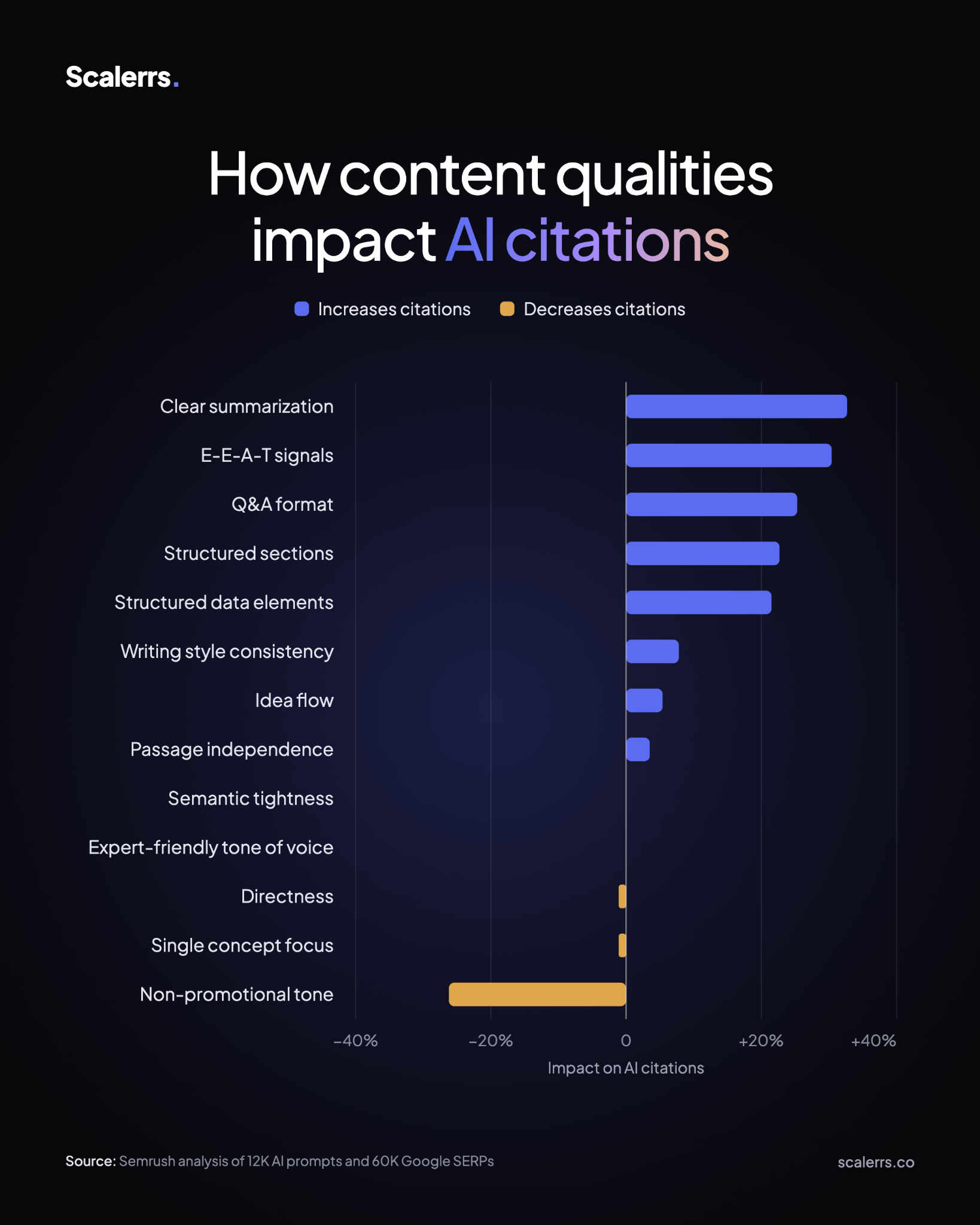
The idea here is not to make every paragraph robotic. Make each important passage understandable enough to stand on its own when retrieved outside the context of the full article.
Step 5: Earn Third-Party Listicle, Review, and Comparison Visibility
Once the owned-site foundation is in place, work on the third-party sources buyers and AI engines already use to compare vendors.
Return to your source map from Step 2 and prioritize:
- “Best [category] software” articles
- Alternatives roundups
- Product comparison pages
- G2/Capterra-style review profiles
- Relevant analyst or industry roundups
For each source, check:
- Does your product appear?
- Where is it positioned?
- Is the product description accurate?
- Which competitors appear instead?
- Does the page get cited across multiple prompts or engines?
Then pursue legitimate opportunities to improve coverage, such as editorial outreach, providing accurate product information, strengthening review profiles, or pitching inclusion only where appropriate.
Step 6: Build Presence Across Reddit, YouTube, and Reference Sources
Expand the same strategy across the other source types identified earlier.
On Reddit, focus on disclosed, value-first, white-hat participation. That can include:
- Branded handles where appropriate
- Company experts participating under their own names
- Helpful answers to relevant questions
- Genuine product feedback requests
- Recommending another product when yours is not the right fit
- Building and moderating an owned community when there is a genuine audience for one
Avoid manufactured recommendations, disguised promotion, or tactics designed to manipulate community consensus. Trust us when we say this: these won’t work in the long run.
Reddit’s value comes from credible discussion. On YouTube, build tutorials, demonstrations, category explainers, comparison videos, and expert-led content around the same prompt themes. On Wikipedia, pursue visibility only where the company or subject legitimately meets Wikipedia’s notability requirements and independent sourcing standards.
📥 Free Download: Check out this Reddit A-Z guide to learn how to market the right way on Reddit.
Step 7: Track Citations, Buyer Discovery, and Pipeline
Finally, rerun the benchmark prompts from Step 1 on a consistent schedule.
Track more than whether your website received another citation. Measure:
- Brand mentions across target prompts
- Citation frequency
- Average brand visibility or position
- Which URLs and domains are cited
- Changes in source mix
- AI referral traffic
- Self-reported AI discovery
- Demos, trials, opportunities, and pipeline influenced by AI search
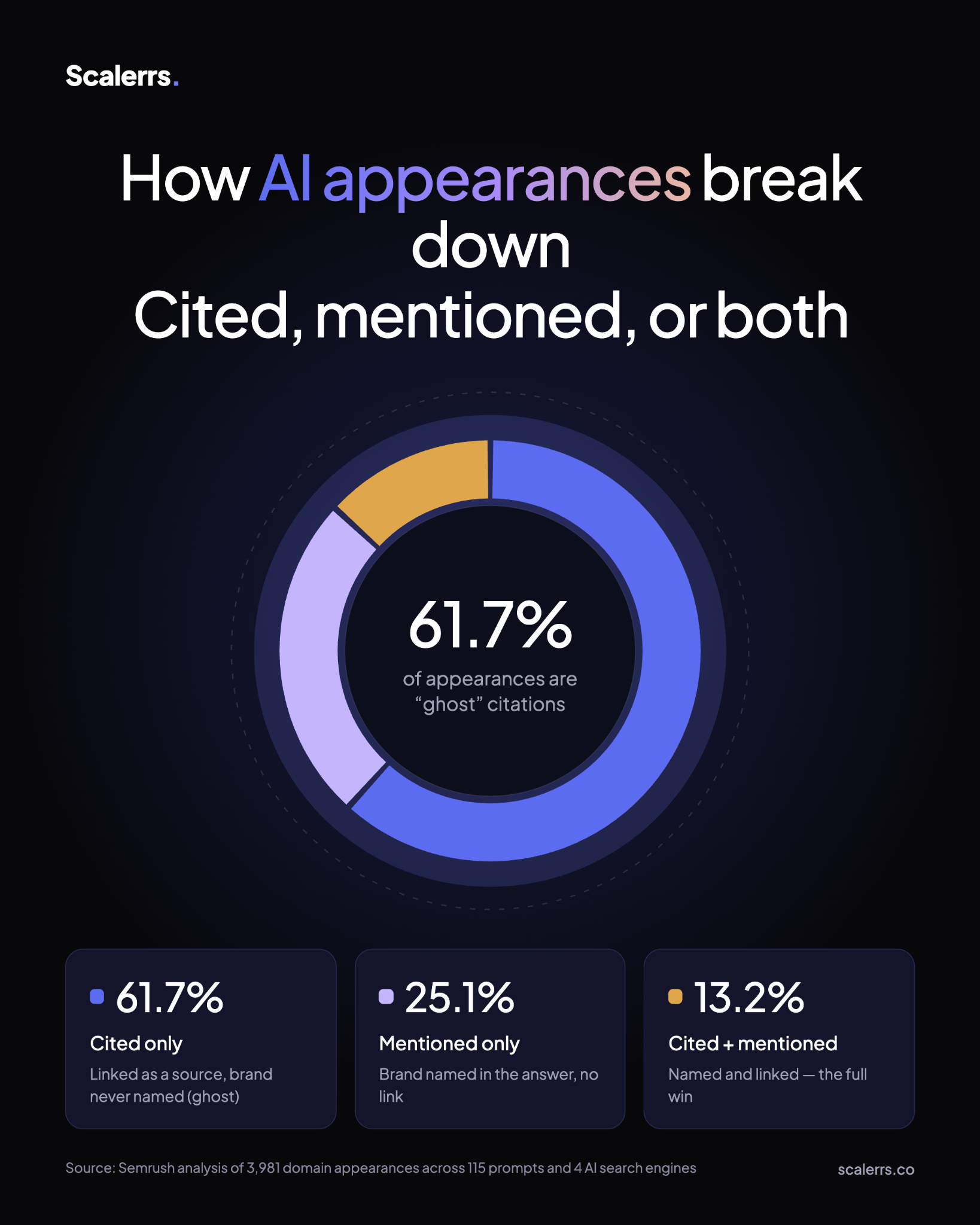
Keep brand mentions and citations separate. A rising citation count may show that answer engines increasingly trust your content, while brand mentions tell you whether buyers are actually seeing your company in the answer.
Use the data to feed the strategy back into earlier steps.
If visibility is weak for one topic, inspect the sources. If you are being cited but rarely mentioned, look at whether comparison and category content makes the brand relationship explicit. If visibility is improving without demos or qualified discovery, revisit whether you are targeting commercially useful prompts.
📥 Free Download: Want the complete implementation framework? Use the AEO Checklist for B2B SaaS to work through the setup, source coverage, content, tracking, and measurement steps.
What AEO Friendly Content Looks Like
AEO-friendly content makes important information easy for both people and answer engines to identify, understand, and reuse.
The strongest pages still need depth and original insight. The difference is that their most useful passages do not make the reader dig through several paragraphs before reaching the answer.
Best Practice 1: Put the Answer Before the Explanation
Lead with the direct answer, then add context, evidence, examples, or caveats.
Before:
Companies evaluating a CRM have a number of factors to consider when looking at integrations, including their existing technology stack and workflow requirements. Salesforce is one platform that many teams may want to connect.
After:
Product X integrates with Salesforce through a native integration that syncs contact, account, and opportunity data. Teams can then configure which records and fields move between the two platforms.
The second version is easier for a buyer to understand and gives an answer engine a self-contained passage it can retrieve.
The same principle works particularly well for definitions, FAQs, product capabilities, comparisons, pricing explanations, and implementation questions.
📚 Further Reading: For more examples, check out our SaaS content writing guide.
Best Practice 2: Break Pages Into Clear, Extractable Sections
Give each important question or subtopic its own descriptive heading and answer it directly underneath.
Use short paragraphs, bullets, comparison tables, and FAQs where they genuinely improve comprehension. A section called “Does Product X Integrate With Salesforce?” gives both readers and retrieval systems more context than a vague heading such as “Integrations.”
This does not mean reducing every article to a collection of fragments. The page still needs a logical narrative.
The goal is to make individual passages useful even when they are retrieved outside the context of the full page. Use this structure where it improves clarity rather than forcing Q&A formatting into every section.
📚 Further Reading: Our SaaS FAQ SEO guide and SaaS on-page SEO guide go deeper into these page-level best practices.
Best Practice 3: Name Entities and Relationships Explicitly
Write so the relationship between your company, product, feature, category, integration, and customer use case is clear.
Compare:
It connects with your CRM so teams can sync their data.
With:
Product X integrates with HubSpot and Salesforce so B2B sales teams can sync contact and opportunity data.
The second version removes ambiguity around what “it,” “your CRM,” and “their data” refer to.
Be specific when mentioning:
- Product and company names
- Software categories
- Integrations
- Features
- Standards and certifications
- Prices and quantities
- Dates
- Customer segments
- Relationships among products and entities
Clear entity relationships help buyers understand the product and give retrieval systems less missing context to infer.
Best Practice 4: Support Important Answers With Evidence
Give answer engines a reason to trust the passage they retrieve.
Support important claims with original research, primary-source statistics, expert commentary, customer evidence, product screenshots, or clearly attributed external sources.
For example, instead of saying:
Our platform improves reporting efficiency.
Show the specific result:
Customer X reduced weekly reporting time from six hours to two after implementing the platform.
The strongest AEO content combines a direct answer with evidence that another source could independently verify.
Schema, clear HTML, and strong technical foundations can make that information easier to interpret, but they cannot substitute for weak or unsupported content.
📥 Free Download: For implementing the technical layer for AEO, download the LLM SEO Technical Guide.
How to Measure AEO Performance
AEO performance should tell you more than how many times an AI tool cited your website.
A useful measurement system follows the buyer journey from visibility → citation source → discovery → commercial outcome.
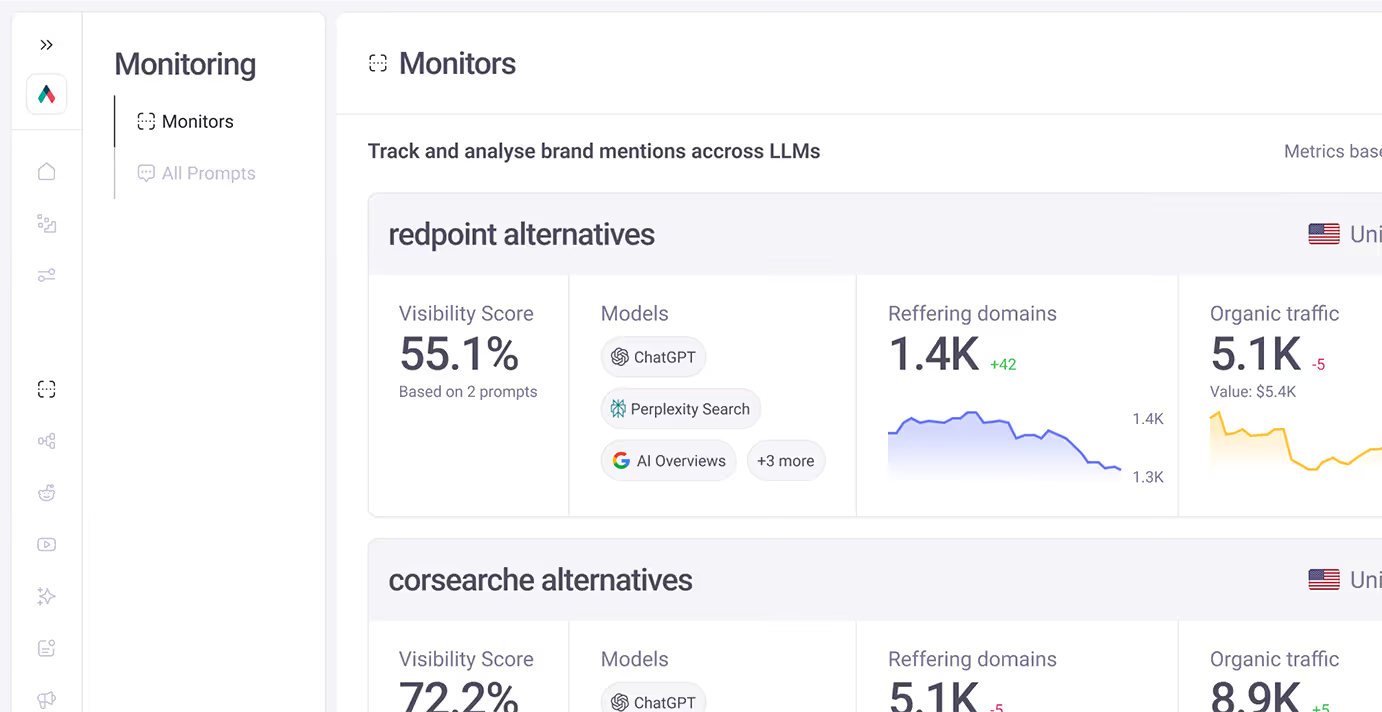
AI visibility platforms like Promptwatch (we use this) or OtterlyAI can automate prompt tracking and citation monitoring. Web analytics, CRM data, and self-reported attribution then help connect that visibility to buyer behavior.
Metric 1: AI Visibility and Prompt Coverage
AI visibility shows whether your brand appears for the questions that matter to your buyers.
Start with the fixed prompt set created in Step 1 and track:
- Percentage of prompts where your brand appears
- Average brand position or visibility
- Competitors appearing more frequently
- Prompts where your brand has gained or lost visibility
Segment the results by intent.
Appearing for:
What is the best workflow automation software?
is commercially different from appearing for:
What is workflow automation?
A strong AEO report should therefore separate category, comparison, alternatives, feature, problem, and implementation prompts rather than blending everything into one visibility score.
Track changes consistently over time. The prompt wording, target market, and answer engine should stay stable enough for the trend to mean something.
Metric 2: Citation Share and Source Mix
Citation share shows which sources answer engines rely on when your category comes up.
Track both the number of citations and where those citations come from:
- Your own domain
- Third-party listicles
- Review sites
- YouTube
- Wikipedia
- Industry publications
- Competitor domains
This tells you why your visibility is moving.
If your brand is rarely mentioned and competitors dominate through the same three comparison pages, you have an off-site coverage problem.
If your own pages are cited but the brand is absent from the generated answer, you have a different problem. As mentioned earlier, Semrush’s study found that 61.7% of citations were “ghost citations,” meaning the page was cited without the brand being mentioned in the generated answer.
So track mentions and citations separately.
A citation indicates source trust. A brand mention indicates buyer-visible presence.
Metric 3: AI Referrals and Self-Attributed Discovery
AI referral traffic shows when someone clicks from an answer engine to your website.
Track referrals from platforms such as ChatGPT and Perplexity in analytics, then monitor what those visitors do:
- Demo requests
- Trial starts
- Signups
- High-intent page visits
- Conversion rate
But referral traffic captures only part of the buyer journey.
Someone can discover your product in ChatGPT, close the tab, search your brand on Google two days later, and convert through a branded organic visit.
Your analytics platform would probably credit Google.
Metric 4: AI-Influenced Pipeline and ARR
Pipeline is the metric that tells leadership whether AEO is creating commercial value.
Connect AI referrals and self-reported discovery to your CRM so you can track:
- Qualified opportunities
- Pipeline value
- Closed-won revenue
- ARR influenced by AI discovery
- Conversion rates by acquisition source
Do not force false precision.
AEO often influences a buying journey alongside Google search, Reddit, review sites, sales conversations, and other touchpoints.
The goal is to understand whether AI visibility is creating qualified demand and how its contribution changes over time.
For the wider reporting framework, go through our SaaS SEO KPI guide.
👉🏽 Want this measured for you? Our SaaS AEO service maps prompts, citations, AI visibility, and downstream pipeline.
Common AEO Mistakes to Avoid
Most AEO mistakes are strategic rather than technical.
B2B SaaS teams usually get into trouble when they track the wrong prompts, focus entirely on their own website, or chase visibility through tactics that damage trust.
Mistake 1: Tracking Prompts With No Commercial Value
The mistake: Building an impressive AI visibility dashboard around broad questions your actual buyers rarely ask when choosing software.
A cybersecurity platform could rank across dozens of general prompts about data security and still be invisible for something like:
Best cloud security platform for a 500-person SaaS company
or:
Product X vs. Product Y for SOC 2 compliance
The fix: Build the prompt set from your ICP, commercial keywords, sales conversations, competitor comparisons, objections, integrations, and real buying questions.
The closer a prompt sits to a genuine purchase decision, the more valuable visibility there becomes.
Mistake 2: Optimizing Your Website While Ignoring the Sources AI Already Cites
The mistake: Rewriting every blog post for AI retrieval while competitors keep getting recommended through third-party listicles, Reddit discussions, review platforms, and YouTube.
Your source map from Step 2 should decide where the work goes.
If the same independent comparison article keeps appearing across your priority prompts, another on-site article may do very little to change the answer.
The fix: Optimize the owned page and build presence across the third-party sources shaping the answer.
AEO works best when your own content and independent sources reinforce the same product/category associations.
Mistake 3: Trying to Manufacture Brand Recommendations on Reddit
The mistake: Treating Reddit as a placement channel and trying to manufacture praise, disguised recommendations, or promotional replies.
Reddit communities are unusually sensitive to commercial manipulation. A tactic that briefly gets the brand into a thread can cost more in credibility than the visibility was worth.
The fix: Participate transparently and contribute something useful.
Use branded accounts where appropriate, or have identifiable company experts participate under their own names. Answer real questions, disclose relevant affiliation, ask for genuine feedback, and recommend another product when yours is not the right solution.
The objective is credible participation that can earn buyer trust and AI visibility over time.
📥 Free Download: Check out our Reddit AEO Checklist to learn more about account setup, profile hygiene, and engagement guardrails to run Reddit without getting flagged.
Mistake 4: Ignoring Technical and Entity Consistency
The mistake: Scaling AEO content while important pages are difficult to crawl, product naming is inconsistent, or the relationship among company, product, features, integrations, and category is unclear.
This creates avoidable ambiguity.
The fix: Clean up crawlability, indexation, site architecture, internal links, schema, and entity naming before scaling content production.
For a complex SaaS product, technical clarity and editorial clarity need to reinforce each other.
📚 Further Reading: Our SaaS technical SEO guide covers the technical side in more depth.
AEO Examples From B2B SaaS Companies
AEO is easier to evaluate when you move past citation theory and look at what changed commercially.
The three examples below come from Scalerrs client engagements and show different versions of the same pattern: identify high-value prompts, understand the sources shaping those answers, improve owned content, build credible third-party coverage, and measure what happens downstream.
Example 1: Pabau
Pabau is practice management software used by more than 4,000 clinics globally.
Before working with Scalerrs, organic growth had stalled and the company wanted to expand its visibility across both traditional and AI search.
The strategy began with high-intent SEO and then reverse-engineered the sources LLMs used when buyers asked for practice management software recommendations.
That meant building presence across Reddit threads, review aggregators, comparison blogs, and third-party articles while strengthening Pabau’s own content and authority.
After eight months:
- 33% of self-attributed pipeline came from AI search
- Pabau reached #1 AI visibility across tracked prompts
- It became the #1 cited domain, ahead of Zenoti, Vagaro, and Boulevard
- AI platforms sent 4,000+ direct referral visits
- Organic traffic grew from 21,900 to 75,300 monthly visits
Thiago Muffo, Head of Growth at Pabau, summarizes the result:
“We're the highest-cited domain and often rank #1 for comparison queries.”
📚Read the full Pabau AEO case study.
Example 2: Default
Default entered a crowded revenue orchestration category against established companies such as Chili Piper and LeanData.
Scalerrs mapped Default’s ICP and highest-intent commercial searches, built bottom-of-funnel comparison and alternatives content, then expanded the program into AEO, Reddit, and authority building.
For AI search, the team reverse-engineered the source models used around Default’s most valuable prompts and built visibility across those sources.
The result:
- 2,771 AI citations in 14 days
- 30% of pipeline attributed to AEO/SEO
- More than $300K in pipeline in one month from the channel
- $45K in monthly traffic value
Stan Rymkiewicz, Head of Growth at Default, sums it up:
"I can confidently say about 30% of our pipeline comes from AEO/SEO and AI search. In the last month we got over $300K in pipeline just from AEO/SEO for really no additional work."
The useful lesson here is measurement. A citation count can show that visibility is moving. Default’s pipeline data shows whether that visibility is reaching the right buyers.
📚Read the full Default case study.
Example 3: Morgen
Morgen already had some SEO and YouTube traction when the engagement started, but the channels were operating without one coordinated strategy.
Scalerrs built a multi-surface program around the topics Morgen’s highest-value customers searched and asked about across SEO, AEO, Reddit, YouTube, and authority building.
The team then backtraced which sources AI systems were using for relevant prompts and created content for those same surfaces.
When Morgen tested LLM responses, it found both Scalerrs-written SEO articles and Reddit threads being cited.
Within six months:
- Morgen reached #3 average AI visibility, ahead of Notion and Todoist
- It recorded 4,316 AI citations in 30 days
- Organic clicks grew from 9,000 to 29,000 per month
- Signups increased 125% year over year
Jim Hartung, Head of Growth at Morgen, shares:
"We got to 29,000 clicks per month. That's a 3x increase in really just four or five months. Signups are up 125% year over year. It's an investment that pays off across the funnel."
Morgen is a useful example because the AI-search gains did not come from one isolated optimization. Owned content, Reddit, YouTube, SEO, and authority work supported the same buyer topics.
📚Read the full Morgen case study.
👉🏽 Want to see more outcomes across SEO and AI search? Browse the Scalerrs case study library.
FAQs
1. Does a company need a separate AEO team?
No. SEO, content, technical, and community teams can run AEO together if one strategy coordinates prompts, source coverage, content, and measurement.
2. Should every page on a SaaS website be optimized for AEO?
No. Prioritize pages connected to important buyer prompts, commercial searches, product questions, comparisons, integrations, and topics that already influence pipeline.
3. Do you need a high Domain Rating to succeed with AEO?
No. Strong domain authority can help, but relevant third-party citations, clear entities, useful content, and credible source coverage can give smaller brands visibility too.
Get Cited in AI Answers With Scalerrs
AEO works when your brand becomes easy to retrieve, verify, and recommend across the sources your buyers already use.
Scalerrs helps US-focused B2B SaaS companies build that visibility across owned content, technical SEO, third-party listicles, white-hat Reddit marketing, YouTube, Wikipedia, and other AI-cited sources, then connects the work back to pipeline and ARR.
If you want to see where competitors are being recommended ahead of you, book a demo and we’ll map the biggest gaps in your current AI visibility.
Or, browse the free Scalerrs playbooks if you want to start implementing the same process in-house.
Book a Discovery Call
Turn Organic Search Into Your #1 SaaS Acquisition Channel.

Let us scale your SEO channel for you.
reviewed onClutch
4.9 rating






Get Free Resources In Your Inbox
Get all of our FUTURE playbooks such as Figma files, checklists and SOPs directly into your inbox.

.avif)